⚕️ FCPS MCPS IMM MD Paediatrics TOACS · Mock Test
static station · 8-Minute Observed Station
📚 paeds.online
⏱️ TIME REMAINING
08:00
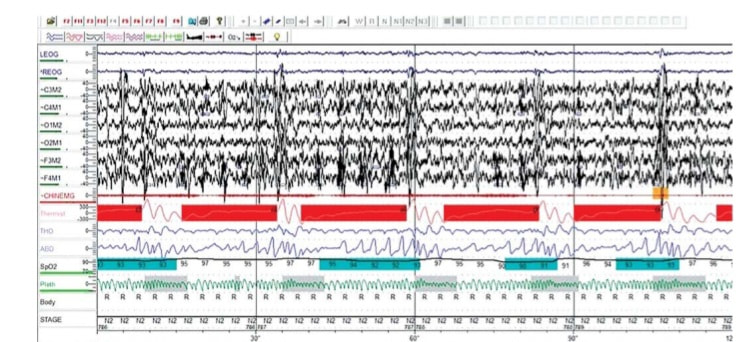
❓ Q1. Describe this study. What is being measured? What are the indications for performing this study in children?
✅ Model Answer:
• Study: Polysomnography (PSG) – a comprehensive overnight sleep study that records multiple physiological parameters during sleep. It is the gold standard for diagnosing sleep-disordered breathing.
• Parameters measured:
- EEG (brain waves) → sleep staging (NREM/REM).
- EOG (eye movements) → REM sleep detection.
- EMG (chin/leg muscles) → sleep stage and limb movements.
- ECG (heart rate and rhythm).
- Nasal airflow (thermistor + pressure) → detects apnoeas/hypopnoeas.
- Respiratory effort (chest/abdominal belts) → differentiates obstructive vs central apnoeas.
- SpO₂ (pulse oximetry) → oxygen desaturations.
- End-tidal CO₂ / transcutaneous CO₂ → hypoventilation.
- Snoring microphone and body position.
• Indications for PSG in children (AAP/AASM guidelines):
1. Suspected OSA – diagnosis and severity assessment (AHI).
2. Pre-operative evaluation – high-risk patients (severe OSA, age <3 years, Down syndrome, craniofacial anomalies).
3. Post-operative monitoring – persistent symptoms after adenotonsillectomy or high-risk patients.
4. Children with comorbidities – obesity, Down syndrome, neuromuscular disease, craniofacial anomalies, sickle cell disease.
5. Non-OSA sleep disorders – central apnoea, hypoventilation, parasomnias.
6. Evaluation of treatment response – CPAP titration or effectiveness.
• Study: Polysomnography (PSG) – a comprehensive overnight sleep study that records multiple physiological parameters during sleep. It is the gold standard for diagnosing sleep-disordered breathing.
• Parameters measured:
- EEG (brain waves) → sleep staging (NREM/REM).
- EOG (eye movements) → REM sleep detection.
- EMG (chin/leg muscles) → sleep stage and limb movements.
- ECG (heart rate and rhythm).
- Nasal airflow (thermistor + pressure) → detects apnoeas/hypopnoeas.
- Respiratory effort (chest/abdominal belts) → differentiates obstructive vs central apnoeas.
- SpO₂ (pulse oximetry) → oxygen desaturations.
- End-tidal CO₂ / transcutaneous CO₂ → hypoventilation.
- Snoring microphone and body position.
• Indications for PSG in children (AAP/AASM guidelines):
1. Suspected OSA – diagnosis and severity assessment (AHI).
2. Pre-operative evaluation – high-risk patients (severe OSA, age <3 years, Down syndrome, craniofacial anomalies).
3. Post-operative monitoring – persistent symptoms after adenotonsillectomy or high-risk patients.
4. Children with comorbidities – obesity, Down syndrome, neuromuscular disease, craniofacial anomalies, sickle cell disease.
5. Non-OSA sleep disorders – central apnoea, hypoventilation, parasomnias.
6. Evaluation of treatment response – CPAP titration or effectiveness.
❓ Q2. Interpret the PSG findings in this patient. What is the AHI and severity of OSA?
✅ Model Answer:
• AHI (Apnea-Hypopnea Index): 12 events/hour → Moderate-Severe OSA (pediatric: >10 = severe).
• Oxygen saturation nadir: 82% during REM sleep (significant desaturation).
• Arousal index: 18 events/hour (fragmented sleep).
• REM sleep: Reduced (15% vs expected 20-25%).
• Obstructive apneas: Mixed/obstructive events with continued respiratory effort.
• AHI (Apnea-Hypopnea Index): 12 events/hour → Moderate-Severe OSA (pediatric: >10 = severe).
• Oxygen saturation nadir: 82% during REM sleep (significant desaturation).
• Arousal index: 18 events/hour (fragmented sleep).
• REM sleep: Reduced (15% vs expected 20-25%).
• Obstructive apneas: Mixed/obstructive events with continued respiratory effort.
❓ Q3. What are the diagnostic criteria for OSA in children based on PSG?
✅ Model Answer:
• Pediatric OSA is defined as AHI ≥1.5 events/hour on polysomnography.
• Severity grading:
- Mild: AHI 1.5 – 5 events/hour
- Moderate: AHI 5 – 10 events/hour
- Severe: AHI > 10 events/hour
• Additional criteria: Oxygen desaturation nadir <90%, frequent arousals, hypercapnia (end-tidal CO2 >50 mmHg).
• Pediatric OSA is defined as AHI ≥1.5 events/hour on polysomnography.
• Severity grading:
- Mild: AHI 1.5 – 5 events/hour
- Moderate: AHI 5 – 10 events/hour
- Severe: AHI > 10 events/hour
• Additional criteria: Oxygen desaturation nadir <90%, frequent arousals, hypercapnia (end-tidal CO2 >50 mmHg).
❓ Q4. What are the clinical features of OSA in children? How do they differ from adults?
✅ Model Answer:
• Pediatric OSA features:
- Nocturnal: Loud snoring, witnessed apnoeas, restless sleep, mouth breathing, enuresis.
- Daytime: Excessive daytime sleepiness (less common), hyperactivity (ADHD-like), poor school performance, irritability, morning headaches.
- Growth: Failure to thrive (due to increased energy expenditure).
- Examination: Adenotonsillar hypertrophy, obesity, narrow airway, retrognathia.
• Differences from adults:
- Children present with hyperactivity rather than daytime sleepiness.
- Enuresis is more common in children.
- Adenotonsillar hypertrophy is the most common cause in children (vs obesity in adults).
• Pediatric OSA features:
- Nocturnal: Loud snoring, witnessed apnoeas, restless sleep, mouth breathing, enuresis.
- Daytime: Excessive daytime sleepiness (less common), hyperactivity (ADHD-like), poor school performance, irritability, morning headaches.
- Growth: Failure to thrive (due to increased energy expenditure).
- Examination: Adenotonsillar hypertrophy, obesity, narrow airway, retrognathia.
• Differences from adults:
- Children present with hyperactivity rather than daytime sleepiness.
- Enuresis is more common in children.
- Adenotonsillar hypertrophy is the most common cause in children (vs obesity in adults).
❓ Q5. What is the first-line treatment for OSA in a child with tonsillar hypertrophy and AHI of 12?
✅ Model Answer:
• Adenotonsillectomy (T&A) is the first-line treatment for children with OSA and adenotonsillar hypertrophy.
• Indications: Moderate-severe OSA (AHI ≥5) with tonsillar hypertrophy.
• Success rate: 70-80% resolution of OSA.
• For mild OSA (AHI 1.5-5): Observation, intranasal corticosteroids, or montelukast may be tried.
• Post-operative: High-risk patients (age <3 years, severe OSA AHI >10, underlying conditions) should be admitted post-T&A for monitoring.
• Adenotonsillectomy (T&A) is the first-line treatment for children with OSA and adenotonsillar hypertrophy.
• Indications: Moderate-severe OSA (AHI ≥5) with tonsillar hypertrophy.
• Success rate: 70-80% resolution of OSA.
• For mild OSA (AHI 1.5-5): Observation, intranasal corticosteroids, or montelukast may be tried.
• Post-operative: High-risk patients (age <3 years, severe OSA AHI >10, underlying conditions) should be admitted post-T&A for monitoring.
❓ Q6. What are the indications for CPAP in pediatric OSA?
✅ Model Answer:
• CPAP is indicated for:
- Severe OSA that persists after adenotonsillectomy (residual OSA).
- OSA in children without adenotonsillar hypertrophy (obesity, craniofacial anomalies).
- Children with contraindications to surgery (bleeding disorders, craniofacial surgery).
- Moderate-severe OSA in high-risk patients (Down syndrome, neuromuscular disease).
• CPAP challenges: Compliance issues in children (mask intolerance, behavioural issues).
• Alternative: BPAP (bilevel positive airway pressure) for hypoventilation.
• CPAP is indicated for:
- Severe OSA that persists after adenotonsillectomy (residual OSA).
- OSA in children without adenotonsillar hypertrophy (obesity, craniofacial anomalies).
- Children with contraindications to surgery (bleeding disorders, craniofacial surgery).
- Moderate-severe OSA in high-risk patients (Down syndrome, neuromuscular disease).
• CPAP challenges: Compliance issues in children (mask intolerance, behavioural issues).
• Alternative: BPAP (bilevel positive airway pressure) for hypoventilation.
❓ Q7. What are the complications of untreated OSA in children?
✅ Model Answer:
• Neurocognitive: Learning difficulties, poor school performance, ADHD-like behaviour, mood disorders, developmental delay.
• Growth: Failure to thrive, poor weight gain (or obesity).
• Cardiovascular: Pulmonary hypertension, right ventricular hypertrophy (RVH), systemic hypertension, cor pulmonale.
• Endocrine: Obesity (bidirectional), insulin resistance, metabolic syndrome.
• Quality of life: Poor sleep quality, daytime fatigue, irritability.
• Nocturnal enuresis – more common in children with OSA.
• Sudden death – rare but possible (especially in severe OSA).
• Neurocognitive: Learning difficulties, poor school performance, ADHD-like behaviour, mood disorders, developmental delay.
• Growth: Failure to thrive, poor weight gain (or obesity).
• Cardiovascular: Pulmonary hypertension, right ventricular hypertrophy (RVH), systemic hypertension, cor pulmonale.
• Endocrine: Obesity (bidirectional), insulin resistance, metabolic syndrome.
• Quality of life: Poor sleep quality, daytime fatigue, irritability.
• Nocturnal enuresis – more common in children with OSA.
• Sudden death – rare but possible (especially in severe OSA).
❓ Q8. What is the relationship between OSA and ADHD-like symptoms in children?
✅ Model Answer:
• OSA in children often presents with hyperactivity, inattention, and impulsivity – mimicking ADHD.
• Mechanism: Sleep fragmentation and intermittent hypoxia → prefrontal cortex dysfunction → impaired executive function, attention deficits, and behavioural problems.
• Up to 50% of children with OSA are misdiagnosed with ADHD.
• Treatment of OSA (adenotonsillectomy) often leads to improvement in ADHD symptoms.
• Clinical pearl: Always screen for OSA in children presenting with ADHD-like symptoms.
• OSA in children often presents with hyperactivity, inattention, and impulsivity – mimicking ADHD.
• Mechanism: Sleep fragmentation and intermittent hypoxia → prefrontal cortex dysfunction → impaired executive function, attention deficits, and behavioural problems.
• Up to 50% of children with OSA are misdiagnosed with ADHD.
• Treatment of OSA (adenotonsillectomy) often leads to improvement in ADHD symptoms.
• Clinical pearl: Always screen for OSA in children presenting with ADHD-like symptoms.
❓ Q9. A child with severe OSA (AHI 12) is scheduled for adenotonsillectomy. Should this be done as an inpatient or outpatient?
✅ Model Answer:
• Inpatient admission is recommended for:
- Children < 3 years of age.
- Severe OSA (AHI > 10).
- Oxygen saturation nadir < 80%.
- Underlying medical conditions: obesity, Down syndrome, craniofacial anomalies, neuromuscular disease, or cardiac disease.
- Prolonged surgical time or difficult airway.
- Social concerns (lack of follow-up).
• This patient (age 6, AHI 12) would qualify for inpatient admission based on severe OSA (AHI >10).
• Inpatient admission is recommended for:
- Children < 3 years of age.
- Severe OSA (AHI > 10).
- Oxygen saturation nadir < 80%.
- Underlying medical conditions: obesity, Down syndrome, craniofacial anomalies, neuromuscular disease, or cardiac disease.
- Prolonged surgical time or difficult airway.
- Social concerns (lack of follow-up).
• This patient (age 6, AHI 12) would qualify for inpatient admission based on severe OSA (AHI >10).
❓ Q10. What is the role of post-operative PSG after adenotonsillectomy?
✅ Model Answer:
• Post-operative PSG is indicated for:
- Children with persistent symptoms (snoring, daytime sleepiness) after surgery.
- High-risk patients: Down syndrome, craniofacial anomalies, obesity, neuromuscular disease.
- Severe pre-operative OSA (AHI > 10).
- Children with underlying medical conditions that predispose to residual OSA.
• Timing: Usually performed 3-6 months after surgery.
• If residual OSA (AHI ≥ 1.5): CPAP or other therapy may be needed.
• Post-operative PSG is indicated for:
- Children with persistent symptoms (snoring, daytime sleepiness) after surgery.
- High-risk patients: Down syndrome, craniofacial anomalies, obesity, neuromuscular disease.
- Severe pre-operative OSA (AHI > 10).
- Children with underlying medical conditions that predispose to residual OSA.
• Timing: Usually performed 3-6 months after surgery.
• If residual OSA (AHI ≥ 1.5): CPAP or other therapy may be needed.
❓ Q11. What are the alternative treatments for OSA in children who are not candidates for surgery?
✅ Model Answer:
• Intranasal corticosteroids: For mild OSA or children with allergies.
• Montelukast: Anti-inflammatory, may reduce adenotonsillar hypertrophy.
• CPAP/BiPAP: For moderate-severe OSA, residual OSA post-surgery, or children with craniofacial anomalies.
• Weight management: For obesity-related OSA (dietary intervention, exercise).
• Oral appliances (mandibular advancement devices): For older children/adolescents with mild-moderate OSA.
• Myofunctional therapy: Oropharyngeal exercises to improve airway tone.
• Intranasal corticosteroids: For mild OSA or children with allergies.
• Montelukast: Anti-inflammatory, may reduce adenotonsillar hypertrophy.
• CPAP/BiPAP: For moderate-severe OSA, residual OSA post-surgery, or children with craniofacial anomalies.
• Weight management: For obesity-related OSA (dietary intervention, exercise).
• Oral appliances (mandibular advancement devices): For older children/adolescents with mild-moderate OSA.
• Myofunctional therapy: Oropharyngeal exercises to improve airway tone.
❓ Q12. How does obesity contribute to OSA in children? What is the role of weight loss?
✅ Model Answer:
• Obesity contributes to OSA through:
- Fat deposition in the pharyngeal area → narrow airway.
- Increased abdominal adiposity → reduced lung volume (functional residual capacity).
- Leptin resistance and inflammation.
• Weight loss: Even 5-10% weight loss improves OSA severity.
• Role: Weight loss should be part of the management plan for obese children with OSA.
• Combination of weight loss + adenotonsillectomy (if tonsillar hypertrophy) gives the best outcomes.
• Obesity contributes to OSA through:
- Fat deposition in the pharyngeal area → narrow airway.
- Increased abdominal adiposity → reduced lung volume (functional residual capacity).
- Leptin resistance and inflammation.
• Weight loss: Even 5-10% weight loss improves OSA severity.
• Role: Weight loss should be part of the management plan for obese children with OSA.
• Combination of weight loss + adenotonsillectomy (if tonsillar hypertrophy) gives the best outcomes.
⚠️ Key PSG threshold: Pediatric OSA is defined as AHI ≥1.5 events/hour.
AHI 1.5-5 = mild, 5-10 = moderate, >10 = severe (this patient: AHI 12 → severe).
📋 Mock Test Feedback
💡 Examiner's note: Compare your answers with the model answers. In real TOACS, you would discuss these with the examiner.