⚕️ FCPS MCPS MD Paediatrics TOACS · Mock Test
· ECG Interpretation · 8-Minute Station
📚 paeds.online
⏱️ TIME REMAINING
08:00
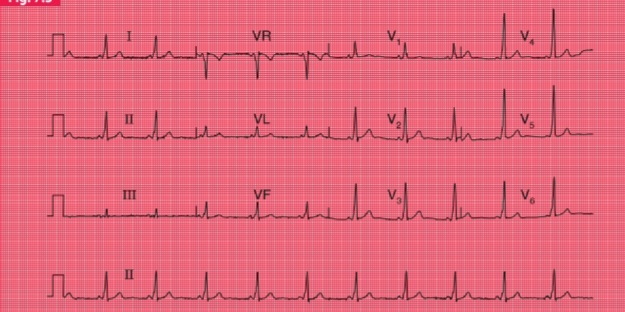
❓ Q1. Describe the ECG findings in this tracing.
✅ Model Answer:
• Classic ECG features: Short PR interval (<0.12 sec in adolescents), Delta wave (slurred upstroke of QRS), and Wide QRS (>0.10 sec).
• Secondary ST-T changes (discordant to QRS axis).
• This ECG is diagnostic of Wolff-Parkinson-White (WPW) syndrome – caused by an accessory pathway (Kent bundle) that bypasses the AV node.
• Classic ECG features: Short PR interval (<0.12 sec in adolescents), Delta wave (slurred upstroke of QRS), and Wide QRS (>0.10 sec).
• Secondary ST-T changes (discordant to QRS axis).
• This ECG is diagnostic of Wolff-Parkinson-White (WPW) syndrome – caused by an accessory pathway (Kent bundle) that bypasses the AV node.
❓ Q2. What is the most common mechanism of SVT in WPW syndrome? Explain the reentry circuit.
✅ Model Answer:
• Orthodromic AVRT (atrioventricular reentry tachycardia) – occurs in 80-90% of WPW patients with SVT.
• Circuit: Impulse travels anterograde down the AV node (slow conduction) → activates ventricles normally (narrow QRS) → returns retrograde to atrium via accessory pathway.
• ECG during tachycardia: Narrow QRS, inverted P waves after QRS (RP > PR).
• Antidromic AVRT (5-10%): Impulse travels down accessory pathway (anterograde) → wide QRS tachycardia.
• Orthodromic AVRT (atrioventricular reentry tachycardia) – occurs in 80-90% of WPW patients with SVT.
• Circuit: Impulse travels anterograde down the AV node (slow conduction) → activates ventricles normally (narrow QRS) → returns retrograde to atrium via accessory pathway.
• ECG during tachycardia: Narrow QRS, inverted P waves after QRS (RP > PR).
• Antidromic AVRT (5-10%): Impulse travels down accessory pathway (anterograde) → wide QRS tachycardia.
❓ Q3. The patient is hemodynamically stable. What is your acute management for SVT in WPW?
✅ Model Answer:
• Step 1: Vagal maneuvers – modified Valsalva (supine to leg raise) for older children; ice to face for infants.
• Step 2: Adenosine – 0.1 mg/kg rapid IV push (max 6 mg), followed by saline flush. Second dose 0.2 mg/kg (max 12 mg) if needed.
• Step 3: Alternative – esmolol, procainamide, or amiodarone if adenosine fails.
• If unstable (hypotension, poor perfusion): Synchronized cardioversion 0.5-1 J/kg.
• Step 1: Vagal maneuvers – modified Valsalva (supine to leg raise) for older children; ice to face for infants.
• Step 2: Adenosine – 0.1 mg/kg rapid IV push (max 6 mg), followed by saline flush. Second dose 0.2 mg/kg (max 12 mg) if needed.
• Step 3: Alternative – esmolol, procainamide, or amiodarone if adenosine fails.
• If unstable (hypotension, poor perfusion): Synchronized cardioversion 0.5-1 J/kg.
❓ Q4. Which medications are contraindicated in WPW syndrome? Why?
✅ Model Answer:
• Digoxin and Verapamil are contraindicated.
• Why? These drugs slow conduction through the AV node but do NOT affect the accessory pathway. If atrial fibrillation develops, the accessory pathway may conduct rapidly → preexcited AF with very rapid ventricular rate → ventricular fibrillation → sudden death.
• Adenosine is safe for orthodromic AVRT but contraindicated in wide complex tachycardia (if unsure).
• Digoxin and Verapamil are contraindicated.
• Why? These drugs slow conduction through the AV node but do NOT affect the accessory pathway. If atrial fibrillation develops, the accessory pathway may conduct rapidly → preexcited AF with very rapid ventricular rate → ventricular fibrillation → sudden death.
• Adenosine is safe for orthodromic AVRT but contraindicated in wide complex tachycardia (if unsure).
❓ Q5. A patient with WPW presents with palpitations, irregularly irregular wide QRS tachycardia, HR 280 bpm, and hypotension. What is the diagnosis and management?
✅ Model Answer:
• Diagnosis: Preexcited atrial fibrillation – life-threatening arrhythmia in WPW.
• Management (unstable): Synchronized cardioversion 0.5-1 J/kg (increase to 2 J/kg if needed).
• Do NOT use: Digoxin, verapamil, adenosine (may worsen or cause VF).
• If stable: Procainamide IV (slows accessory pathway conduction).
• If VF: Defibrillation 2 J/kg → 4 J/kg with CPR.
• Diagnosis: Preexcited atrial fibrillation – life-threatening arrhythmia in WPW.
• Management (unstable): Synchronized cardioversion 0.5-1 J/kg (increase to 2 J/kg if needed).
• Do NOT use: Digoxin, verapamil, adenosine (may worsen or cause VF).
• If stable: Procainamide IV (slows accessory pathway conduction).
• If VF: Defibrillation 2 J/kg → 4 J/kg with CPR.
❓ Q6. How do you risk-stratify a patient with WPW for sudden cardiac death?
✅ Model Answer:
• High-risk features: Symptomatic (syncope, palpitations), preexcited AF with rapid rate (>240 bpm), multiple accessory pathways, Ebstein anomaly.
• Invasive EP study findings: Shortest preexcited RR interval (SPERRI) <250 ms, accessory pathway ERP <250 ms, inducible AF.
• Asymptomatic patients: Risk of SCD is very low (<0.1% per year).
• All symptomatic patients should undergo EP study and ablation. Asymptomatic athletes need EP study or ablation before competitive sports.
• High-risk features: Symptomatic (syncope, palpitations), preexcited AF with rapid rate (>240 bpm), multiple accessory pathways, Ebstein anomaly.
• Invasive EP study findings: Shortest preexcited RR interval (SPERRI) <250 ms, accessory pathway ERP <250 ms, inducible AF.
• Asymptomatic patients: Risk of SCD is very low (<0.1% per year).
• All symptomatic patients should undergo EP study and ablation. Asymptomatic athletes need EP study or ablation before competitive sports.
❓ Q7. What is the role of catheter ablation in WPW? When is it indicated?
✅ Model Answer:
• Catheter ablation is curative – success rate >95%.
• Indications: Symptomatic patients (SVT, syncope), high-risk pathways on EP study, competitive athletes, failed medical therapy, Ebstein anomaly.
• Infants: Ablation is usually deferred (many outgrow WPW by 12-18 months).
• Complications: AV block (<1%), vascular injury, pericardial effusion.
• After successful ablation, patients can return to sports after 3 months.
• Catheter ablation is curative – success rate >95%.
• Indications: Symptomatic patients (SVT, syncope), high-risk pathways on EP study, competitive athletes, failed medical therapy, Ebstein anomaly.
• Infants: Ablation is usually deferred (many outgrow WPW by 12-18 months).
• Complications: AV block (<1%), vascular injury, pericardial effusion.
• After successful ablation, patients can return to sports after 3 months.
❓ Q8. A 2-week-old infant presents with SVT and ECG shows WPW. How does management differ from an adolescent?
✅ Model Answer:
• Acute: Vagal maneuvers (ice to face) → adenosine 0.1-0.2 mg/kg IV. Verapamil is contraindicated in infants (<1 year).
• Chronic: Beta-blockers (propranolol) first-line; flecainide for refractory cases.
• Prognosis: 50% of infants outgrow WPW by 12-18 months – ablation is usually deferred.
• Ablation in infants: Only for life-threatening arrhythmias (preexcited AF, cardiac arrest) or refractory SVT.
• Acute: Vagal maneuvers (ice to face) → adenosine 0.1-0.2 mg/kg IV. Verapamil is contraindicated in infants (<1 year).
• Chronic: Beta-blockers (propranolol) first-line; flecainide for refractory cases.
• Prognosis: 50% of infants outgrow WPW by 12-18 months – ablation is usually deferred.
• Ablation in infants: Only for life-threatening arrhythmias (preexcited AF, cardiac arrest) or refractory SVT.
❓ Q9. What is the inheritance pattern of WPW? Should family members be screened?
✅ Model Answer:
• Most WPW is sporadic, but familial WPW is autosomal dominant (PRKAG2, MYH6 mutations).
• First-degree relatives should have ECG screening.
• Asymptomatic relatives with WPW need evaluation if they participate in sports or have symptoms.
• Genetic testing is not routine unless family history of WPW or PRKAG2 syndrome.
• Most WPW is sporadic, but familial WPW is autosomal dominant (PRKAG2, MYH6 mutations).
• First-degree relatives should have ECG screening.
• Asymptomatic relatives with WPW need evaluation if they participate in sports or have symptoms.
• Genetic testing is not routine unless family history of WPW or PRKAG2 syndrome.
❓ Q10. Can this child participate in competitive sports? What are the AHA/ACC guidelines?
✅ Model Answer:
• Symptomatic WPW: Must undergo ablation before competitive sports.
• Asymptomatic WPW: Can participate if EP study shows low-risk pathway (SPERRI >250 ms, ERP >250 ms, no inducible AF) OR after ablation.
• This patient has symptoms → cannot participate until after ablation.
• After successful ablation, can return to sports after 3-6 months.
• Symptomatic WPW: Must undergo ablation before competitive sports.
• Asymptomatic WPW: Can participate if EP study shows low-risk pathway (SPERRI >250 ms, ERP >250 ms, no inducible AF) OR after ablation.
• This patient has symptoms → cannot participate until after ablation.
• After successful ablation, can return to sports after 3-6 months.
📋 Mock Test Feedback
💡 Examiner's note: Compare your answers with the model answers. In real TOACS, you would discuss these with the examiner.