FCPS MCPS IMM MD Paediatrics TOACS
Observed Station | CPSP Format | 8 minutes
⏱️ TIME REMAINING
08:00
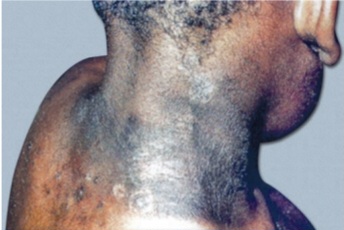
A 10‑year‑old child presents with a photosensitive rash around the neck, chest, and dorsal hands, history of chronic diarrhea and now has become confused and irritable.
❓ Q1. Identify the skin finding shown in the image. What condition is it pathognomonic for?
✅ Model Answer: • Skin finding: Casal necklace – a photosensitive, well-demarcated, erythematous and hyperpigmented rash around the neck and upper chest in a collar-like distribution.
• Pathognomonic for: Pellagra (niacin/Vitamin B3 deficiency).
• Other affected areas: Dorsal hands (glove distribution), feet (stocking distribution), and face.
• Pathognomonic for: Pellagra (niacin/Vitamin B3 deficiency).
• Other affected areas: Dorsal hands (glove distribution), feet (stocking distribution), and face.
❓ Q2. What is the classic triad of pellagra? Describe each component.
✅ Model Answer: • Classic triad (3 D's):
- Dermatitis: Photosensitive, symmetric, well-demarcated erythematous rash on sun-exposed areas (Casal necklace, hands, feet, face).
- Diarrhea: Chronic, often watery diarrhea due to gastrointestinal mucosal involvement.
- Dementia: Neurologic symptoms including confusion, irritability, depression, memory loss, and in severe cases, delirium.
- Dermatitis: Photosensitive, symmetric, well-demarcated erythematous rash on sun-exposed areas (Casal necklace, hands, feet, face).
- Diarrhea: Chronic, often watery diarrhea due to gastrointestinal mucosal involvement.
- Dementia: Neurologic symptoms including confusion, irritability, depression, memory loss, and in severe cases, delirium.
❓ Q3. What is the pathophysiology of pellagra?
✅ Model Answer: • Pathophysiology: Pellagra is caused by deficiency of niacin (Vitamin B3) – which can be dietary (lack of niacin or its precursor tryptophan) or due to impaired absorption/conversion.
• Niacin is a precursor of NAD (nicotinamide adenine dinucleotide) and NADP – essential coenzymes in cellular metabolism.
• Deficiency → reduced NAD/NADP → impaired energy metabolism, DNA repair, and cellular proliferation → affects skin, GI tract, and CNS.
• Sources: Niacin is found in meat, fish, poultry, eggs, and legumes. Tryptophan (found in proteins) can be converted to niacin in the body.
• Niacin is a precursor of NAD (nicotinamide adenine dinucleotide) and NADP – essential coenzymes in cellular metabolism.
• Deficiency → reduced NAD/NADP → impaired energy metabolism, DNA repair, and cellular proliferation → affects skin, GI tract, and CNS.
• Sources: Niacin is found in meat, fish, poultry, eggs, and legumes. Tryptophan (found in proteins) can be converted to niacin in the body.
❓ Q4. What are the risk factors for developing pellagra?
✅ Model Answer: • Risk factors:
- Maize-based diet: Maize (corn) is low in niacin and tryptophan; niacin is bound as niacytin (unavailable unless nixtamalized).
- Malnutrition: Protein-energy malnutrition, famine, poverty.
- Malabsorption: Crohn's disease, celiac disease, chronic diarrhea.
- Hartnup disease: Impaired tryptophan absorption.
- Carcinoid syndrome: Tryptophan is diverted to serotonin production → reduced niacin synthesis.
- Drugs: Isoniazid (INH) – competitive inhibitor of niacin synthesis; 6-mercaptopurine.
- Alcoholism: Poor diet and malabsorption.
- Maize-based diet: Maize (corn) is low in niacin and tryptophan; niacin is bound as niacytin (unavailable unless nixtamalized).
- Malnutrition: Protein-energy malnutrition, famine, poverty.
- Malabsorption: Crohn's disease, celiac disease, chronic diarrhea.
- Hartnup disease: Impaired tryptophan absorption.
- Carcinoid syndrome: Tryptophan is diverted to serotonin production → reduced niacin synthesis.
- Drugs: Isoniazid (INH) – competitive inhibitor of niacin synthesis; 6-mercaptopurine.
- Alcoholism: Poor diet and malabsorption.
❓ Q5. What are the other clinical manifestations of pellagra besides the 3 D's?
✅ Model Answer: • Other manifestations:
- Oral: Beefy red tongue (glossitis), stomatitis, cheilosis (angular stomatitis).
- Gastrointestinal: Nausea, vomiting, abdominal pain, chronic diarrhea.
- Neurologic: Headache, fatigue, insomnia, peripheral neuritis, ataxia, and in severe cases, psychosis (delirium, hallucinations).
- Skin: Photosensitivity – rash worsens with sun exposure; hyperpigmentation and scaling after healing.
- General: Weight loss, weakness, and anemia (due to folate/B12 deficiency).
- Oral: Beefy red tongue (glossitis), stomatitis, cheilosis (angular stomatitis).
- Gastrointestinal: Nausea, vomiting, abdominal pain, chronic diarrhea.
- Neurologic: Headache, fatigue, insomnia, peripheral neuritis, ataxia, and in severe cases, psychosis (delirium, hallucinations).
- Skin: Photosensitivity – rash worsens with sun exposure; hyperpigmentation and scaling after healing.
- General: Weight loss, weakness, and anemia (due to folate/B12 deficiency).
❓ Q6. What is the treatment for pellagra?
✅ Model Answer: • Treatment:
- Nicotinamide (niacinamide): Preferred over niacin to avoid flushing (prostaglandin-mediated). Dose: 50-300 mg/day orally in divided doses. In severe cases, IV nicotinamide 100 mg.
- B-complex vitamins: Because pellagra is often accompanied by other B-vitamin deficiencies, supplement with a B-complex or multivitamin.
- Dietary improvement: Ensure adequate intake of niacin-rich foods (meat, fish, poultry, eggs, legumes) and tryptophan-containing proteins.
- Sun protection: Advise sun avoidance and use of sunscreen to prevent exacerbation of dermatitis.
- Supportive care: Treat diarrhea (hydration, oral rehydration), provide nutritional support.
- Nicotinamide (niacinamide): Preferred over niacin to avoid flushing (prostaglandin-mediated). Dose: 50-300 mg/day orally in divided doses. In severe cases, IV nicotinamide 100 mg.
- B-complex vitamins: Because pellagra is often accompanied by other B-vitamin deficiencies, supplement with a B-complex or multivitamin.
- Dietary improvement: Ensure adequate intake of niacin-rich foods (meat, fish, poultry, eggs, legumes) and tryptophan-containing proteins.
- Sun protection: Advise sun avoidance and use of sunscreen to prevent exacerbation of dermatitis.
- Supportive care: Treat diarrhea (hydration, oral rehydration), provide nutritional support.
❓ Q7. What is the difference between niacin and nicotinamide?
✅ Model Answer: • Niacin (nicotinic acid): Causes vasodilation → flushing, itching, and warmth (prostaglandin-mediated). Used for hyperlipidemia (lowers LDL, raises HDL).
• Nicotinamide (niacinamide): Does NOT cause flushing. It is the preferred form for treating pellagra.
• Both are forms of Vitamin B3 and are converted to NAD/NADP in the body.
• Clinical use: Nicotinamide is used for deficiency; niacin is used for lipid-lowering.
• Nicotinamide (niacinamide): Does NOT cause flushing. It is the preferred form for treating pellagra.
• Both are forms of Vitamin B3 and are converted to NAD/NADP in the body.
• Clinical use: Nicotinamide is used for deficiency; niacin is used for lipid-lowering.
❓ Q8. What is the role of tryptophan in niacin metabolism?
✅ Model Answer: • Tryptophan → niacin: Tryptophan is an essential amino acid that can be converted to niacin (Vitamin B3) in the liver.
• Conversion efficiency: 60 mg of tryptophan → 1 mg of niacin.
• Significance: A diet high in tryptophan (e.g., protein-rich foods) can prevent pellagra even if niacin intake is low.
• Deficiency: In Hartnup disease (impaired tryptophan absorption) and carcinoid syndrome (tryptophan diverted to serotonin), niacin deficiency can occur even with adequate dietary intake.
• Conversion efficiency: 60 mg of tryptophan → 1 mg of niacin.
• Significance: A diet high in tryptophan (e.g., protein-rich foods) can prevent pellagra even if niacin intake is low.
• Deficiency: In Hartnup disease (impaired tryptophan absorption) and carcinoid syndrome (tryptophan diverted to serotonin), niacin deficiency can occur even with adequate dietary intake.
❓ Q9. What is the role of sun exposure in pellagra?
✅ Model Answer: • Sun exposure: The dermatitis in pellagra is photosensitive – UV radiation triggers or exacerbates the rash.
• Mechanism: Niacin deficiency leads to impaired DNA repair and increased cellular susceptibility to UV-induced damage.
• Clinical: The rash is typically on sun-exposed areas (Casal necklace, dorsal hands, feet, face). It may improve with sun avoidance.
• Management: Advise patients to avoid sun exposure and use sunscreen.
• Mechanism: Niacin deficiency leads to impaired DNA repair and increased cellular susceptibility to UV-induced damage.
• Clinical: The rash is typically on sun-exposed areas (Casal necklace, dorsal hands, feet, face). It may improve with sun avoidance.
• Management: Advise patients to avoid sun exposure and use sunscreen.
❓ Q10. What are the differential diagnoses of the Casal necklace rash?
✅ Model Answer: • Differential diagnoses:
- Drug-induced photosensitivity: Thiazides, tetracyclines, NSAIDs, amiodarone – rash may be similar but history of drug exposure.
- Lupus erythematosus (SLE): Photosensitive malar rash, but typically not in a collar-like distribution; other systemic features (arthritis, serositis, renal involvement).
- Acrodermatitis enteropathica (zinc deficiency): Perioral and perianal dermatitis, alopecia, diarrhea – not photosensitive.
- Porphyria cutanea tarda: Photosensitive rash on sun-exposed areas, blistering, scarring; associated with liver disease.
- Phototoxic reactions: Contact dermatitis from plants (phytophotodermatitis).
- Drug-induced photosensitivity: Thiazides, tetracyclines, NSAIDs, amiodarone – rash may be similar but history of drug exposure.
- Lupus erythematosus (SLE): Photosensitive malar rash, but typically not in a collar-like distribution; other systemic features (arthritis, serositis, renal involvement).
- Acrodermatitis enteropathica (zinc deficiency): Perioral and perianal dermatitis, alopecia, diarrhea – not photosensitive.
- Porphyria cutanea tarda: Photosensitive rash on sun-exposed areas, blistering, scarring; associated with liver disease.
- Phototoxic reactions: Contact dermatitis from plants (phytophotodermatitis).
❓ Q11. What is Hartnup disease? How is it related to pellagra?
✅ Model Answer: • Hartnup disease: An autosomal recessive disorder caused by a defect in the transport of neutral amino acids (including tryptophan) in the renal tubules and intestines.
• Link to pellagra: Impaired tryptophan absorption → reduced conversion to niacin → niacin deficiency → pellagra-like symptoms (photosensitive rash, ataxia, psychiatric symptoms).
• Clinical features: Photosensitive rash, intermittent ataxia, cerebellar signs, psychiatric symptoms (emotional lability, hallucinations).
• Treatment: Niacinamide supplementation, high-protein diet.
• Link to pellagra: Impaired tryptophan absorption → reduced conversion to niacin → niacin deficiency → pellagra-like symptoms (photosensitive rash, ataxia, psychiatric symptoms).
• Clinical features: Photosensitive rash, intermittent ataxia, cerebellar signs, psychiatric symptoms (emotional lability, hallucinations).
• Treatment: Niacinamide supplementation, high-protein diet.
❓ Q12. What is the role of nixtamalization in preventing pellagra?
✅ Model Answer: • Nixtamalization: A traditional process of treating maize (corn) with an alkaline solution (limewater/calcium hydroxide) followed by washing and cooking.
• Role: Releases bound niacin (niacytin) and makes it bioavailable, preventing pellagra.
• Historical significance: Pellagra was epidemic in populations where maize was the staple food without nixtamalization (e.g., in the southern US, parts of Africa).
• Modern application: Fortification of maize flour with niacin is now common.
• Role: Releases bound niacin (niacytin) and makes it bioavailable, preventing pellagra.
• Historical significance: Pellagra was epidemic in populations where maize was the staple food without nixtamalization (e.g., in the southern US, parts of Africa).
• Modern application: Fortification of maize flour with niacin is now common.
❓ Q13. How would you counsel the parents of a child with pellagra?
✅ Model Answer: • "Your child has pellagra, a condition caused by a deficiency of Vitamin B3 (niacin). This is often due to a diet that lacks this nutrient."
• "We will give your child Vitamin B3 supplementation (nicotinamide) to correct the deficiency. The rash, diarrhea, and confusion should improve within days to weeks."
• "We also recommend a balanced diet rich in niacin – foods like meat, fish, poultry, eggs, and legumes. If you rely on maize (corn) as a staple, it must be treated with limewater (nixtamalization) to release the niacin."
• "Protect your child's skin from the sun, as the rash is triggered by sunlight. Use sunscreen and wear protective clothing."
• "We will monitor your child's progress and ensure they are getting all necessary vitamins."
• "We will give your child Vitamin B3 supplementation (nicotinamide) to correct the deficiency. The rash, diarrhea, and confusion should improve within days to weeks."
• "We also recommend a balanced diet rich in niacin – foods like meat, fish, poultry, eggs, and legumes. If you rely on maize (corn) as a staple, it must be treated with limewater (nixtamalization) to release the niacin."
• "Protect your child's skin from the sun, as the rash is triggered by sunlight. Use sunscreen and wear protective clothing."
• "We will monitor your child's progress and ensure they are getting all necessary vitamins."
❓ Q14. What is the role of B-complex vitamins in treating pellagra?
✅ Model Answer: • B-complex vitamins: Pellagra often occurs in the context of multiple B-vitamin deficiencies (especially thiamine, riboflavin, pyridoxine, and folate).
• Rationale: Supplementing with a B-complex ensures that other deficiencies are addressed, as the clinical presentation may overlap.
• Benefits: Supports overall metabolic function, improves neurologic symptoms, and prevents other deficiency-related complications.
• Indications: Especially important in malnourished patients, those with alcoholism, and those with malabsorption.
• Rationale: Supplementing with a B-complex ensures that other deficiencies are addressed, as the clinical presentation may overlap.
• Benefits: Supports overall metabolic function, improves neurologic symptoms, and prevents other deficiency-related complications.
• Indications: Especially important in malnourished patients, those with alcoholism, and those with malabsorption.
❓ Q15. What is the prognosis of pellagra with treatment?
✅ Model Answer: • Excellent prognosis with prompt treatment.
- Skin: Dermatitis improves within 2-3 days of niacin supplementation.
- Gastrointestinal: Diarrhea resolves within a few days.
- Neurologic: Dementia/confusion improves over 1-2 weeks.
- Without treatment: Pellagra is progressive and can be fatal (death due to severe diarrhea, malnutrition, or organ failure).
- Prevention: Adequate dietary intake of niacin and tryptophan prevents recurrence.
- Skin: Dermatitis improves within 2-3 days of niacin supplementation.
- Gastrointestinal: Diarrhea resolves within a few days.
- Neurologic: Dementia/confusion improves over 1-2 weeks.
- Without treatment: Pellagra is progressive and can be fatal (death due to severe diarrhea, malnutrition, or organ failure).
- Prevention: Adequate dietary intake of niacin and tryptophan prevents recurrence.
📋 Mock Test Feedback
💡 Examiner's note: Compare your answers with model answers. In real TOACS, you would discuss these with the examiner.