FCPS MCPS IMM MD Pediatrics TOACS
Observed Station | CPSP Format | 8 minutes
⏱️ TIME REMAINING
08:00
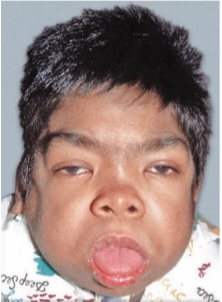
A 3‑year‑old child is brought to the clinic because of unusual facial features, developmental delay.
❓ Q1. Identify the facial features shown in the image. What condition are they characteristic of?
✅ Model Answer: • Facial features: Coarse facies – macrocephaly, prominent forehead, depressed nasal bridge, wide-set eyes (hypertelorism), thick lips, macroglossia, and thickened facial features.
• Characteristic of: Mucopolysaccharidosis (MPS) and other lysosomal storage disorders.
• These features become progressively more noticeable with age due to accumulation of glycosaminoglycans (GAGs) in connective tissues.
• Characteristic of: Mucopolysaccharidosis (MPS) and other lysosomal storage disorders.
• These features become progressively more noticeable with age due to accumulation of glycosaminoglycans (GAGs) in connective tissues.
❓ Q2. What is the underlying pathophysiology of coarse facies in MPS?
✅ Model Answer: • Pathophysiology: Mucopolysaccharidoses are lysosomal storage disorders caused by deficiency of specific enzymes involved in the degradation of glycosaminoglycans (GAGs).
• Accumulation of partially degraded GAGs (dermatan sulfate, heparan sulfate, keratan sulfate, etc.) in lysosomes of various tissues.
• In facial tissues: GAG deposition in the dermis, subcutaneous tissue, and cartilage leads to thickening of the skin, enlargement of the nose and lips, and coarsening of facial features.
• Bone involvement (dysostosis multiplex) contributes to the skeletal features (depressed nasal bridge, macrocephaly).
• Accumulation of partially degraded GAGs (dermatan sulfate, heparan sulfate, keratan sulfate, etc.) in lysosomes of various tissues.
• In facial tissues: GAG deposition in the dermis, subcutaneous tissue, and cartilage leads to thickening of the skin, enlargement of the nose and lips, and coarsening of facial features.
• Bone involvement (dysostosis multiplex) contributes to the skeletal features (depressed nasal bridge, macrocephaly).
❓ Q3. What are the different types of mucopolysaccharidosis?
✅ Model Answer: • MPS types and deficient enzymes:
- MPS I (Hurler, Scheie, Hurler-Scheie): α-L-iduronidase deficiency.
- MPS II (Hunter syndrome): Iduronate sulfatase deficiency (X-linked).
- MPS III (Sanfilippo syndrome): Heparan N-sulfatase, α-N-acetylglucosaminidase, acetyl-CoA:α-glucosaminide acetyltransferase, or N-acetylglucosamine-6-sulfatase deficiency (4 subtypes).
- MPS IV (Morquio syndrome): Galactosamine-6-sulfatase (IVA) or β-galactosidase (IVB) deficiency.
- MPS VI (Maroteaux-Lamy syndrome): Arylsulfatase B deficiency.
- MPS VII (Sly syndrome): β-glucuronidase deficiency.
- MPS IX: Hyaluronidase deficiency (rare).
- MPS I (Hurler, Scheie, Hurler-Scheie): α-L-iduronidase deficiency.
- MPS II (Hunter syndrome): Iduronate sulfatase deficiency (X-linked).
- MPS III (Sanfilippo syndrome): Heparan N-sulfatase, α-N-acetylglucosaminidase, acetyl-CoA:α-glucosaminide acetyltransferase, or N-acetylglucosamine-6-sulfatase deficiency (4 subtypes).
- MPS IV (Morquio syndrome): Galactosamine-6-sulfatase (IVA) or β-galactosidase (IVB) deficiency.
- MPS VI (Maroteaux-Lamy syndrome): Arylsulfatase B deficiency.
- MPS VII (Sly syndrome): β-glucuronidase deficiency.
- MPS IX: Hyaluronidase deficiency (rare).
❓ Q4. What are the common clinical features of mucopolysaccharidosis?
✅ Model Answer: • Common clinical features:
- Coarse facies: Macrocephaly, prominent forehead, depressed nasal bridge, thick lips, macroglossia.
- Skeletal: Dysostosis multiplex (abnormal bone development), joint stiffness/contractures, short stature, kyphoscoliosis.
- Organomegaly: Hepatosplenomegaly.
- Corneal clouding: Present in MPS I, IV, VI, VII; absent in MPS II and III.
- Developmental delay: Variable; severe in MPS I (Hurler), MPS II (severe), MPS III; mild/normal in MPS VI, MPS IV.
- Cardiovascular: Valvular heart disease (mitral/aortic regurgitation), cardiomyopathy.
- Hernias: Umbilical and inguinal hernias.
- Recurrent infections: Otitis media, respiratory infections.
- Airway obstruction: Due to macroglossia and soft tissue thickening.
- Coarse facies: Macrocephaly, prominent forehead, depressed nasal bridge, thick lips, macroglossia.
- Skeletal: Dysostosis multiplex (abnormal bone development), joint stiffness/contractures, short stature, kyphoscoliosis.
- Organomegaly: Hepatosplenomegaly.
- Corneal clouding: Present in MPS I, IV, VI, VII; absent in MPS II and III.
- Developmental delay: Variable; severe in MPS I (Hurler), MPS II (severe), MPS III; mild/normal in MPS VI, MPS IV.
- Cardiovascular: Valvular heart disease (mitral/aortic regurgitation), cardiomyopathy.
- Hernias: Umbilical and inguinal hernias.
- Recurrent infections: Otitis media, respiratory infections.
- Airway obstruction: Due to macroglossia and soft tissue thickening.
❓ Q5. What is the difference between Hurler syndrome and Hunter syndrome?
✅ Model Answer: • Hurler syndrome (MPS I):
- Enzyme: α-L-iduronidase deficiency.
- Inheritance: Autosomal recessive.
- Corneal clouding: Present.
- Intelligence: Severe intellectual disability (progressive).
- Treatment: Enzyme replacement therapy (laronidase) and hematopoietic stem cell transplantation (HSCT) – best outcomes if done before age 2 years.
• Hunter syndrome (MPS II):
- Enzyme: Iduronate sulfatase deficiency.
- Inheritance: X-linked recessive (affects males).
- Corneal clouding: Absent.
- Intelligence: Variable – mild to severe intellectual disability.
- Treatment: Enzyme replacement therapy (idursulfase) – HSCT is not effective for cognitive outcomes.
- Enzyme: α-L-iduronidase deficiency.
- Inheritance: Autosomal recessive.
- Corneal clouding: Present.
- Intelligence: Severe intellectual disability (progressive).
- Treatment: Enzyme replacement therapy (laronidase) and hematopoietic stem cell transplantation (HSCT) – best outcomes if done before age 2 years.
• Hunter syndrome (MPS II):
- Enzyme: Iduronate sulfatase deficiency.
- Inheritance: X-linked recessive (affects males).
- Corneal clouding: Absent.
- Intelligence: Variable – mild to severe intellectual disability.
- Treatment: Enzyme replacement therapy (idursulfase) – HSCT is not effective for cognitive outcomes.
❓ Q6. What is the role of corneal clouding in differentiating MPS types?
✅ Model Answer: • Corneal clouding is a key differentiating feature:
- Present in: MPS I (Hurler), MPS IV (Morquio), MPS VI (Maroteaux-Lamy), MPS VII (Sly).
- Absent in: MPS II (Hunter), MPS III (Sanfilippo).
• Corneal clouding is caused by GAG accumulation in the corneal stroma, leading to opacity.
• It is usually progressive and can cause visual impairment.
• In clinical practice, the presence or absence of corneal clouding helps narrow down the differential diagnosis before enzyme testing.
- Present in: MPS I (Hurler), MPS IV (Morquio), MPS VI (Maroteaux-Lamy), MPS VII (Sly).
- Absent in: MPS II (Hunter), MPS III (Sanfilippo).
• Corneal clouding is caused by GAG accumulation in the corneal stroma, leading to opacity.
• It is usually progressive and can cause visual impairment.
• In clinical practice, the presence or absence of corneal clouding helps narrow down the differential diagnosis before enzyme testing.
❓ Q7. What are the diagnostic tests for mucopolysaccharidosis?
✅ Model Answer: • Diagnostic approach:
1. Urine GAGs (glycosaminoglycans): Qualitative (electrophoresis) and quantitative (dimethylmethylene blue assay) – detects elevated GAG excretion.
2. Enzyme assay: Measurement of specific lysosomal enzyme activity in leukocytes, fibroblasts, or dried blood spots – confirmatory test.
3. Genetic testing: Identifies pathogenic variants in the respective gene – useful for carrier testing and prenatal diagnosis.
4. Imaging: Skeletal survey (dysostosis multiplex), MRI brain, echocardiogram (cardiac involvement).
5. Ophthalmology: Slit-lamp examination for corneal clouding.
1. Urine GAGs (glycosaminoglycans): Qualitative (electrophoresis) and quantitative (dimethylmethylene blue assay) – detects elevated GAG excretion.
2. Enzyme assay: Measurement of specific lysosomal enzyme activity in leukocytes, fibroblasts, or dried blood spots – confirmatory test.
3. Genetic testing: Identifies pathogenic variants in the respective gene – useful for carrier testing and prenatal diagnosis.
4. Imaging: Skeletal survey (dysostosis multiplex), MRI brain, echocardiogram (cardiac involvement).
5. Ophthalmology: Slit-lamp examination for corneal clouding.
❓ Q8. What is the role of enzyme replacement therapy (ERT) in MPS?
✅ Model Answer: • ERT role:
- Provides recombinant enzyme to replace the deficient lysosomal enzyme.
- Available for:
- MPS I (laronidase – Aldurazyme).
- MPS II (idursulfase – Elaprase).
- MPS IVA (elosulfase alfa – Vimizim).
- MPS VI (galsulfase – Naglazyme).
- MPS VII (vestronidase alfa – Mepsevii).
- Benefits: Reduces GAG accumulation, improves organomegaly, joint mobility, and respiratory function.
- Limitations: ERT does not cross the blood-brain barrier, so it does not prevent or treat CNS manifestations (cognitive decline).
- Given intravenously weekly (or biweekly) for life.
- Side effects: Infusion reactions, anaphylaxis, and antibody formation.
- Provides recombinant enzyme to replace the deficient lysosomal enzyme.
- Available for:
- MPS I (laronidase – Aldurazyme).
- MPS II (idursulfase – Elaprase).
- MPS IVA (elosulfase alfa – Vimizim).
- MPS VI (galsulfase – Naglazyme).
- MPS VII (vestronidase alfa – Mepsevii).
- Benefits: Reduces GAG accumulation, improves organomegaly, joint mobility, and respiratory function.
- Limitations: ERT does not cross the blood-brain barrier, so it does not prevent or treat CNS manifestations (cognitive decline).
- Given intravenously weekly (or biweekly) for life.
- Side effects: Infusion reactions, anaphylaxis, and antibody formation.
❓ Q9. What is the role of hematopoietic stem cell transplantation (HSCT) in MPS?
✅ Model Answer: • HSCT role:
- Provides a source of cells that produce the missing enzyme (from donor-derived macrophages).
- Indications: Primarily used for MPS I (Hurler syndrome) – the most severe form.
- Benefits: Can prevent cognitive decline if performed before age 2 years (and before significant neurological damage).
- Also improves somatic features (organomegaly, joint stiffness, airway obstruction).
- Not effective for: MPS II (Hunter) – HSCT does not improve cognitive outcomes.
- Risks: Graft-versus-host disease (GVHD), transplant-related mortality, infections, and graft failure.
- Often combined with ERT before and after transplant.
- Provides a source of cells that produce the missing enzyme (from donor-derived macrophages).
- Indications: Primarily used for MPS I (Hurler syndrome) – the most severe form.
- Benefits: Can prevent cognitive decline if performed before age 2 years (and before significant neurological damage).
- Also improves somatic features (organomegaly, joint stiffness, airway obstruction).
- Not effective for: MPS II (Hunter) – HSCT does not improve cognitive outcomes.
- Risks: Graft-versus-host disease (GVHD), transplant-related mortality, infections, and graft failure.
- Often combined with ERT before and after transplant.
❓ Q10. What are the differential diagnoses of coarse facies?
✅ Model Answer: • Differential diagnoses:
- Other lysosomal storage disorders:
- Mucolipidoses (ML II, ML III): Coarse facies, organomegaly, dysostosis multiplex, but no increased urine GAGs; enzyme assays show multiple enzyme deficiencies.
- GM1 gangliosidosis: Coarse facies, hepatosplenomegaly, cherry-red macula, severe neurodegeneration.
- I-cell disease (ML II): Coarse facies, gingival hypertrophy, severe skeletal dysplasia (dysostosis multiplex), normal urine GAGs.
- Galactosialidosis: Coarse facies, cherry-red macula, bone dysplasia.
- Congenital hypothyroidism: Coarse facies, macroglossia, developmental delay, but no organomegaly or corneal clouding.
- Fetal alcohol syndrome: Microcephaly, smooth philtrum, thin upper lip; no coarse features.
- Other lysosomal storage disorders:
- Mucolipidoses (ML II, ML III): Coarse facies, organomegaly, dysostosis multiplex, but no increased urine GAGs; enzyme assays show multiple enzyme deficiencies.
- GM1 gangliosidosis: Coarse facies, hepatosplenomegaly, cherry-red macula, severe neurodegeneration.
- I-cell disease (ML II): Coarse facies, gingival hypertrophy, severe skeletal dysplasia (dysostosis multiplex), normal urine GAGs.
- Galactosialidosis: Coarse facies, cherry-red macula, bone dysplasia.
- Congenital hypothyroidism: Coarse facies, macroglossia, developmental delay, but no organomegaly or corneal clouding.
- Fetal alcohol syndrome: Microcephaly, smooth philtrum, thin upper lip; no coarse features.
❓ Q11. What is the role of genetic counseling in MPS?
✅ Model Answer: • Genetic counseling role:
- Inheritance patterns:
- MPS I, III, IV, VI, VII: Autosomal recessive (25% recurrence risk).
- MPS II (Hunter): X-linked recessive (50% risk for male offspring).
- Carrier testing: For at-risk family members.
- Prenatal testing: Chorionic villus sampling (CVS) or amniocentesis for known mutations.
- Preimplantation genetic diagnosis (PGD): For families with known mutations.
- Newborn screening: Increasingly available for MPS I and II (using enzyme assay on dried blood spots).
- Counseling should include discussion of prognosis, treatment options, and reproductive choices.
- Inheritance patterns:
- MPS I, III, IV, VI, VII: Autosomal recessive (25% recurrence risk).
- MPS II (Hunter): X-linked recessive (50% risk for male offspring).
- Carrier testing: For at-risk family members.
- Prenatal testing: Chorionic villus sampling (CVS) or amniocentesis for known mutations.
- Preimplantation genetic diagnosis (PGD): For families with known mutations.
- Newborn screening: Increasingly available for MPS I and II (using enzyme assay on dried blood spots).
- Counseling should include discussion of prognosis, treatment options, and reproductive choices.
❓ Q12. What is the natural history of Hurler syndrome (MPS I)?
✅ Model Answer: • Hurler syndrome (MPS I – severe):
- Onset: Usually presents in the first year of life (coarse facies, hepatosplenomegaly, hernias).
- Progression: Progressive developmental regression, intellectual disability, and severe skeletal dysplasia (dysostosis multiplex).
- Corneal clouding: Progressive, leads to visual impairment.
- Cardiac: Valvular heart disease (mitral/aortic regurgitation), cardiomyopathy.
- Airway: Obstructive sleep apnea due to macroglossia and airway infiltration.
- Life expectancy: Without treatment, death by age 10-12 years (due to cardiac complications or respiratory infections).
- With HSCT: Improved survival and cognitive outcomes if performed early (<2 years).
- Onset: Usually presents in the first year of life (coarse facies, hepatosplenomegaly, hernias).
- Progression: Progressive developmental regression, intellectual disability, and severe skeletal dysplasia (dysostosis multiplex).
- Corneal clouding: Progressive, leads to visual impairment.
- Cardiac: Valvular heart disease (mitral/aortic regurgitation), cardiomyopathy.
- Airway: Obstructive sleep apnea due to macroglossia and airway infiltration.
- Life expectancy: Without treatment, death by age 10-12 years (due to cardiac complications or respiratory infections).
- With HSCT: Improved survival and cognitive outcomes if performed early (<2 years).
❓ Q13. How would you counsel the parents of a child with newly diagnosed MPS?
✅ Model Answer: • "Your child has been diagnosed with mucopolysaccharidosis, a rare genetic condition that affects the body's ability to break down certain complex sugars (GAGs)."
• "This leads to a buildup of these sugars in various organs, which causes the facial features, organ enlargement, joint stiffness, and developmental challenges."
• "We will do further tests to determine the specific type of MPS, as this will guide treatment options."
• "Treatment options include enzyme replacement therapy (ERT) to help break down the accumulated sugars, and for some types, bone marrow transplant may be considered to stop the progression of brain involvement."
• "Early treatment is important to improve outcomes. We will also monitor for complications like heart problems, breathing difficulties, and joint issues."
• "This is a lifelong condition, but with a multidisciplinary team, we can help manage the symptoms and improve your child's quality of life."
• "This leads to a buildup of these sugars in various organs, which causes the facial features, organ enlargement, joint stiffness, and developmental challenges."
• "We will do further tests to determine the specific type of MPS, as this will guide treatment options."
• "Treatment options include enzyme replacement therapy (ERT) to help break down the accumulated sugars, and for some types, bone marrow transplant may be considered to stop the progression of brain involvement."
• "Early treatment is important to improve outcomes. We will also monitor for complications like heart problems, breathing difficulties, and joint issues."
• "This is a lifelong condition, but with a multidisciplinary team, we can help manage the symptoms and improve your child's quality of life."
❓ Q14. What is dysostosis multiplex and how does it relate to MPS?
✅ Model Answer: • Dysostosis multiplex: A group of skeletal abnormalities characteristic of MPS and other lysosomal storage disorders.
• Features:
- Skull: Thickened calvarium, J-shaped sella turcica.
- Spine: Ovoid or beaked vertebrae (anterior inferior beaking – e.g., Morquio syndrome), kyphoscoliosis.
- Pelvis: Flattened acetabula, coxa valga.
- Long bones: Thickened diaphyses, irregular metaphyses, shortened bones.
- Hands: Brachydactyly, bullet-shaped phalanges.
- Relationship to MPS: GAG accumulation in cartilage and bone leads to impaired endochondral ossification and bone development, resulting in these characteristic changes.
- Diagnosed by skeletal survey (X-rays).
• Features:
- Skull: Thickened calvarium, J-shaped sella turcica.
- Spine: Ovoid or beaked vertebrae (anterior inferior beaking – e.g., Morquio syndrome), kyphoscoliosis.
- Pelvis: Flattened acetabula, coxa valga.
- Long bones: Thickened diaphyses, irregular metaphyses, shortened bones.
- Hands: Brachydactyly, bullet-shaped phalanges.
- Relationship to MPS: GAG accumulation in cartilage and bone leads to impaired endochondral ossification and bone development, resulting in these characteristic changes.
- Diagnosed by skeletal survey (X-rays).
❓ Q15. What is the prognosis for a child with MPS?
✅ Model Answer: • Prognosis: Highly variable depending on the MPS type and severity.
- MPS I (Hurler): Severe, progressive cognitive decline, death by age 10-12 without HSCT; with HSCT (<2 years), improved survival and cognitive outcomes.
- MPS I (Scheie): Mild form, normal intelligence, can survive into adulthood.
- MPS II (Hunter): Variable – severe form leads to cognitive decline and death by teenage years; mild form allows survival into adulthood.
- MPS III (Sanfilippo): Severe neurologic regression, death by teenage years (progressive dementia).
- MPS IV (Morquio): Normal intelligence, short-trunk dwarfism, orthopedic complications, can survive into adulthood.
- MPS VI (Maroteaux-Lamy): Normal intelligence, progressive skeletal and cardiac disease, survival into adulthood.
- Prognostic factors: Age at diagnosis, early treatment (ERT/HSCT), presence of CNS involvement, and cardiac/respiratory complications.
- MPS I (Hurler): Severe, progressive cognitive decline, death by age 10-12 without HSCT; with HSCT (<2 years), improved survival and cognitive outcomes.
- MPS I (Scheie): Mild form, normal intelligence, can survive into adulthood.
- MPS II (Hunter): Variable – severe form leads to cognitive decline and death by teenage years; mild form allows survival into adulthood.
- MPS III (Sanfilippo): Severe neurologic regression, death by teenage years (progressive dementia).
- MPS IV (Morquio): Normal intelligence, short-trunk dwarfism, orthopedic complications, can survive into adulthood.
- MPS VI (Maroteaux-Lamy): Normal intelligence, progressive skeletal and cardiac disease, survival into adulthood.
- Prognostic factors: Age at diagnosis, early treatment (ERT/HSCT), presence of CNS involvement, and cardiac/respiratory complications.
📋 Mock Test Feedback
💡 Examiner's note: Compare your answers with model answers. In real TOACS, you would discuss these with the examiner.