FCPS MCPS IMM MD TOACS
Observed Station | CPSP Format | 8 minutes
⏱️ TIME REMAINING
08:00
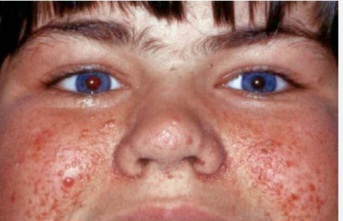
A 10‑year‑old child is brought to the dermatology clinic with reddish bumps on the face that have been increasing in number over the past 2 years.The child has a history of seizures since infancy.
❓ Q1. Identify the skin lesions shown in the image. What condition are they associated with?
✅ Model Answer: • Skin lesions: Facial angiofibromas (previously known as adenoma sebaceum).
• Associated condition: Tuberous sclerosis complex (TSC).
• Characteristics: Multiple erythematous papules and small nodules distributed symmetrically in a butterfly pattern over the cheeks, nose, and chin. They are a major diagnostic criterion for TSC.
• Associated condition: Tuberous sclerosis complex (TSC).
• Characteristics: Multiple erythematous papules and small nodules distributed symmetrically in a butterfly pattern over the cheeks, nose, and chin. They are a major diagnostic criterion for TSC.
❓ Q2. What is the genetic basis of tuberous sclerosis complex?
✅ Model Answer: • Genetics: TSC is caused by mutations in either of two genes:
- TSC1: Located on chromosome 9q34, encodes hamartin.
- TSC2: Located on chromosome 16p13, encodes tuberin.
• Inheritance: Autosomal dominant with high penetrance; ~2/3 of cases are de novo (sporadic).
• Pathophysiology: Loss of function of TSC1 or TSC2 leads to overactivation of the mTOR signaling pathway, resulting in abnormal cell growth and tumor formation.
- TSC1: Located on chromosome 9q34, encodes hamartin.
- TSC2: Located on chromosome 16p13, encodes tuberin.
• Inheritance: Autosomal dominant with high penetrance; ~2/3 of cases are de novo (sporadic).
• Pathophysiology: Loss of function of TSC1 or TSC2 leads to overactivation of the mTOR signaling pathway, resulting in abnormal cell growth and tumor formation.
❓ Q3. What are the major diagnostic criteria for tuberous sclerosis complex?
✅ Model Answer: • Major criteria (≥2 for definite TSC):
1. Facial angiofibromas (≥3) or forehead fibrous plaque.
2. Hypomelanotic macules (≥3, ≥5 mm).
3. Shagreen patch (connective tissue nevus).
4. Ungual fibromas (≥2).
5. Cardiac rhabdomyoma (single or multiple).
6. Cortical tubers (≥2).
7. Subependymal nodules (≥2).
8. Subependymal giant cell astrocytoma (SEGA).
9. Renal angiomyolipoma (≥2).
10. Lymphangioleiomyomatosis (LAM).
• Minor criteria: Dental pits, hamartomatous rectal polyps, bone cysts, etc.
1. Facial angiofibromas (≥3) or forehead fibrous plaque.
2. Hypomelanotic macules (≥3, ≥5 mm).
3. Shagreen patch (connective tissue nevus).
4. Ungual fibromas (≥2).
5. Cardiac rhabdomyoma (single or multiple).
6. Cortical tubers (≥2).
7. Subependymal nodules (≥2).
8. Subependymal giant cell astrocytoma (SEGA).
9. Renal angiomyolipoma (≥2).
10. Lymphangioleiomyomatosis (LAM).
• Minor criteria: Dental pits, hamartomatous rectal polyps, bone cysts, etc.
❓ Q4. What are the typical cutaneous manifestations of tuberous sclerosis?
✅ Model Answer: • Cutaneous manifestations:
- Hypomelanotic macules ("ash-leaf" spots): Pale, oval, or polygonal macules; appear early in infancy; best seen under Wood's lamp.
- Facial angiofibromas: Erythematous papules/nodules in butterfly distribution (cheeks, nose).
- Shagreen patch: Raised, flesh-colored, pebbly plaque (connective tissue nevus), typically on the lower back or flank.
- Ungual fibromas (Koenen tumors): Flesh-colored nodules around or under the nails; appear in adolescence/adulthood.
- Forehead fibrous plaque.
- Hypomelanotic macules ("ash-leaf" spots): Pale, oval, or polygonal macules; appear early in infancy; best seen under Wood's lamp.
- Facial angiofibromas: Erythematous papules/nodules in butterfly distribution (cheeks, nose).
- Shagreen patch: Raised, flesh-colored, pebbly plaque (connective tissue nevus), typically on the lower back or flank.
- Ungual fibromas (Koenen tumors): Flesh-colored nodules around or under the nails; appear in adolescence/adulthood.
- Forehead fibrous plaque.
❓ Q5. What are the neurologic manifestations of tuberous sclerosis?
✅ Model Answer: • Neurologic manifestations:
- Seizures: Most common neurologic feature; often infantile spasms (hypsarrhythmia) in early infancy.
- Developmental delay: Intellectual disability, autism spectrum disorder, learning difficulties.
- Cortical tubers: Benign hamartomas in the cerebral cortex; associated with epilepsy.
- Subependymal nodules: Small nodules along the ventricular walls.
- Subependymal giant cell astrocytoma (SEGA): Slow-growing tumor near the foramen of Monro; can cause obstructive hydrocephalus.
- Behavioral issues: Autism, ADHD, aggressive behavior.
- Seizures: Most common neurologic feature; often infantile spasms (hypsarrhythmia) in early infancy.
- Developmental delay: Intellectual disability, autism spectrum disorder, learning difficulties.
- Cortical tubers: Benign hamartomas in the cerebral cortex; associated with epilepsy.
- Subependymal nodules: Small nodules along the ventricular walls.
- Subependymal giant cell astrocytoma (SEGA): Slow-growing tumor near the foramen of Monro; can cause obstructive hydrocephalus.
- Behavioral issues: Autism, ADHD, aggressive behavior.
❓ Q6. What is the pathogenesis of facial angiofibromas in tuberous sclerosis?
✅ Model Answer: • Pathogenesis: Facial angiofibromas are benign tumors composed of fibroblasts, blood vessels, and collagen.
• Mutations in TSC1/TSC2 lead to loss of hamartin/tuberin function → constitutive activation of the mTOR (mechanistic target of rapamycin) pathway.
• mTOR overactivation promotes cell growth, proliferation, and angiogenesis, leading to the formation of angiofibromas.
• The lesions typically appear in childhood (ages 2-5 years) and increase in number and size with age, especially during adolescence.
• Mutations in TSC1/TSC2 lead to loss of hamartin/tuberin function → constitutive activation of the mTOR (mechanistic target of rapamycin) pathway.
• mTOR overactivation promotes cell growth, proliferation, and angiogenesis, leading to the formation of angiofibromas.
• The lesions typically appear in childhood (ages 2-5 years) and increase in number and size with age, especially during adolescence.
❓ Q7. What is the first-line treatment for facial angiofibromas in tuberous sclerosis?
✅ Model Answer: • First-line treatment: Topical sirolimus (rapamycin) 0.1-1% cream.
- Mechanism: mTOR inhibitor that blocks the downstream signaling of mTOR, reducing cell proliferation.
- Application: Applied once or twice daily to the affected areas.
- Efficacy: Studies show significant improvement in size, color, and number of lesions.
- Side effects: Local irritation, erythema, burning sensation (usually mild and transient).
- Alternative topicals: Everolimus cream (less commonly used).
- Laser therapy: Pulsed dye laser or CO2 laser may be used for refractory lesions.
- Mechanism: mTOR inhibitor that blocks the downstream signaling of mTOR, reducing cell proliferation.
- Application: Applied once or twice daily to the affected areas.
- Efficacy: Studies show significant improvement in size, color, and number of lesions.
- Side effects: Local irritation, erythema, burning sensation (usually mild and transient).
- Alternative topicals: Everolimus cream (less commonly used).
- Laser therapy: Pulsed dye laser or CO2 laser may be used for refractory lesions.
❓ Q8. What is the role of mTOR inhibitors in the systemic management of tuberous sclerosis?
✅ Model Answer: • mTOR inhibitors (everolimus, sirolimus):
- Everolimus: FDA-approved for:
- SEGA: Reduces tumor size and prevents hydrocephalus.
- Renal angiomyolipomas: Reduces tumor volume and prevents bleeding.
- Refractory seizures in TSC (adjunctive therapy).
- LAM: Slows disease progression.
- Dose: Everolimus 4.5 mg/m² (trough levels 5-15 ng/mL).
- Side effects: Mouth ulcers, hyperlipidemia, immunosuppression, growth retardation.
- Monitoring: Drug levels, renal function, lipid panel, and blood counts.
- Everolimus: FDA-approved for:
- SEGA: Reduces tumor size and prevents hydrocephalus.
- Renal angiomyolipomas: Reduces tumor volume and prevents bleeding.
- Refractory seizures in TSC (adjunctive therapy).
- LAM: Slows disease progression.
- Dose: Everolimus 4.5 mg/m² (trough levels 5-15 ng/mL).
- Side effects: Mouth ulcers, hyperlipidemia, immunosuppression, growth retardation.
- Monitoring: Drug levels, renal function, lipid panel, and blood counts.
❓ Q9. What are the cardiac manifestations of tuberous sclerosis?
✅ Model Answer: • Cardiac manifestations:
- Cardiac rhabdomyomas: Benign tumors of the heart, most common in infancy.
- Location: Often multiple, can be in the ventricles, atria, or septum.
- Clinical significance: Usually asymptomatic; may cause arrhythmias, outflow obstruction, or heart failure in severe cases.
- Prognosis: Most regress spontaneously by age 2-3 years.
- Diagnosis: Echocardiogram is used for detection and monitoring.
- Major criterion: Cardiac rhabdomyoma (single or multiple) is a major diagnostic criterion for TSC.
- Cardiac rhabdomyomas: Benign tumors of the heart, most common in infancy.
- Location: Often multiple, can be in the ventricles, atria, or septum.
- Clinical significance: Usually asymptomatic; may cause arrhythmias, outflow obstruction, or heart failure in severe cases.
- Prognosis: Most regress spontaneously by age 2-3 years.
- Diagnosis: Echocardiogram is used for detection and monitoring.
- Major criterion: Cardiac rhabdomyoma (single or multiple) is a major diagnostic criterion for TSC.
❓ Q10. What are the renal manifestations of tuberous sclerosis?
✅ Model Answer: • Renal manifestations:
- Renal angiomyolipomas (AML): Most common renal lesion in TSC (70-80%).
- Composition: Blood vessels, smooth muscle, and adipose tissue.
- Risk: Can bleed (retroperitoneal hemorrhage) if >4 cm.
- Renal cysts: Often multiple, may lead to renal insufficiency.
- Renal cell carcinoma: Rare but increased risk.
- Surveillance: Renal ultrasound every 1-3 years from diagnosis.
- Treatment: Everolimus for growing AML (>3 cm), embolization for bleeding, or partial nephrectomy.
- Renal angiomyolipomas (AML): Most common renal lesion in TSC (70-80%).
- Composition: Blood vessels, smooth muscle, and adipose tissue.
- Risk: Can bleed (retroperitoneal hemorrhage) if >4 cm.
- Renal cysts: Often multiple, may lead to renal insufficiency.
- Renal cell carcinoma: Rare but increased risk.
- Surveillance: Renal ultrasound every 1-3 years from diagnosis.
- Treatment: Everolimus for growing AML (>3 cm), embolization for bleeding, or partial nephrectomy.
❓ Q11. What is the role of surveillance in tuberous sclerosis?
✅ Model Answer: • Surveillance recommendations:
- Brain MRI: Every 1-3 years to monitor for SEGA and cortical tubers.
- Renal ultrasound: Every 1-3 years to monitor for AML and cysts.
- Echocardiogram: At diagnosis, then follow until rhabdomyoma regresses.
- Ophthalmology: Annual exams to detect retinal hamartomas (minor criterion).
- Dermatology: Annual skin exam for new or changing lesions.
- Neuropsychological: Developmental and behavioral screening.
- EEG: If seizures are suspected or present.
- Blood pressure: Monitor for hypertension (renal involvement).
- Brain MRI: Every 1-3 years to monitor for SEGA and cortical tubers.
- Renal ultrasound: Every 1-3 years to monitor for AML and cysts.
- Echocardiogram: At diagnosis, then follow until rhabdomyoma regresses.
- Ophthalmology: Annual exams to detect retinal hamartomas (minor criterion).
- Dermatology: Annual skin exam for new or changing lesions.
- Neuropsychological: Developmental and behavioral screening.
- EEG: If seizures are suspected or present.
- Blood pressure: Monitor for hypertension (renal involvement).
❓ Q12. What is the difference between facial angiofibromas and acne vulgaris?
✅ Model Answer: • Facial angiofibromas (TSC):
- Erythematous papules/nodules, firm, skin-colored or reddish.
- Butterfly distribution – cheeks, nose, chin.
- Usually painless, not inflammatory.
- Associated with other TSC features (seizures, hypomelanotic macules, shagreen patch).
- No comedones (blackheads/whiteheads).
- Responds to mTOR inhibitors (topical sirolimus).
• Acne vulgaris:
- Inflammatory papules, pustules, nodules, comedones.
- Can appear anywhere on the face, chest, back.
- Associated with puberty and androgen stimulation.
- Responds to benzoyl peroxide, retinoids, antibiotics.
- No associated systemic features.
- Erythematous papules/nodules, firm, skin-colored or reddish.
- Butterfly distribution – cheeks, nose, chin.
- Usually painless, not inflammatory.
- Associated with other TSC features (seizures, hypomelanotic macules, shagreen patch).
- No comedones (blackheads/whiteheads).
- Responds to mTOR inhibitors (topical sirolimus).
• Acne vulgaris:
- Inflammatory papules, pustules, nodules, comedones.
- Can appear anywhere on the face, chest, back.
- Associated with puberty and androgen stimulation.
- Responds to benzoyl peroxide, retinoids, antibiotics.
- No associated systemic features.
❓ Q13. How would you counsel the parents of a child with tuberous sclerosis and facial angiofibromas?
✅ Model Answer: • "Your child has tuberous sclerosis complex, a genetic condition that causes benign tumors to grow in different organs, including the skin, brain, heart, and kidneys."
• "The facial bumps are called angiofibromas. They are not cancerous and are not harmful, but they can be cosmetically concerning."
• "We can treat them with a topical cream (sirolimus) that can shrink them or prevent new ones from forming."
• "We will need to monitor your child regularly with brain MRI (to check for brain tumors), kidney ultrasound, and heart ultrasound to ensure any growths are managed promptly."
• "Your child may also have seizures or developmental delays, and we have a team of specialists to help manage these."
• "This is a lifelong condition, but with regular monitoring and treatment, most people with TSC live full and productive lives."
• "The facial bumps are called angiofibromas. They are not cancerous and are not harmful, but they can be cosmetically concerning."
• "We can treat them with a topical cream (sirolimus) that can shrink them or prevent new ones from forming."
• "We will need to monitor your child regularly with brain MRI (to check for brain tumors), kidney ultrasound, and heart ultrasound to ensure any growths are managed promptly."
• "Your child may also have seizures or developmental delays, and we have a team of specialists to help manage these."
• "This is a lifelong condition, but with regular monitoring and treatment, most people with TSC live full and productive lives."
❓ Q14. What is the role of genetic testing in tuberous sclerosis?
✅ Model Answer: • Role of genetic testing:
- Confirm diagnosis: Identifies pathogenic variants in TSC1 or TSC2.
- Differentiate from other conditions: e.g., NF1, neurocutaneous syndromes.
- Family counseling: Helps identify at-risk family members (autosomal dominant, 50% risk).
- Prenatal testing: For families with known mutations (CVS or amniocentesis).
- Prognostic information: TSC2 mutations are generally associated with more severe disease than TSC1 mutations.
- Detection rate: ~85-90% with comprehensive sequencing (including deletion/duplication analysis).
- Clinical utility: Early diagnosis allows for targeted surveillance and management.
- Confirm diagnosis: Identifies pathogenic variants in TSC1 or TSC2.
- Differentiate from other conditions: e.g., NF1, neurocutaneous syndromes.
- Family counseling: Helps identify at-risk family members (autosomal dominant, 50% risk).
- Prenatal testing: For families with known mutations (CVS or amniocentesis).
- Prognostic information: TSC2 mutations are generally associated with more severe disease than TSC1 mutations.
- Detection rate: ~85-90% with comprehensive sequencing (including deletion/duplication analysis).
- Clinical utility: Early diagnosis allows for targeted surveillance and management.
❓ Q15. What is the prognosis for a child with tuberous sclerosis?
✅ Model Answer: • Prognosis: Highly variable, depending on the severity of organ involvement.
- Cognitive function: ~50% have normal intelligence; 30-50% have intellectual disability.
- Seizures: Can be controlled with medications in many; some may have refractory epilepsy.
- SEGA: With early detection and everolimus treatment, most are well-controlled.
- Renal AML: Risk of bleeding; regular monitoring and everolimus reduce complications.
- LAM: Can be life-threatening in adults (pulmonary involvement).
- Life expectancy: Near normal with modern surveillance and treatment; leading causes of death: renal disease, SEGA, LAM, and status epilepticus.
- Quality of life: Good with multidisciplinary care and early intervention.
- Cognitive function: ~50% have normal intelligence; 30-50% have intellectual disability.
- Seizures: Can be controlled with medications in many; some may have refractory epilepsy.
- SEGA: With early detection and everolimus treatment, most are well-controlled.
- Renal AML: Risk of bleeding; regular monitoring and everolimus reduce complications.
- LAM: Can be life-threatening in adults (pulmonary involvement).
- Life expectancy: Near normal with modern surveillance and treatment; leading causes of death: renal disease, SEGA, LAM, and status epilepticus.
- Quality of life: Good with multidisciplinary care and early intervention.
📋 Mock Test Feedback
💡 Examiner's note: Compare your answers with model answers. In real TOACS, you would discuss these with the examiner.