⚕️ FCPS Paediatrics TOACS · Mock Test
| Observed Station | CPSP Format
⏱️ TIME REMAINING
08:00
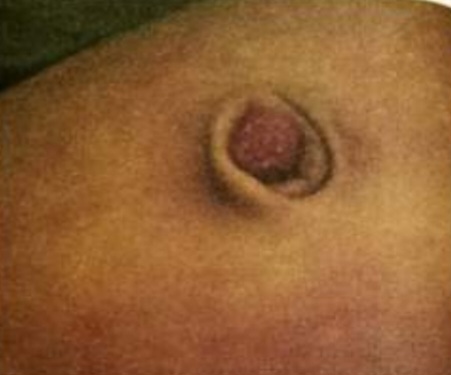
❓ Q1. Identify the lesion shown in the image. (1 mark)
✅ Model Answer: Umbilical granuloma. A pinkish-red, moist, friable granulation tissue at the umbilical base after cord separation.
❓ Q2. List TWO important differential diagnoses of an umbilical granuloma in a 3-week-old infant. (2 marks)
✅ Model Answer: 1) Patent urachus (urine discharge, tract to bladder). 2) Omphalomesenteric (vitelline) duct remnant (fecal or bilious discharge, may have polyp). Also: Omphalitis, umbilical polyp.
❓ Q3. Describe the correct technique for silver nitrate cauterization of this lesion. Mention two important precautions. (2 marks)
✅ Model Answer:
• Protect surrounding skin with petroleum jelly (Vaseline) barrier.
• Moisten silver nitrate stick with sterile water/saline; gently roll on granuloma only until turns white/grey (10–20 seconds).
• Precautions: Avoid if signs of infection (omphalitis) or suspected patent urachus (risk of chemical peritonitis).
• Max 3–4 sessions; if recurrent → refer for surgical evaluation.
• Protect surrounding skin with petroleum jelly (Vaseline) barrier.
• Moisten silver nitrate stick with sterile water/saline; gently roll on granuloma only until turns white/grey (10–20 seconds).
• Precautions: Avoid if signs of infection (omphalitis) or suspected patent urachus (risk of chemical peritonitis).
• Max 3–4 sessions; if recurrent → refer for surgical evaluation.
❓ Q4. What clinical features would raise suspicion of a patent urachus rather than a simple umbilical granuloma? (2 marks)
✅ Model Answer: Persistent clear (urine-like) discharge; intermittent wetness; large or recurrent granuloma after repeated cautery; associated with urinary tract anomalies; ultrasound shows tract from umbilicus to bladder.
❓ Q5. What is the first-line conservative (non-cautery) treatment for umbilical granuloma? (1 mark)
✅ Model Answer: Application of common salt (sodium chloride) – a pinch of salt covered with dry gauze for 20–30 minutes twice daily for 3–5 days. Also: dry cord care with 70% alcohol.
❓ Q6. When should you refer a patient with umbilical granuloma to a pediatric surgeon? (2 marks)
✅ Model Answer: • Failure of resolution after 3 silver nitrate sessions. • Suspicion of patent urachus or vitelline duct remnant (discharge of urine/faeces). • Lesion >1 cm or polypoid morphology. • Recurrent omphalitis or persistent drainage.
📋 Mock Test Feedback
💡 Examiner's note: Compare your answers with the model answers. In real TOACS, you would discuss these with the examiner.