FCPS MCPS IMM MD TOACS
Observed Station | CPSP Format | 8 minutes
⏱️ TIME REMAINING
08:00
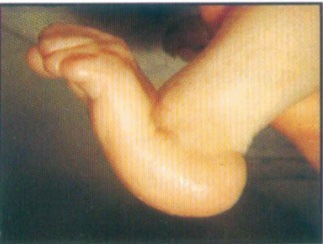
❓ Q1. Identify the foot deformity shown in the image. Which syndrome is it classically associated with?
✅ Model Answer: • Foot deformity: Rocker-bottom foot (congenital vertical talus).
• Associated syndrome: Edwards syndrome (trisomy 18).
• Features: Prominent heel, convex plantar surface (like the bottom of a rocking chair), forefoot elevated, short dorsiflexed toes.
• Associated syndrome: Edwards syndrome (trisomy 18).
• Features: Prominent heel, convex plantar surface (like the bottom of a rocking chair), forefoot elevated, short dorsiflexed toes.
❓ Q2. Describe the four classic craniofacial and hand features of Edwards syndrome.
✅ Model Answer: • Craniofacial: Prominent occiput, micrognathia (small jaw), low-set malformed ears, small mouth.
• Hands: Clenched fists with overlapping fingers – index finger over third finger, fifth finger over fourth finger.
• Other features: Growth restriction (IUGR), short sternum, cardiac defects (VSD, PDA, ASD).
• Hands: Clenched fists with overlapping fingers – index finger over third finger, fifth finger over fourth finger.
• Other features: Growth restriction (IUGR), short sternum, cardiac defects (VSD, PDA, ASD).
❓ Q3. What is the genetic abnormality in Edwards syndrome? What is the karyotype?
✅ Model Answer: • Genetic abnormality: Trisomy 18 – three copies of chromosome 18.
• Karyotype: 47,XX,+18 (female) or 47,XY,+18 (male).
• Incidence: 1 in 5,000 live births.
• Risk factors: Advanced maternal age (increased risk with older mothers).
• Karyotype: 47,XX,+18 (female) or 47,XY,+18 (male).
• Incidence: 1 in 5,000 live births.
• Risk factors: Advanced maternal age (increased risk with older mothers).
❓ Q4. What is the incidence of Edwards syndrome? What is the most common cardiac defect associated with it?
✅ Model Answer: • Incidence: 1 in 5,000 live births (higher in females).
• Most common cardiac defect: Ventricular septal defect (VSD) – present in >80% of cases.
• Other cardiac defects: Patent ductus arteriosus (PDA), atrial septal defect (ASD), coarctation of the aorta.
• Most common cardiac defect: Ventricular septal defect (VSD) – present in >80% of cases.
• Other cardiac defects: Patent ductus arteriosus (PDA), atrial septal defect (ASD), coarctation of the aorta.
❓ Q5. What is the prognosis for an infant with Edwards syndrome? What is the median survival?
✅ Model Answer: • Prognosis: Very poor – most infants die within the first year of life.
• Median survival: 12 days (50% die in the first week).
• Survival to 1 year: Less than 10%.
• Management: Supportive care, palliative care, feeding support, comfort measures.
• Median survival: 12 days (50% die in the first week).
• Survival to 1 year: Less than 10%.
• Management: Supportive care, palliative care, feeding support, comfort measures.
❓ Q6. What are the three most common congenital anomalies associated with Edwards syndrome?
✅ Model Answer: • 1. Cardiac defects: VSD, PDA, ASD, coarctation.
• 2. CNS anomalies: Myelomeningocele, hydrocephalus, Dandy-Walker malformation, holoprosencephaly.
• 3. Renal anomalies: Hydronephrosis, horseshoe kidney, cystic kidney.
• Also: Omphalocele, esophageal atresia, diaphragmatic hernia.
• 2. CNS anomalies: Myelomeningocele, hydrocephalus, Dandy-Walker malformation, holoprosencephaly.
• 3. Renal anomalies: Hydronephrosis, horseshoe kidney, cystic kidney.
• Also: Omphalocele, esophageal atresia, diaphragmatic hernia.
❓ Q7. What is the difference between rocker-bottom foot and clubfoot?
✅ Model Answer: • Rocker-bottom foot (vertical talus): Convex plantar surface, prominent heel, forefoot elevated and dorsiflexed, short toes. Rigid deformity.
• Clubfoot (talipes equinovarus): Foot is plantarflexed (equinus), inverted (varus), and adducted. Heel is not prominent; foot is turned inward and downward.
• Rocker-bottom foot is associated with trisomy 18; clubfoot is associated with many conditions including idiopathic.
• Clubfoot (talipes equinovarus): Foot is plantarflexed (equinus), inverted (varus), and adducted. Heel is not prominent; foot is turned inward and downward.
• Rocker-bottom foot is associated with trisomy 18; clubfoot is associated with many conditions including idiopathic.
❓ Q8. What is the management approach for an infant with Edwards syndrome? ()
✅ Model Answer: • Palliative care: Focus on comfort, quality of life, and parental support.
• Feeding support: NG tube feeding for poor suck/swallow.
• Cardiac support: Monitor for heart failure; prostaglandins if duct-dependent lesion.
• Respiratory support: CPAP or ventilation if needed (but often not escalated).
• Multidisciplinary care: Genetic counseling, social work, neonatology, cardiology.
• Parental counseling: Honest discussion of prognosis, decision-making regarding interventions.
• Feeding support: NG tube feeding for poor suck/swallow.
• Cardiac support: Monitor for heart failure; prostaglandins if duct-dependent lesion.
• Respiratory support: CPAP or ventilation if needed (but often not escalated).
• Multidisciplinary care: Genetic counseling, social work, neonatology, cardiology.
• Parental counseling: Honest discussion of prognosis, decision-making regarding interventions.
❓ Q9. Can Edwards syndrome be diagnosed prenatally? What are the screening and diagnostic options?
✅ Model Answer: • Yes, prenatal diagnosis is possible.
• Screening: First-trimester serum screening (low PAPP-A, low β-hCG), second-trimester quad screen (low AFP, low estriol, low β-hCG, high inhibin A). NIPT (non-invasive prenatal testing).
• Diagnostic: Chorionic villus sampling (CVS) at 10-13 weeks, or amniocentesis at 15-20 weeks with karyotype or FISH.
• Ultrasound findings: Rocker-bottom feet, overlapping fingers, choroid plexus cysts, growth restriction, cardiac anomalies, omphalocele.
• Screening: First-trimester serum screening (low PAPP-A, low β-hCG), second-trimester quad screen (low AFP, low estriol, low β-hCG, high inhibin A). NIPT (non-invasive prenatal testing).
• Diagnostic: Chorionic villus sampling (CVS) at 10-13 weeks, or amniocentesis at 15-20 weeks with karyotype or FISH.
• Ultrasound findings: Rocker-bottom feet, overlapping fingers, choroid plexus cysts, growth restriction, cardiac anomalies, omphalocele.
❓ Q10. What other trisomy conditions can present with rocker-bottom feet?
✅ Model Answer: • Trisomy 13 (Patau syndrome): Can also have rocker-bottom feet, but classically has cleft lip/palate, microphthalmia, holoprosencephaly.
• Trisomy 18: Most classic for rocker-bottom feet.
• Other: Rarely in trisomy 21 (Down syndrome) – usually not a feature.
• Rocker-bottom foot is also seen in congenital vertical talus (isolated) and other syndromes.
• Trisomy 18: Most classic for rocker-bottom feet.
• Other: Rarely in trisomy 21 (Down syndrome) – usually not a feature.
• Rocker-bottom foot is also seen in congenital vertical talus (isolated) and other syndromes.
❓ Q11. What are the characteristic ultrasound findings in trisomy 18?
✅ Model Answer: • Common prenatal ultrasound findings:
- Choroid plexus cysts (frequently present).
- Growth restriction (IUGR).
- Rocker-bottom feet and overlapping fingers.
- Cardiac anomalies (VSD, PDA).
- Omphalocele.
- Micrognathia, prominent occiput.
- Single umbilical artery.
- Ventriculomegaly / hydrocephalus.
- Choroid plexus cysts (frequently present).
- Growth restriction (IUGR).
- Rocker-bottom feet and overlapping fingers.
- Cardiac anomalies (VSD, PDA).
- Omphalocele.
- Micrognathia, prominent occiput.
- Single umbilical artery.
- Ventriculomegaly / hydrocephalus.
❓ Q12. What is the role of genetic counseling in Edwards syndrome?
✅ Model Answer: • Genetic counseling is essential.
• Discuss: The diagnosis, karyotype, inheritance pattern (usually sporadic, not inherited).
• Recurrence risk: Low for parents with normal karyotypes (1-2%).
• Options for future pregnancies: Prenatal screening/diagnostic options.
• Emotional support: Address parental grief, provide resources for support groups.
• Discuss: The diagnosis, karyotype, inheritance pattern (usually sporadic, not inherited).
• Recurrence risk: Low for parents with normal karyotypes (1-2%).
• Options for future pregnancies: Prenatal screening/diagnostic options.
• Emotional support: Address parental grief, provide resources for support groups.
❓ Q13. How would you counsel the parents of a newborn with Edwards syndrome?
✅ Model Answer: • "Your baby has a condition called Edwards syndrome (trisomy 18), which is a chromosomal disorder."
• "This condition causes multiple birth defects, including the foot deformity, heart problems, and brain abnormalities."
• "We will provide supportive care to keep your baby comfortable – helping with feeding, breathing, and pain relief."
• "Most babies with this condition live only a few days to weeks, but we will focus on making sure your baby is comfortable and pain-free."
• "We are here to support you and your family during this difficult time. You can hold and bond with your baby."
• "This condition causes multiple birth defects, including the foot deformity, heart problems, and brain abnormalities."
• "We will provide supportive care to keep your baby comfortable – helping with feeding, breathing, and pain relief."
• "Most babies with this condition live only a few days to weeks, but we will focus on making sure your baby is comfortable and pain-free."
• "We are here to support you and your family during this difficult time. You can hold and bond with your baby."
❓ Q14. What are the differential diagnoses for rocker-bottom foot?
✅ Model Answer: • Trisomy 18 (Edwards syndrome) – most common.
• Trisomy 13 (Patau syndrome) – also associated with rocker-bottom feet.
• Congenital vertical talus (isolated): Idiopathic rocker-bottom foot without other anomalies.
• Neuromuscular conditions: Arthrogryposis multiplex congenita, myelomeningocele.
• Other syndromes: DiGeorge syndrome (22q11.2 deletion) – rarely.
• Trisomy 13 (Patau syndrome) – also associated with rocker-bottom feet.
• Congenital vertical talus (isolated): Idiopathic rocker-bottom foot without other anomalies.
• Neuromuscular conditions: Arthrogryposis multiplex congenita, myelomeningocele.
• Other syndromes: DiGeorge syndrome (22q11.2 deletion) – rarely.
❓ Q15. What is the treatment for rocker-bottom foot if the infant survives?
✅ Model Answer: • Non-surgical: Serial casting (Ponseti-like method) may be attempted in milder cases.
• Surgical: If the infant survives and is stable, surgical correction may be considered – open reduction of the talonavicular joint, tendon transfers.
• However: Most infants with trisomy 18 do not survive long enough for surgical correction.
• Management: In Edwards syndrome, treatment is usually palliative, not surgical.
• Surgical: If the infant survives and is stable, surgical correction may be considered – open reduction of the talonavicular joint, tendon transfers.
• However: Most infants with trisomy 18 do not survive long enough for surgical correction.
• Management: In Edwards syndrome, treatment is usually palliative, not surgical.
📋 Mock Test Feedback
💡 Examiner's note: Compare your answers with model answers. In real TOACS, you would discuss these with the examiner.