⚡ · FCPS MCPS IMM MD Paediatrics TOACS
Observed Station | CPSP Format | 8 minutes
⏱️ TIME REMAINING
08:00
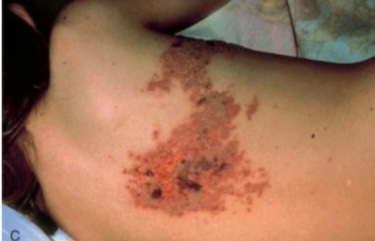
❓ Q1. Identify the skin condition shown in the image. Describe its characteristic features.
✅ Model Answer: • Condition: Herpes zoster (shingles).
• Features: Unilateral, dermatomal vesicular rash; grouped vesicles on an erythematous base; pain, burning, or itching often precedes the rash; follows a single dermatome (thoracic, cervical, ophthalmic, etc.).
• Features: Unilateral, dermatomal vesicular rash; grouped vesicles on an erythematous base; pain, burning, or itching often precedes the rash; follows a single dermatome (thoracic, cervical, ophthalmic, etc.).
❓ Q2. What is the etiology of herpes zoster? Which virus is responsible?
✅ Model Answer: • Etiology: Reactivation of latent varicella-zoster virus (VZV).
• Virus: Varicella-zoster virus (human herpesvirus 3, HHV-3).
• The virus remains latent in the dorsal root ganglia after primary infection (chickenpox) and reactivates due to immunosuppression, aging, or stress.
• Virus: Varicella-zoster virus (human herpesvirus 3, HHV-3).
• The virus remains latent in the dorsal root ganglia after primary infection (chickenpox) and reactivates due to immunosuppression, aging, or stress.
❓ Q3. What are the risk factors for reactivation of VZV?
✅ Model Answer: • Risk factors:
- Age: >50 years (most important).
- Immunocompromise: HIV/AIDS, malignancy, chemotherapy, organ transplant, corticosteroid use.
- Stress (physical or emotional).
- Trauma to the affected dermatome.
- Radiation therapy to the area.
- Age: >50 years (most important).
- Immunocompromise: HIV/AIDS, malignancy, chemotherapy, organ transplant, corticosteroid use.
- Stress (physical or emotional).
- Trauma to the affected dermatome.
- Radiation therapy to the area.
❓ Q4. What are the common dermatomes affected by herpes zoster?
✅ Model Answer: • Thoracic (T3–T12): Most common (50-60% of cases).
• Cervical (C2–C8): 15-20%.
• Ophthalmic (V1): 10-15% – vision-threatening (requires urgent ophthalmology referral).
• Lumbar (L1–L5) and Sacral (S1–S5): Less common.
• Note: The rash does not cross the midline.
• Cervical (C2–C8): 15-20%.
• Ophthalmic (V1): 10-15% – vision-threatening (requires urgent ophthalmology referral).
• Lumbar (L1–L5) and Sacral (S1–S5): Less common.
• Note: The rash does not cross the midline.
❓ Q5. What is the prodrome of herpes zoster? How long does it last?
✅ Model Answer: • Prodrome: Pain, burning, itching, or tingling in the affected dermatome.
• Duration: 1-3 days before the rash appears.
• May be accompanied by fever, malaise, headache, and lymphadenopathy.
• The pain can be severe and is often described as "burning" or "stabbing."
• Duration: 1-3 days before the rash appears.
• May be accompanied by fever, malaise, headache, and lymphadenopathy.
• The pain can be severe and is often described as "burning" or "stabbing."
❓ Q6. What is the typical course of the herpes zoster rash?
✅ Model Answer: • Course:
- Days 1-3: Erythematous macules → papules → vesicles (grouped).
- Days 3-5: Vesicles become pustular.
- Days 7-10: Crusting and healing begins.
- Weeks 2-4: Complete healing, may leave hypopigmented or hyperpigmented scars.
- New vesicles may continue to appear for 3-5 days.
- Days 1-3: Erythematous macules → papules → vesicles (grouped).
- Days 3-5: Vesicles become pustular.
- Days 7-10: Crusting and healing begins.
- Weeks 2-4: Complete healing, may leave hypopigmented or hyperpigmented scars.
- New vesicles may continue to appear for 3-5 days.
❓ Q7. What is the first-line treatment for herpes zoster? What is the therapeutic window?
✅ Model Answer: • First-line treatment: Oral antiviral therapy.
- Acyclovir: 800 mg 5 times daily for 7 days.
- Valacyclovir: 1 g three times daily for 7 days (better absorption, QD).
- Famciclovir: 500 mg three times daily for 7 days.
• Therapeutic window: Initiate within 72 hours of rash onset for maximum benefit (reduces viral shedding, new lesion formation, and pain; reduces risk of post-herpetic neuralgia).
• In immunocompromised, severe cases, or ophthalmic zoster, consider IV acyclovir.
- Acyclovir: 800 mg 5 times daily for 7 days.
- Valacyclovir: 1 g three times daily for 7 days (better absorption, QD).
- Famciclovir: 500 mg three times daily for 7 days.
• Therapeutic window: Initiate within 72 hours of rash onset for maximum benefit (reduces viral shedding, new lesion formation, and pain; reduces risk of post-herpetic neuralgia).
• In immunocompromised, severe cases, or ophthalmic zoster, consider IV acyclovir.
❓ Q8. What are the complications of herpes zoster?
✅ Model Answer: • Post-herpetic neuralgia (PHN): Pain persisting >90 days after rash healing – most common and debilitating complication, especially in elderly.
• Ophthalmic zoster (HZO): Involvement of the ophthalmic division of trigeminal nerve (V1) → keratitis, uveitis, glaucoma, vision loss, blindness.
• Ramsay Hunt syndrome: Involvement of geniculate ganglion → facial palsy, ear pain, vesicles in the ear canal (herpes zoster oticus).
• VZV encephalitis: Rare but serious.
• Bacterial superinfection: Cellulitis, impetigo.
• Disseminated zoster: In immunocompromised – widespread vesicular rash (≥20 lesions outside the primary dermatome).
• Ophthalmic zoster (HZO): Involvement of the ophthalmic division of trigeminal nerve (V1) → keratitis, uveitis, glaucoma, vision loss, blindness.
• Ramsay Hunt syndrome: Involvement of geniculate ganglion → facial palsy, ear pain, vesicles in the ear canal (herpes zoster oticus).
• VZV encephalitis: Rare but serious.
• Bacterial superinfection: Cellulitis, impetigo.
• Disseminated zoster: In immunocompromised – widespread vesicular rash (≥20 lesions outside the primary dermatome).
❓ Q9. What is post-herpetic neuralgia (PHN)? How is it managed?
✅ Model Answer: • Definition: Pain persisting for ≥90 days after the onset of the herpes zoster rash.
• Pathophysiology: Nerve damage and inflammation of dorsal root ganglia.
• Management:
- First-line: Gabapentin or pregabalin (anticonvulsants).
- Second-line: Tricyclic antidepressants (amitriptyline, nortriptyline).
- Topical: Lidocaine 5% patch, capsaicin cream.
- Opioid analgesics for severe pain (short-term).
- Early antiviral therapy reduces the risk of PHN.
• Pathophysiology: Nerve damage and inflammation of dorsal root ganglia.
• Management:
- First-line: Gabapentin or pregabalin (anticonvulsants).
- Second-line: Tricyclic antidepressants (amitriptyline, nortriptyline).
- Topical: Lidocaine 5% patch, capsaicin cream.
- Opioid analgesics for severe pain (short-term).
- Early antiviral therapy reduces the risk of PHN.
❓ Q10. How does herpes zoster differ from varicella (chickenpox)?
✅ Model Answer: • Varicella (chickenpox): Primary infection; generalized rash (centripetal, crops of vesicles in different stages); fever, malaise; children > adults.
• Herpes zoster (shingles): Reactivation; unilateral, dermatomal vesicular rash; pain/burning precedes rash; older adults > children.
• Both caused by VZV.
• Chickenpox is highly contagious (airborne); zoster is less contagious (contact with vesicular fluid can cause chickenpox in susceptible individuals).
• Herpes zoster (shingles): Reactivation; unilateral, dermatomal vesicular rash; pain/burning precedes rash; older adults > children.
• Both caused by VZV.
• Chickenpox is highly contagious (airborne); zoster is less contagious (contact with vesicular fluid can cause chickenpox in susceptible individuals).
❓ Q11. What is the role of the zoster vaccine (Shingrix) in prevention?
✅ Model Answer: • Shingrix (RZV): Recombinant zoster vaccine (adjuvanted).
• Indications: Adults ≥50 years (2 doses, 2-6 months apart).
• Efficacy: >90% effective in preventing herpes zoster and post-herpetic neuralgia.
• Contraindications: Severe allergy to vaccine components; pregnancy.
• Live vaccine (Zostavax) is no longer available in the US (discontinued).
• Indications: Adults ≥50 years (2 doses, 2-6 months apart).
• Efficacy: >90% effective in preventing herpes zoster and post-herpetic neuralgia.
• Contraindications: Severe allergy to vaccine components; pregnancy.
• Live vaccine (Zostavax) is no longer available in the US (discontinued).
❓ Q12. What is herpes zoster ophthalmicus (HZO)? Why is it an emergency?
✅ Model Answer: • HZO: Involvement of the ophthalmic division (V1) of the trigeminal nerve.
• Presentation: Vesicular rash on the forehead, nose (Hutchinson's sign – involvement of the tip of the nose), and eyelid; eye pain, redness, photophobia, blurred vision.
• Why emergency: Can lead to severe ocular complications: keratitis, uveitis, scleritis, glaucoma, retinal necrosis, and blindness.
• Management: Immediate ophthalmology referral; oral or IV acyclovir; topical corticosteroids may be needed for inflammation (under ophthalmology supervision).
• Presentation: Vesicular rash on the forehead, nose (Hutchinson's sign – involvement of the tip of the nose), and eyelid; eye pain, redness, photophobia, blurred vision.
• Why emergency: Can lead to severe ocular complications: keratitis, uveitis, scleritis, glaucoma, retinal necrosis, and blindness.
• Management: Immediate ophthalmology referral; oral or IV acyclovir; topical corticosteroids may be needed for inflammation (under ophthalmology supervision).
❓ Q13. What is Ramsay Hunt syndrome?
✅ Model Answer: • Ramsay Hunt syndrome: Herpes zoster infection of the geniculate ganglion of the facial nerve (Cranial nerve VII).
• Classic triad:
- Ipsilateral facial nerve palsy (lower motor neuron facial weakness).
- Vesicles in the external ear canal, pinna, or tympanic membrane (herpes zoster oticus).
- Ear pain (otalgia).
• May also cause hearing loss, tinnitus, vertigo, and loss of taste (anterior 2/3 of tongue).
• Treatment: Oral antivirals + corticosteroids (prednisone) within 72 hours; prognosis for facial nerve recovery is worse than Bell's palsy.
• Classic triad:
- Ipsilateral facial nerve palsy (lower motor neuron facial weakness).
- Vesicles in the external ear canal, pinna, or tympanic membrane (herpes zoster oticus).
- Ear pain (otalgia).
• May also cause hearing loss, tinnitus, vertigo, and loss of taste (anterior 2/3 of tongue).
• Treatment: Oral antivirals + corticosteroids (prednisone) within 72 hours; prognosis for facial nerve recovery is worse than Bell's palsy.
❓ Q14. How would you counsel a patient with herpes zoster?
✅ Model Answer: • "You have shingles – a reactivation of the chickenpox virus. It is not a new infection."
• "We are starting antiviral medication to reduce the severity and duration of the rash and to lower the risk of persistent pain (post-herpetic neuralgia)."
• "The medication works best if started within 3 days of the rash appearing."
• "Keep the rash clean and covered. Avoid scratching to prevent bacterial infection."
• "You are contagious to people who have not had chickenpox or the vaccine – cover the rash and avoid contact with pregnant women, newborns, and immunocompromised individuals."
• "If the pain persists after the rash heals, there are treatments available for nerve pain."
• "We are starting antiviral medication to reduce the severity and duration of the rash and to lower the risk of persistent pain (post-herpetic neuralgia)."
• "The medication works best if started within 3 days of the rash appearing."
• "Keep the rash clean and covered. Avoid scratching to prevent bacterial infection."
• "You are contagious to people who have not had chickenpox or the vaccine – cover the rash and avoid contact with pregnant women, newborns, and immunocompromised individuals."
• "If the pain persists after the rash heals, there are treatments available for nerve pain."
❓ Q15. What are the indications for hospitalization in a patient with herpes zoster?
✅ Model Answer: • Indications:
- Immunocompromised patients (HIV, malignancy, transplant, chemotherapy).
- Ophthalmic zoster (HZO) – often requires ophthalmology consultation.
- Disseminated zoster (>20 lesions outside primary dermatome).
- Severe pain requiring IV opioids or pain management.
- Complications: Encephalitis, meningitis, severe bacterial superinfection, Ramsay Hunt syndrome.
- Neonates and pregnant women (especially near term).
- Immunocompromised patients (HIV, malignancy, transplant, chemotherapy).
- Ophthalmic zoster (HZO) – often requires ophthalmology consultation.
- Disseminated zoster (>20 lesions outside primary dermatome).
- Severe pain requiring IV opioids or pain management.
- Complications: Encephalitis, meningitis, severe bacterial superinfection, Ramsay Hunt syndrome.
- Neonates and pregnant women (especially near term).
📋 Mock Test Feedback
💡 Examiner's note: Compare your answers with model answers. In real TOACS, you would discuss these with the examiner.