FCPS MCPS IMM MD Paediatrics TOACS
Observed Station | CPSP Format | 8 minutes
⏱️ TIME REMAINING
08:00
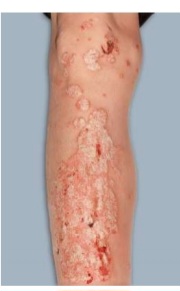
A 12‑year‑old child is brought to the dermatology clinic with persistent, scaly patches on the elbows and knees that have been present for several months.
❓ Q1. Identify the skin condition shown in the image. Describe its characteristic features.
✅ Model Answer: • Condition: Plaque psoriasis (psoriasis vulgaris).
• Characteristic features: Well-demarcated, erythematous plaques with thick silvery-white scales. Commonly affects extensor surfaces (elbows, knees), scalp, sacrum, and nails. Associated with nail pitting, onycholysis, Auspitz sign (pinpoint bleeding when scale is removed), and Koebner phenomenon (new lesions at sites of trauma).
• Characteristic features: Well-demarcated, erythematous plaques with thick silvery-white scales. Commonly affects extensor surfaces (elbows, knees), scalp, sacrum, and nails. Associated with nail pitting, onycholysis, Auspitz sign (pinpoint bleeding when scale is removed), and Koebner phenomenon (new lesions at sites of trauma).
❓ Q2. What is the pathophysiology of psoriasis?
✅ Model Answer: • Pathophysiology: Psoriasis is a chronic, immune-mediated inflammatory skin disease.
• T-cell mediated: Activated T cells (Th1 and Th17) infiltrate the skin and release inflammatory cytokines (TNF-α, IL-17, IL-23).
• Keratinocyte hyperproliferation: Increased turnover of epidermal cells (from 28 days to 3-4 days), leading to thick, scaly plaques.
• Genetic predisposition: HLA-Cw6 and other psoriasis susceptibility genes (PSORS1-9).
• Triggers: Streptococcal infection (guttate psoriasis), stress, trauma (Koebner phenomenon), medications (lithium, beta-blockers, antimalarials), obesity, smoking, and alcohol.
• T-cell mediated: Activated T cells (Th1 and Th17) infiltrate the skin and release inflammatory cytokines (TNF-α, IL-17, IL-23).
• Keratinocyte hyperproliferation: Increased turnover of epidermal cells (from 28 days to 3-4 days), leading to thick, scaly plaques.
• Genetic predisposition: HLA-Cw6 and other psoriasis susceptibility genes (PSORS1-9).
• Triggers: Streptococcal infection (guttate psoriasis), stress, trauma (Koebner phenomenon), medications (lithium, beta-blockers, antimalarials), obesity, smoking, and alcohol.
❓ Q3. What are the different clinical types of psoriasis?
✅ Model Answer: • Clinical types of psoriasis:
1. Plaque psoriasis (psoriasis vulgaris): Most common (90%). Well-demarcated, erythematous plaques with silvery-white scale on extensor surfaces, scalp, and sacrum.
2. Guttate psoriasis: Small, drop-like papules with fine scale; often triggered by streptococcal infection (especially in children and young adults).
3. Pustular psoriasis: Sterile pustules on erythematous skin; can be localized (palms/soles) or generalized (von Zumbusch – medical emergency).
4. Erythrodermic psoriasis: Generalized erythema and scaling involving >90% of body surface area; medical emergency.
5. Inverse psoriasis: Smooth, erythematous plaques in flexural areas (axillae, groin, submammary) – no scale.
6. Nail psoriasis: Pitting, onycholysis, oil spots, subungual hyperkeratosis.
7. Psoriatic arthritis: Inflammatory arthritis affecting 10-30% of psoriasis patients.
1. Plaque psoriasis (psoriasis vulgaris): Most common (90%). Well-demarcated, erythematous plaques with silvery-white scale on extensor surfaces, scalp, and sacrum.
2. Guttate psoriasis: Small, drop-like papules with fine scale; often triggered by streptococcal infection (especially in children and young adults).
3. Pustular psoriasis: Sterile pustules on erythematous skin; can be localized (palms/soles) or generalized (von Zumbusch – medical emergency).
4. Erythrodermic psoriasis: Generalized erythema and scaling involving >90% of body surface area; medical emergency.
5. Inverse psoriasis: Smooth, erythematous plaques in flexural areas (axillae, groin, submammary) – no scale.
6. Nail psoriasis: Pitting, onycholysis, oil spots, subungual hyperkeratosis.
7. Psoriatic arthritis: Inflammatory arthritis affecting 10-30% of psoriasis patients.
❓ Q4. What are the nail findings in psoriasis? )
✅ Model Answer: • Nail findings in psoriasis (present in ~50% of patients):
- Pitting: Multiple small, superficial pits on the nail surface – most specific finding.
- Onycholysis: Separation of the nail plate from the nail bed (distal detachment).
- Oil spots (salmon patches): Yellow-brown discoloration under the nail plate.
- Subungual hyperkeratosis: Thickening of the nail bed with accumulation of scale.
- Nail crumbling and dystrophy.
- Nail changes are strongly associated with psoriatic arthritis.
- Pitting: Multiple small, superficial pits on the nail surface – most specific finding.
- Onycholysis: Separation of the nail plate from the nail bed (distal detachment).
- Oil spots (salmon patches): Yellow-brown discoloration under the nail plate.
- Subungual hyperkeratosis: Thickening of the nail bed with accumulation of scale.
- Nail crumbling and dystrophy.
- Nail changes are strongly associated with psoriatic arthritis.
❓ Q5. What is the Auspitz sign? What is the Koebner phenomenon?
✅ Model Answer: • Auspitz sign: Pinpoint bleeding that occurs when the silvery scale is removed from a psoriatic plaque. It is caused by the proliferation of capillaries in the dermal papillae and is a characteristic finding in psoriasis.
• Koebner phenomenon (isomorphic response): The development of new psoriatic lesions at sites of skin trauma (scratching, injury, sunburn, surgical incision, or friction). It is also seen in other skin conditions (lichen planus, vitiligo, warts). In psoriasis, it occurs in ~25-30% of patients.
• Koebner phenomenon (isomorphic response): The development of new psoriatic lesions at sites of skin trauma (scratching, injury, sunburn, surgical incision, or friction). It is also seen in other skin conditions (lichen planus, vitiligo, warts). In psoriasis, it occurs in ~25-30% of patients.
❓ Q6. What are the triggers for psoriasis exacerbations?
✅ Model Answer: • Triggers for psoriasis exacerbation:
- Infections: Streptococcal pharyngitis (most common trigger for guttate psoriasis).
- Stress: Emotional or physical stress.
- Trauma: Koebner phenomenon (cuts, scratches, burns, friction).
- Medications: Lithium, beta-blockers, antimalarials (chloroquine, hydroxychloroquine), NSAIDs, interferon, ACE inhibitors.
- Alcohol and smoking.
- Obesity: Adipose tissue produces inflammatory cytokines.
- Sunburn: UV radiation in the context of psoriasis can paradoxically exacerbate or improve psoriasis (phototherapy is effective).
- Hormonal changes: Puberty, pregnancy, menopause.
- Infections: Streptococcal pharyngitis (most common trigger for guttate psoriasis).
- Stress: Emotional or physical stress.
- Trauma: Koebner phenomenon (cuts, scratches, burns, friction).
- Medications: Lithium, beta-blockers, antimalarials (chloroquine, hydroxychloroquine), NSAIDs, interferon, ACE inhibitors.
- Alcohol and smoking.
- Obesity: Adipose tissue produces inflammatory cytokines.
- Sunburn: UV radiation in the context of psoriasis can paradoxically exacerbate or improve psoriasis (phototherapy is effective).
- Hormonal changes: Puberty, pregnancy, menopause.
❓ Q7. What is the treatment of mild to moderate plaque psoriasis?
✅ Model Answer: • Treatment of mild to moderate plaque psoriasis:
- Topical corticosteroids: Potency depends on site (low potency for face and flexures, medium to high potency for trunk and limbs).
- Vitamin D analogs (calcipotriene/calcipotriol): Slows keratinocyte proliferation. Often used in combination with topical steroids.
- Topical retinoids (tazarotene): Gel or cream, used for localized plaques.
- Coal tar preparations: Shampoos, creams, or ointments for scalp and body.
- Salicylic acid: Keratolytic to remove scale and enhance penetration of other topicals.
- Emollients: Moisturizers to reduce dryness and scale.
- Calcineurin inhibitors (tacrolimus, pimecrolimus): For sensitive areas (face, flexures).
- Topical corticosteroids: Potency depends on site (low potency for face and flexures, medium to high potency for trunk and limbs).
- Vitamin D analogs (calcipotriene/calcipotriol): Slows keratinocyte proliferation. Often used in combination with topical steroids.
- Topical retinoids (tazarotene): Gel or cream, used for localized plaques.
- Coal tar preparations: Shampoos, creams, or ointments for scalp and body.
- Salicylic acid: Keratolytic to remove scale and enhance penetration of other topicals.
- Emollients: Moisturizers to reduce dryness and scale.
- Calcineurin inhibitors (tacrolimus, pimecrolimus): For sensitive areas (face, flexures).
❓ Q8. What is the treatment of moderate to severe psoriasis? ()
✅ Model Answer: • Treatment of moderate to severe psoriasis:
- Phototherapy: Narrowband UVB (NB-UVB) and PUVA (psoralen + UVA) – effective for generalized plaque psoriasis.
- Systemic therapies (traditional): Methotrexate (folic acid antagonist), cyclosporine (calcineurin inhibitor), acitretin (oral retinoid).
- Biologics (for refractory/severe disease or psoriatic arthritis):
- TNF inhibitors: Etanercept, adalimumab, infliximab.
- IL-17 inhibitors: Secukinumab, ixekizumab, brodalumab.
- IL-23 inhibitors: Ustekinumab, guselkumab, risankizumab.
- IL-12/23 inhibitor: Ustekinumab.
- Monitoring: LFTs, renal function, lipid profile, TB screening before biologics.
- Phototherapy: Narrowband UVB (NB-UVB) and PUVA (psoralen + UVA) – effective for generalized plaque psoriasis.
- Systemic therapies (traditional): Methotrexate (folic acid antagonist), cyclosporine (calcineurin inhibitor), acitretin (oral retinoid).
- Biologics (for refractory/severe disease or psoriatic arthritis):
- TNF inhibitors: Etanercept, adalimumab, infliximab.
- IL-17 inhibitors: Secukinumab, ixekizumab, brodalumab.
- IL-23 inhibitors: Ustekinumab, guselkumab, risankizumab.
- IL-12/23 inhibitor: Ustekinumab.
- Monitoring: LFTs, renal function, lipid profile, TB screening before biologics.
❓ Q9. What is psoriatic arthritis? How does it present?
✅ Model Answer: • Psoriatic arthritis: A chronic inflammatory arthritis affecting ~10-30% of patients with psoriasis.
• Clinical features:
- Dactylitis: Sausage-shaped swelling of fingers or toes (due to flexor tenosynovitis).
- Asymmetric oligoarthritis: Most common pattern (affects 1-3 joints).
- Symmetric polyarthritis: Similar to rheumatoid arthritis (but usually negative for rheumatoid factor).
- Distal interphalangeal (DIP) joint involvement: Characteristic of psoriatic arthritis.
- Spondylitis: Axial involvement with back pain and stiffness.
- Enthesitis: Inflammation at tendon insertion sites (Achilles tendon, plantar fascia).
- Nail changes: Pitting, onycholysis (strongly associated with arthritis).
- Treatment: NSAIDs, DMARDs (methotrexate, sulfasalazine), biologics (TNF inhibitors, IL-17 inhibitors).
• Clinical features:
- Dactylitis: Sausage-shaped swelling of fingers or toes (due to flexor tenosynovitis).
- Asymmetric oligoarthritis: Most common pattern (affects 1-3 joints).
- Symmetric polyarthritis: Similar to rheumatoid arthritis (but usually negative for rheumatoid factor).
- Distal interphalangeal (DIP) joint involvement: Characteristic of psoriatic arthritis.
- Spondylitis: Axial involvement with back pain and stiffness.
- Enthesitis: Inflammation at tendon insertion sites (Achilles tendon, plantar fascia).
- Nail changes: Pitting, onycholysis (strongly associated with arthritis).
- Treatment: NSAIDs, DMARDs (methotrexate, sulfasalazine), biologics (TNF inhibitors, IL-17 inhibitors).
❓ Q10. What is the differential diagnosis of plaque psoriasis?
✅ Model Answer: • Differential diagnoses:
- Atopic dermatitis (eczema): Flexural distribution, pruritic, lichenification, less well-demarcated; no silvery scale or nail pitting.
- Seborrheic dermatitis: Greasy, yellowish scales on scalp, face, and chest; no extensor involvement.
- Tinea corporis (ringworm): Annular lesions with central clearing and active border; KOH positive for hyphae.
- Lichen planus: Polygonal, flat-topped, violaceous papules with Wickham striae; often pruritic.
- Nummular eczema: Coin-shaped patches, crusting, and scaling; no silvery scale.
- Pityriasis rosea: Herald patch and Christmas tree pattern; fine scale, usually self-limiting.
- Cutaneous T-cell lymphoma (mycosis fungoides): Chronic, progressive plaques; may mimic psoriasis.
- Atopic dermatitis (eczema): Flexural distribution, pruritic, lichenification, less well-demarcated; no silvery scale or nail pitting.
- Seborrheic dermatitis: Greasy, yellowish scales on scalp, face, and chest; no extensor involvement.
- Tinea corporis (ringworm): Annular lesions with central clearing and active border; KOH positive for hyphae.
- Lichen planus: Polygonal, flat-topped, violaceous papules with Wickham striae; often pruritic.
- Nummular eczema: Coin-shaped patches, crusting, and scaling; no silvery scale.
- Pityriasis rosea: Herald patch and Christmas tree pattern; fine scale, usually self-limiting.
- Cutaneous T-cell lymphoma (mycosis fungoides): Chronic, progressive plaques; may mimic psoriasis.
❓ Q11. What are the comorbidities associated with psoriasis?
✅ Model Answer: • Comorbidities associated with psoriasis:
- Psoriatic arthritis: 10-30% of patients.
- Cardiovascular disease: Increased risk of myocardial infarction, stroke, and hypertension.
- Metabolic syndrome: Obesity, insulin resistance, type 2 diabetes, dyslipidemia.
- Non-alcoholic fatty liver disease (NAFLD).
- Depression and anxiety: Due to chronic disfiguring disease.
- Inflammatory bowel disease (IBD): Crohn's disease and ulcerative colitis.
- Uveitis: Inflammation of the uveal tract (especially in psoriatic arthritis).
- Lymphoma: Slightly increased risk of cutaneous T-cell lymphoma.
- Psoriatic arthritis: 10-30% of patients.
- Cardiovascular disease: Increased risk of myocardial infarction, stroke, and hypertension.
- Metabolic syndrome: Obesity, insulin resistance, type 2 diabetes, dyslipidemia.
- Non-alcoholic fatty liver disease (NAFLD).
- Depression and anxiety: Due to chronic disfiguring disease.
- Inflammatory bowel disease (IBD): Crohn's disease and ulcerative colitis.
- Uveitis: Inflammation of the uveal tract (especially in psoriatic arthritis).
- Lymphoma: Slightly increased risk of cutaneous T-cell lymphoma.
❓ Q12. What is the role of phototherapy in psoriasis?
✅ Model Answer: • Phototherapy role:
- Narrowband UVB (NB-UVB, 311 nm): First-line phototherapy for generalized plaque psoriasis. Effective and well-tolerated.
- PUVA (psoralen + UVA): Psoralen (oral or topical) + UVA exposure. Used for more extensive or resistant psoriasis.
- Mechanism: UV radiation induces T-cell apoptosis, reduces keratinocyte proliferation, and modulates cytokine release.
- Indications: Moderate to severe psoriasis, or when topical therapy fails.
- Limitations: Requires frequent visits (2-3 times per week); cumulative UV exposure increases skin cancer risk (especially PUVA).
- Excimer laser: Targeted UVB for localized plaques.
- Narrowband UVB (NB-UVB, 311 nm): First-line phototherapy for generalized plaque psoriasis. Effective and well-tolerated.
- PUVA (psoralen + UVA): Psoralen (oral or topical) + UVA exposure. Used for more extensive or resistant psoriasis.
- Mechanism: UV radiation induces T-cell apoptosis, reduces keratinocyte proliferation, and modulates cytokine release.
- Indications: Moderate to severe psoriasis, or when topical therapy fails.
- Limitations: Requires frequent visits (2-3 times per week); cumulative UV exposure increases skin cancer risk (especially PUVA).
- Excimer laser: Targeted UVB for localized plaques.
❓ Q13. How would you counsel the parents of a child with psoriasis?
✅ Model Answer: • "Your child has psoriasis, a chronic skin condition that causes red, scaly patches. It is not contagious and is not caused by poor hygiene."
• "It is an immune-mediated condition, meaning the immune system is overactive and causes skin cells to grow too quickly."
• "The goal of treatment is to control the symptoms and prevent flare-ups. We will start with topical creams and ointments. For more extensive disease, we may consider light therapy or oral medications."
• "Psoriasis can be triggered by infections (especially strep throat), stress, or skin injuries. Keeping your child healthy and managing stress is important."
• "Some children with psoriasis may develop joint pain (psoriatic arthritis) – let us know if you notice any joint swelling or stiffness."
• "We will monitor your child's growth and development and adjust treatment as needed. Most children with psoriasis can lead normal, active lives."
• "It is an immune-mediated condition, meaning the immune system is overactive and causes skin cells to grow too quickly."
• "The goal of treatment is to control the symptoms and prevent flare-ups. We will start with topical creams and ointments. For more extensive disease, we may consider light therapy or oral medications."
• "Psoriasis can be triggered by infections (especially strep throat), stress, or skin injuries. Keeping your child healthy and managing stress is important."
• "Some children with psoriasis may develop joint pain (psoriatic arthritis) – let us know if you notice any joint swelling or stiffness."
• "We will monitor your child's growth and development and adjust treatment as needed. Most children with psoriasis can lead normal, active lives."
❓ Q14. What is the role of biologics in the treatment of psoriasis?
✅ Model Answer: • Biologics role: Targeted therapies that block specific immune pathways involved in psoriasis.
- Indications: Moderate to severe plaque psoriasis refractory to conventional systemic therapy, or psoriatic arthritis.
- TNF-α inhibitors: Etanercept, adalimumab, infliximab – block TNF-α (a pro-inflammatory cytokine).
- IL-17 inhibitors: Secukinumab, ixekizumab, brodalumab – block IL-17A or its receptor.
- IL-23 inhibitors: Ustekinumab (blocks IL-12/23), guselkumab, risankizumab – block the IL-23/Th17 pathway.
- Advantages: High efficacy, rapid onset, targeted action.
- Risks: Increased risk of infections (TB, fungal, bacterial), reactivation of latent infections, injection site reactions, and rare malignancies.
- Monitoring: TB screening, LFTs, renal function, and regular clinical assessments.
- Indications: Moderate to severe plaque psoriasis refractory to conventional systemic therapy, or psoriatic arthritis.
- TNF-α inhibitors: Etanercept, adalimumab, infliximab – block TNF-α (a pro-inflammatory cytokine).
- IL-17 inhibitors: Secukinumab, ixekizumab, brodalumab – block IL-17A or its receptor.
- IL-23 inhibitors: Ustekinumab (blocks IL-12/23), guselkumab, risankizumab – block the IL-23/Th17 pathway.
- Advantages: High efficacy, rapid onset, targeted action.
- Risks: Increased risk of infections (TB, fungal, bacterial), reactivation of latent infections, injection site reactions, and rare malignancies.
- Monitoring: TB screening, LFTs, renal function, and regular clinical assessments.
❓ Q15. What is the prognosis for a child with psoriasis?
✅ Model Answer: • Prognosis: Chronic, relapsing condition with no cure. The course is variable.
- Mild disease: Can be well-controlled with topical therapy.
- Moderate to severe disease: May require phototherapy or systemic therapy; flares can occur with triggers.
- Guttate psoriasis: Often resolves after the acute episode but may recur.
- Early-onset psoriasis: Associated with a more severe and chronic course.
- Psoriatic arthritis: May develop in 10-30% of patients; early recognition is important.
- Quality of life: Psoriasis can impact self-esteem, social interactions, and school performance; psychological support is important.
- Life expectancy: Not significantly reduced in mild disease, but associated comorbidities (cardiovascular, metabolic) may affect long-term health.
- Mild disease: Can be well-controlled with topical therapy.
- Moderate to severe disease: May require phototherapy or systemic therapy; flares can occur with triggers.
- Guttate psoriasis: Often resolves after the acute episode but may recur.
- Early-onset psoriasis: Associated with a more severe and chronic course.
- Psoriatic arthritis: May develop in 10-30% of patients; early recognition is important.
- Quality of life: Psoriasis can impact self-esteem, social interactions, and school performance; psychological support is important.
- Life expectancy: Not significantly reduced in mild disease, but associated comorbidities (cardiovascular, metabolic) may affect long-term health.
📋 Mock Test Feedback
💡 Examiner's note: Compare your answers with model answers. In real TOACS, you would discuss these with the examiner.