FCPS Paediatrics TOACS · Interactive Station
🩺 Congenital Hypothyroidism — Newborn screening, clinical features, skeletal manifestations, thyroid hormone replacement, neurodevelopmental outcomes
📚 Paeds Online – paeds.online
⚕️ OBSERVED STATION · CPSP FORMAT · 8 MINUTES · SEPARATE TABS · CLINICAL PHOTO INCLUDED
📖 Problem-oriented Clinical Scenario + Photograph
👶🏻 Clinical Scenario (read aloud – 2 min):
A 6-week-old term female infant is brought to the pediatric outpatient department by her mother with concerns of "always sleepy, feeding poorly, and not gaining weight well." Mother reports that the baby has a hoarse cry, is constipated (passing stool every 3–4 days), and is "floppy." The baby was born at home with an uncomplicated delivery and was discharged without newborn screening. On examination, the infant is hypotonic, has a large anterior fontanel (4x4 cm), macroglossia, umbilical hernia, and dry, mottled skin. There is prolonged jaundice (still present at 6 weeks). A clinical photograph shows the characteristic facial features (puffy face, macroglossia, coarse facies). The mother is anxious and asks, "What is wrong with my baby? Will she be normal?"
A 6-week-old term female infant is brought to the pediatric outpatient department by her mother with concerns of "always sleepy, feeding poorly, and not gaining weight well." Mother reports that the baby has a hoarse cry, is constipated (passing stool every 3–4 days), and is "floppy." The baby was born at home with an uncomplicated delivery and was discharged without newborn screening. On examination, the infant is hypotonic, has a large anterior fontanel (4x4 cm), macroglossia, umbilical hernia, and dry, mottled skin. There is prolonged jaundice (still present at 6 weeks). A clinical photograph shows the characteristic facial features (puffy face, macroglossia, coarse facies). The mother is anxious and asks, "What is wrong with my baby? Will she be normal?"
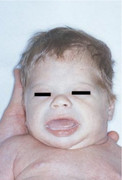
🔍 Figure: Typical facial appearance in congenital hypothyroidism: puffy eyelids, coarse facies, macroglossia (enlarged tongue), dry skin. Umbilical hernia is often present. This infant is hypotonic with prolonged jaundice.
💡 Examiner instruction (interactive): The candidate will be asked to identify signs of congenital hypothyroidism, discuss the importance of newborn screening (heel prick), describe the thyroid axis (TSH, fT4), outline treatment (levothyroxine, starting dose, monitoring), and discuss prognosis with early vs. delayed treatment. Candidate must also address parental counseling, including the need for lifelong therapy.
🔍 Examiner Questions (interactive) – Click to reveal model answers
❓ Q1 (Examiner): “Based on the image and scenario, what is the most likely diagnosis? List at least five clinical features that support it.”
✅ Candidate's answer:
• Diagnosis: Congenital hypothyroidism (CH).
• Clinical features (6-week-old):
1️⃣ Prolonged unconjugated hyperbilirubinemia (jaundice >2 weeks)
2️⃣ Macroglossia (enlarged protruding tongue)
3️⃣ Hypotonia (floppy baby)
4️⃣ Large anterior fontanel and delayed bone age
5️⃣ Umbilical hernia
6️⃣ Constipation, poor feeding, lethargy
7️⃣ Hoarse cry, dry skin, mottled/cool extremities
8️⃣ Coarse facial features (puffy eyes, flat nasal bridge)
• Diagnosis: Congenital hypothyroidism (CH).
• Clinical features (6-week-old):
1️⃣ Prolonged unconjugated hyperbilirubinemia (jaundice >2 weeks)
2️⃣ Macroglossia (enlarged protruding tongue)
3️⃣ Hypotonia (floppy baby)
4️⃣ Large anterior fontanel and delayed bone age
5️⃣ Umbilical hernia
6️⃣ Constipation, poor feeding, lethargy
7️⃣ Hoarse cry, dry skin, mottled/cool extremities
8️⃣ Coarse facial features (puffy eyes, flat nasal bridge)
❓ Q2 (Examiner): “How is congenital hypothyroidism screened in the newborn period? When should it be done?”
✅ Candidate's answer:
• Method: Heel prick dried blood spot (Guthrie card).
• Analytes: TSH (primary marker) or total T4 with reflex TSH. Most programs use TSH alone.
• Timing: 48 hours to 7 days after birth (optimal at 72 hours). Avoid before 24 hours (false high TSH due to birth surge).
• Cut-off: TSH >20-40 mIU/L (varies by lab) triggers recall for confirmatory serum TSH and free T4.
• If newborn screen is abnormal → immediate venous sampling (TSH, fT4).
• Goal: Treatment initiated by 2 weeks of age to prevent neurodevelopmental impairment.
• Method: Heel prick dried blood spot (Guthrie card).
• Analytes: TSH (primary marker) or total T4 with reflex TSH. Most programs use TSH alone.
• Timing: 48 hours to 7 days after birth (optimal at 72 hours). Avoid before 24 hours (false high TSH due to birth surge).
• Cut-off: TSH >20-40 mIU/L (varies by lab) triggers recall for confirmatory serum TSH and free T4.
• If newborn screen is abnormal → immediate venous sampling (TSH, fT4).
• Goal: Treatment initiated by 2 weeks of age to prevent neurodevelopmental impairment.
❓ Q3 (Examiner): “What are the causes of congenital hypothyroidism? Which is most common?”
✅ Candidate's answer:
• Primary CH (thyroid gland problem) – 85-90% of cases:
- Thyroid dysgenesis (80%): agenesis (absence), ectopic (lingual/sublingual), hypoplasia.
- Thyroid dyshormonogenesis (10-15%): inborn errors of thyroid hormone synthesis (TPO, TG, DUOX2, NIS mutations).
• Secondary/central CH (5%): pituitary or hypothalamic defect (TSH deficiency, TRH deficiency) – usually associated with other pituitary hormone deficiencies.
• Transient CH: maternal iodine deficiency/excess, maternal antithyroid drugs (methimazole, PTU), maternal TSH receptor blocking antibodies.
• Most common cause: Thyroid dysgenesis (especially ectopic thyroid).
• Primary CH (thyroid gland problem) – 85-90% of cases:
- Thyroid dysgenesis (80%): agenesis (absence), ectopic (lingual/sublingual), hypoplasia.
- Thyroid dyshormonogenesis (10-15%): inborn errors of thyroid hormone synthesis (TPO, TG, DUOX2, NIS mutations).
• Secondary/central CH (5%): pituitary or hypothalamic defect (TSH deficiency, TRH deficiency) – usually associated with other pituitary hormone deficiencies.
• Transient CH: maternal iodine deficiency/excess, maternal antithyroid drugs (methimazole, PTU), maternal TSH receptor blocking antibodies.
• Most common cause: Thyroid dysgenesis (especially ectopic thyroid).
❓ Q4 (Examiner): “What confirmatory tests would you order in this 6-week-old infant?”
✅ Candidate's answer:
• Serum thyroid function tests:
- TSH (elevated, usually >50-100 mIU/L)
- Free T4 (low, <0.8 ng/dL)
- Total T4 (low)
• Additional tests to determine etiology (not mandatory for immediate treatment):
- Thyroid ultrasound (to detect agenesis, ectopic thyroid, hypoplasia)
- 99mTc pertechnetate or 123I thyroid scan (if diagnosis unclear) – helps locate ectopic tissue.
- Serum thyroglobulin (low in agenesis, high in dyshormonogenesis).
• Skeletal survey (X-ray knee or wrist): delayed bone age (absent distal femoral epiphysis at birth).
• If central hypothyroidism suspected: workup for other pituitary hormones (ACTH, cortisol, GH, prolactin).
• Serum thyroid function tests:
- TSH (elevated, usually >50-100 mIU/L)
- Free T4 (low, <0.8 ng/dL)
- Total T4 (low)
• Additional tests to determine etiology (not mandatory for immediate treatment):
- Thyroid ultrasound (to detect agenesis, ectopic thyroid, hypoplasia)
- 99mTc pertechnetate or 123I thyroid scan (if diagnosis unclear) – helps locate ectopic tissue.
- Serum thyroglobulin (low in agenesis, high in dyshormonogenesis).
• Skeletal survey (X-ray knee or wrist): delayed bone age (absent distal femoral epiphysis at birth).
• If central hypothyroidism suspected: workup for other pituitary hormones (ACTH, cortisol, GH, prolactin).
❓ Q5 (Examiner): “What is the radiological finding in untreated congenital hypothyroidism? Which X-ray is most informative?”
✅ Candidate's answer:
• Epiphyseal dysgenesis (stippled or fragmented epiphyses) – most characteristic.
• Delayed bone age: at birth, distal femoral epiphysis (>5 mm) should be present in term infant – absent in severe CH.
• Best X-ray: Anteroposterior view of the left knee or wrist. Look for:
- Absent distal femoral ossification center (normal term >5 mm)
- Irregular, stippled appearance of epiphyses
• Other signs: Wormian bones in skull, narrow spinal canal, "bullet-shaped" vertebrae in older infants.
• Clinical relevance: Delayed bone age indicates prolonged intrauterine hypothyroidism and correlates with risk of intellectual impairment.
• Epiphyseal dysgenesis (stippled or fragmented epiphyses) – most characteristic.
• Delayed bone age: at birth, distal femoral epiphysis (>5 mm) should be present in term infant – absent in severe CH.
• Best X-ray: Anteroposterior view of the left knee or wrist. Look for:
- Absent distal femoral ossification center (normal term >5 mm)
- Irregular, stippled appearance of epiphyses
• Other signs: Wormian bones in skull, narrow spinal canal, "bullet-shaped" vertebrae in older infants.
• Clinical relevance: Delayed bone age indicates prolonged intrauterine hypothyroidism and correlates with risk of intellectual impairment.
❓ Q6 (Examiner): “How do you treat congenital hypothyroidism? What is the starting dose and how is it adjusted?”
✅ Candidate's answer:
• Drug: Levothyroxine (synthetic L-thyroxine, T4).
• Starting dose:
- 10-15 mcg/kg/day (typically 50-75 mcg/day for term infant).
- Once daily, crushed tablet mixed with breast milk/formula/water.
• Monitoring: Check TSH and free T4 every 1-2 months in first 6 months, then every 3 months until 3 years, then every 6-12 months.
• Goal: TSH 0.5-2.0 mIU/L, free T4 in upper half of normal range (10-22 pmol/L).
• Dose adjustment: Based on TSH and free T4; typical maintenance dose ~3-5 mcg/kg/day after infancy.
• Warning: Do not use T3-only preparations; do not over-supplement (risk of craniosynostosis and irritability).
• Lifelong treatment required.
• Drug: Levothyroxine (synthetic L-thyroxine, T4).
• Starting dose:
- 10-15 mcg/kg/day (typically 50-75 mcg/day for term infant).
- Once daily, crushed tablet mixed with breast milk/formula/water.
• Monitoring: Check TSH and free T4 every 1-2 months in first 6 months, then every 3 months until 3 years, then every 6-12 months.
• Goal: TSH 0.5-2.0 mIU/L, free T4 in upper half of normal range (10-22 pmol/L).
• Dose adjustment: Based on TSH and free T4; typical maintenance dose ~3-5 mcg/kg/day after infancy.
• Warning: Do not use T3-only preparations; do not over-supplement (risk of craniosynostosis and irritability).
• Lifelong treatment required.
❓ Q7 (Examiner): “What is the prognosis for intellectual outcome in congenital hypothyroidism? How does treatment timing affect it?”
✅ Candidate's answer:
• Excellent prognosis if treatment initiated within first 2-3 weeks of life: normal IQ (mean 100-110).
• Delayed treatment (>3 months) → lower IQ, impaired attention, language delay, fine motor deficits.
• Severe delays if untreated: profound intellectual disability (IQ <50), spastic diplegia, deafness, growth failure (cretinism).
• Factors affecting outcome: severity of CH (ectopic vs agenesis), dose adequacy, socioeconomic status.
• Even with early treatment, subtle deficits: slightly lower performance IQ, visuospatial skills, and processing speed compared to siblings.
• Importance of newborn screening: prevents irreversible brain damage.
• Excellent prognosis if treatment initiated within first 2-3 weeks of life: normal IQ (mean 100-110).
• Delayed treatment (>3 months) → lower IQ, impaired attention, language delay, fine motor deficits.
• Severe delays if untreated: profound intellectual disability (IQ <50), spastic diplegia, deafness, growth failure (cretinism).
• Factors affecting outcome: severity of CH (ectopic vs agenesis), dose adequacy, socioeconomic status.
• Even with early treatment, subtle deficits: slightly lower performance IQ, visuospatial skills, and processing speed compared to siblings.
• Importance of newborn screening: prevents irreversible brain damage.
❓ Q8 (Examiner): “What are the important differential diagnoses for an infant presenting with prolonged jaundice, hypotonia, and macroglossia?”
✅ Candidate's answer:
• Down syndrome (trisomy 21): hypotonia, macroglossia, flat facies, upslanting palpebral fissures, simian crease.
• Beckwith-Wiedemann syndrome: macroglossia, omphalocele, visceromegaly, neonatal hypoglycemia.
• Mucopolysaccharidoses (e.g., Hurler syndrome): coarse facies, macroglossia, hernias, but later onset (>6 months).
• Pompe disease (glycogen storage type II): cardiomegaly, macroglossia, hypotonia, cardiomyopathy.
• Biliary atresia / prolonged neonatal hepatitis: conjugated hyperbilirubinemia, but not hypotonia or macroglossia.
• Idiopathic hypotonia / cerebral palsy.
• Thyroid function tests differentiate CH.
• Down syndrome (trisomy 21): hypotonia, macroglossia, flat facies, upslanting palpebral fissures, simian crease.
• Beckwith-Wiedemann syndrome: macroglossia, omphalocele, visceromegaly, neonatal hypoglycemia.
• Mucopolysaccharidoses (e.g., Hurler syndrome): coarse facies, macroglossia, hernias, but later onset (>6 months).
• Pompe disease (glycogen storage type II): cardiomegaly, macroglossia, hypotonia, cardiomyopathy.
• Biliary atresia / prolonged neonatal hepatitis: conjugated hyperbilirubinemia, but not hypotonia or macroglossia.
• Idiopathic hypotonia / cerebral palsy.
• Thyroid function tests differentiate CH.
❓ Q9 (Examiner): “What signs of congenital hypothyroidism may be present at birth or in the first week?”
✅ Candidate's answer:
• Most infants are asymptomatic at birth. Clinical signs develop over weeks.
• Early clues (first week):
- Prolonged hyperbilirubinemia (direct and indirect)
- Poor feeding / lethargy
- Large fontanel (>3 cm)
- Respiratory distress (large tongue, poor muscle tone)
- Hypothermia, bradycardia
- Delayed passage of meconium / constipation
- Hypoglycemia
• On physical exam: coarse features, umbilical hernia (rarely at birth), immature facies.
• Most infants are asymptomatic at birth. Clinical signs develop over weeks.
• Early clues (first week):
- Prolonged hyperbilirubinemia (direct and indirect)
- Poor feeding / lethargy
- Large fontanel (>3 cm)
- Respiratory distress (large tongue, poor muscle tone)
- Hypothermia, bradycardia
- Delayed passage of meconium / constipation
- Hypoglycemia
• On physical exam: coarse features, umbilical hernia (rarely at birth), immature facies.
❓ Q10 (Examiner): “How is newborn thyroid screening interpreted in preterm infants? Any special considerations?”
✅ Candidate's answer:
• Preterm infants (especially <32 weeks) have a delayed TSH surge and sometimes transient hypothyroxinemia.
• Approach: Perform screening test at 48-72 hours, but repeat at 2-4 weeks of age (or at discharge) because initial screen may be falsely normal even in true CH.
• Low T4 with normal TSH: transient hypothyroxinemia of prematurity – not treated unless TSH elevated.
• TSH cutoff: For very preterm infants, a lower TSH threshold (e.g., >20 mIU/L) may prompt recall; regional guidelines vary.
• Central hypothyroidism is more common in prematurity (especially with intraventricular hemorrhage).
• Liberal retesting is recommended.
• Preterm infants (especially <32 weeks) have a delayed TSH surge and sometimes transient hypothyroxinemia.
• Approach: Perform screening test at 48-72 hours, but repeat at 2-4 weeks of age (or at discharge) because initial screen may be falsely normal even in true CH.
• Low T4 with normal TSH: transient hypothyroxinemia of prematurity – not treated unless TSH elevated.
• TSH cutoff: For very preterm infants, a lower TSH threshold (e.g., >20 mIU/L) may prompt recall; regional guidelines vary.
• Central hypothyroidism is more common in prematurity (especially with intraventricular hemorrhage).
• Liberal retesting is recommended.
❓ Q11 (Examiner): “How does the treatment of central hypothyroidism differ from primary CH?”
✅ Candidate's answer:
• Central CH (low T4 with low/normal TSH) → due to pituitary/hypothalamic defect.
• Treatment: Levothyroxine dose is similar (10-15 mcg/kg/day).
• Monitoring: Cannot rely on TSH; use free T4 (goal mid-upper normal range).
• Critical issue: Must evaluate for other pituitary hormone deficiencies, especially ACTH deficiency (adrenal crisis). Start levothyroxine only after confirming normal cortisol or after covering with hydrocortisone (because T4 increases cortisol metabolism and can precipitate adrenal crisis).
• Associations: septo-optic dysplasia, midline defects, hypopituitarism.
• Central CH (low T4 with low/normal TSH) → due to pituitary/hypothalamic defect.
• Treatment: Levothyroxine dose is similar (10-15 mcg/kg/day).
• Monitoring: Cannot rely on TSH; use free T4 (goal mid-upper normal range).
• Critical issue: Must evaluate for other pituitary hormone deficiencies, especially ACTH deficiency (adrenal crisis). Start levothyroxine only after confirming normal cortisol or after covering with hydrocortisone (because T4 increases cortisol metabolism and can precipitate adrenal crisis).
• Associations: septo-optic dysplasia, midline defects, hypopituitarism.
❓ Q12 (Examiner): “The mother asks: 'Will my baby be normal?' How will you counsel her?”
✅ Candidate's structured answer:
• Empathize: “I understand you are very worried. Your baby has a condition called congenital hypothyroidism – the thyroid gland is not making enough thyroid hormone, which is essential for brain development and growth.”
• “The good news is that this condition is treatable. We will start a daily medication (thyroxine tablet) immediately. It is safe, inexpensive, and replaces the missing hormone exactly.”
• “If we start treatment now and keep the levels normal, your baby’s brain development will be normal. Most children lead completely normal lives, go to regular school, and have normal intelligence.”
• “We will monitor her blood every few months to adjust the dose. She will need medication for life, but it is just one small tablet a day.”
• “Some minor challenges may include slightly slower growth or attention issues, but early treatment prevents severe disability.”
• “I will also order an ultrasound of the thyroid and a bone age X-ray to understand the cause.”
• “You are doing the right thing by bringing her now – we will catch up.”
• Empathize: “I understand you are very worried. Your baby has a condition called congenital hypothyroidism – the thyroid gland is not making enough thyroid hormone, which is essential for brain development and growth.”
• “The good news is that this condition is treatable. We will start a daily medication (thyroxine tablet) immediately. It is safe, inexpensive, and replaces the missing hormone exactly.”
• “If we start treatment now and keep the levels normal, your baby’s brain development will be normal. Most children lead completely normal lives, go to regular school, and have normal intelligence.”
• “We will monitor her blood every few months to adjust the dose. She will need medication for life, but it is just one small tablet a day.”
• “Some minor challenges may include slightly slower growth or attention issues, but early treatment prevents severe disability.”
• “I will also order an ultrasound of the thyroid and a bone age X-ray to understand the cause.”
• “You are doing the right thing by bringing her now – we will catch up.”
❓ Q13 (Examiner): “What complications occur if the levothyroxine dose is too high or too low?”
✅ Candidate's answer:
• Over-treatment (iatrogenic hyperthyroidism): irritability, poor sleep, tachycardia, hypertension, poor weight gain, craniosynostosis (premature fusion of sutures), advanced bone age → short adult stature.
• Under-treatment (persistent hypothyroidism): continued poor growth, developmental delay, intellectual impairment, constipation, cold intolerance, bradycardia, anemia, delayed puberty, poor school performance.
• Monitoring is essential: maintain TSH in reference range (0.5-2.0) and fT4 upper half.
• Over-treatment (iatrogenic hyperthyroidism): irritability, poor sleep, tachycardia, hypertension, poor weight gain, craniosynostosis (premature fusion of sutures), advanced bone age → short adult stature.
• Under-treatment (persistent hypothyroidism): continued poor growth, developmental delay, intellectual impairment, constipation, cold intolerance, bradycardia, anemia, delayed puberty, poor school performance.
• Monitoring is essential: maintain TSH in reference range (0.5-2.0) and fT4 upper half.
❓ Q14 (Examiner): “Can dietary iodine deficiency cause congenital hypothyroidism in the newborn? How is it prevented?”
✅ Candidate's answer:
• Yes, severe maternal iodine deficiency causes fetal hypothyroidism (endemic cretinism).
• The fetus depends on maternal iodine for thyroid hormone synthesis in first trimester.
• Prevention: Universal salt iodization (at least 15 ppm iodine in table salt) and iodine supplementation for pregnant/lactating women (150-250 mcg/day).
• In iodine-deficient regions, infants may have transient hypothyroidism even with normal newborn screen; consider repeat testing.
• Excess iodine (antiseptics, amiodarone, contrast dyes) can also cause transient CH (Wolff-Chaikoff effect).
• Yes, severe maternal iodine deficiency causes fetal hypothyroidism (endemic cretinism).
• The fetus depends on maternal iodine for thyroid hormone synthesis in first trimester.
• Prevention: Universal salt iodization (at least 15 ppm iodine in table salt) and iodine supplementation for pregnant/lactating women (150-250 mcg/day).
• In iodine-deficient regions, infants may have transient hypothyroidism even with normal newborn screen; consider repeat testing.
• Excess iodine (antiseptics, amiodarone, contrast dyes) can also cause transient CH (Wolff-Chaikoff effect).
❓ Q15 (Examiner): “What long-term follow-up is required for a child with congenital hypothyroidism?”
✅ Candidate's answer:
• Regular endocrine follow-up every 3-6 months until 3 years, then annually.
• Growth monitoring (height, weight, head circumference).
• Neurodevelopmental assessment (early intervention if delays).
• Hearing test (sensorineural hearing loss in severe CH).
• Thyroid ultrasound if cause unknown (to detect ectopic thyroid).
• Adherence counseling for lifelong medication.
• Transition to adult care at age 18-20 years.
• In girls with CH (especially dyshormonogenesis), monitor for thyroid goiter, and future pregnancy planning (increase levothyroxine by 30-50% as soon as pregnancy confirmed).
• Regular endocrine follow-up every 3-6 months until 3 years, then annually.
• Growth monitoring (height, weight, head circumference).
• Neurodevelopmental assessment (early intervention if delays).
• Hearing test (sensorineural hearing loss in severe CH).
• Thyroid ultrasound if cause unknown (to detect ectopic thyroid).
• Adherence counseling for lifelong medication.
• Transition to adult care at age 18-20 years.
• In girls with CH (especially dyshormonogenesis), monitor for thyroid goiter, and future pregnancy planning (increase levothyroxine by 30-50% as soon as pregnancy confirmed).
🗣️ Examiner's probing / high-yield points:
• "What is the most common cause of permanent CH?" → Thyroid dysgenesis (ectopic thyroid).
• "What is the earliest sign of CH in the first week?" → Prolonged jaundice (unconjugated).
• "What is the rule for starting levothyroxine?" → Start immediately after confirmation, even before imaging.
• "What X‑ray finding is pathognomonic?" → Epiphyseal dysgenesis/stippled epiphyses.
• "In which condition should you NOT start levothyroxine before cortisol replacement?" → Central hypothyroidism with suspected ACTH deficiency.
• "What is the target TSH range on treatment?" → 0.5-2.0 mIU/L.
• "What is the most common cause of permanent CH?" → Thyroid dysgenesis (ectopic thyroid).
• "What is the earliest sign of CH in the first week?" → Prolonged jaundice (unconjugated).
• "What is the rule for starting levothyroxine?" → Start immediately after confirmation, even before imaging.
• "What X‑ray finding is pathognomonic?" → Epiphyseal dysgenesis/stippled epiphyses.
• "In which condition should you NOT start levothyroxine before cortisol replacement?" → Central hypothyroidism with suspected ACTH deficiency.
• "What is the target TSH range on treatment?" → 0.5-2.0 mIU/L.
📘 Congenital Hypothyroidism – Core Revision for TOACS
🔍 Definition
Deficient thyroid hormone production at birth; most common cause of preventable intellectual disability. Incidence 1:2,000-1:4,000.
Deficient thyroid hormone production at birth; most common cause of preventable intellectual disability. Incidence 1:2,000-1:4,000.
🧬 Etiology
Primary (85-90%): dysgenesis (ectopic/agenesis) > dyshormonogenesis. Secondary (central): TSH deficiency, associated with pituitary anomalies.
Primary (85-90%): dysgenesis (ectopic/agenesis) > dyshormonogenesis. Secondary (central): TSH deficiency, associated with pituitary anomalies.
🩺 Clinical Features
Prolonged jaundice, macroglossia, umbilical hernia, large fontanel, hypotonia, constipation, hoarse cry, delayed bone age.
Prolonged jaundice, macroglossia, umbilical hernia, large fontanel, hypotonia, constipation, hoarse cry, delayed bone age.
📋 Newborn Screening
Heel prick at 48-72h: TSH (primary) or T4+TSH. Confirm with serum TSH, fT4. Goal: treat by 2 weeks of age.
Heel prick at 48-72h: TSH (primary) or T4+TSH. Confirm with serum TSH, fT4. Goal: treat by 2 weeks of age.
💊 Treatment
Levothyroxine 10-15 mcg/kg/day (50-75 mcg daily for term infant). Crushed tablet, lifelong. Monitor TSH (0.5-2.0) and fT4.
Levothyroxine 10-15 mcg/kg/day (50-75 mcg daily for term infant). Crushed tablet, lifelong. Monitor TSH (0.5-2.0) and fT4.
📈 Prognosis
Normal IQ if treated <3 weeks. Delayed treatment → intellectual disability, spastic diplegia, hearing loss.
Normal IQ if treated <3 weeks. Delayed treatment → intellectual disability, spastic diplegia, hearing loss.
⭐ High-yield pearls for TOACS (Congenital Hypothyroidism):
• Most common cause: Ectopic thyroid (thyroid dysgenesis).
• Pathognomonic X-ray finding: Epiphyseal dysgenesis (stippled epiphyses).
• Do NOT delay treatment for imaging – start levothyroxine immediately after confirmatory labs.
• In central hypothyroidism, rule out adrenal insufficiency before starting levothyroxine.
• TSH is not reliable for monitoring in central hypothyroidism – use fT4.
• Newborn screening prevents cretinism – golden hour of treatment.
• Most common cause: Ectopic thyroid (thyroid dysgenesis).
• Pathognomonic X-ray finding: Epiphyseal dysgenesis (stippled epiphyses).
• Do NOT delay treatment for imaging – start levothyroxine immediately after confirmatory labs.
• In central hypothyroidism, rule out adrenal insufficiency before starting levothyroxine.
• TSH is not reliable for monitoring in central hypothyroidism – use fT4.
• Newborn screening prevents cretinism – golden hour of treatment.
🗣️ Candidate's role-play & examiner feedback
💬 To the candidate (role‑play): You will be asked the 15 questions from the Examiner Q&A tab (including identification, newborn screening, confirmatory tests, bone age, levothyroxine dosing, prognosis, central vs primary CH, and parental counseling). Provide concise, evidence‑based answers. Demonstrate empathy when counseling the mother about lifelong therapy and excellent outcomes with early treatment. Know the importance of epiphyseal dysgenesis on X‑ray.
📝 Examiner Marking Grid (Congenital Hypothyroidism – TOACS station):
- ✅ Recognizes the clinical picture (macroglossia, umbilical hernia, hypotonia, prolonged jaundice)
- ✅ Describes newborn screening method (heel prick TSH) and optimal timing (48-72h)
- ✅ Orders confirmatory serum TSH and free T4
- ✅ Mentions X‑ray knee for bone age and epiphyseal dysgenesis
- ✅ Prescribes levothyroxine with correct starting dose (10-15 mcg/kg/day)
- ✅ Explains need for immediate treatment (by 2 weeks) to prevent intellectual disability
- ✅ Distinguishes primary from central CH (TSH low/normal in central)
- ✅ Counsels mother effectively (reassurance, lifelong medication, good prognosis)
- ✅ Discusses monitoring (TSH, fT4 every 1-3 months initially)
- ✅ Mentions complications of overtreatment (craniosynostosis, advanced bone age)
📚 Key references: Nelson Textbook of Pediatrics 22e (Chapter 598 – Hypothyroidism), American Academy of Pediatrics newborn screening guidelines, CPSP guidelines for congenital hypothyroidism management, ESPE consensus guidelines.