FCPS MCPS IMM MD Paediatrics TOACS
Observed Station | CPSP Format | 8 minutes
⏱️ TIME REMAINING
08:00
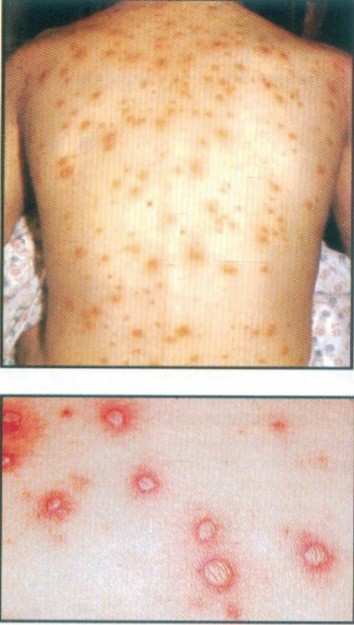
❓ Q1. Identify the skin condition shown in the image. Describe its characteristic rash pattern.
✅ Model Answer: • Condition: Varicella (chickenpox) – primary infection with varicella-zoster virus (VZV).
• Rash pattern: Pruritic vesicular rash that appears in crops (waves), with lesions in various stages (macules → vesicles → pustules → crusts). The rash has a centripetal distribution – more lesions on the trunk than on the extremities. Classically described as "dewdrop on a rose petal" (vesicle on an erythematous base).
• Rash pattern: Pruritic vesicular rash that appears in crops (waves), with lesions in various stages (macules → vesicles → pustules → crusts). The rash has a centripetal distribution – more lesions on the trunk than on the extremities. Classically described as "dewdrop on a rose petal" (vesicle on an erythematous base).
❓ Q2. What is the etiologic agent of varicella? How is it transmitted?
✅ Model Answer: • Etiologic agent: Varicella-zoster virus (VZV) – a human herpesvirus (HHV-3) that is a double-stranded DNA virus.
• Transmission: Respiratory droplets (coughing, sneezing) and direct contact with vesicular fluid from skin lesions.
• Incubation period: 14-16 days (range 10-21 days).
• Contagious period: 1-2 days before the rash appears until all lesions are crusted (about 5-7 days after rash onset).
• Transmission: Respiratory droplets (coughing, sneezing) and direct contact with vesicular fluid from skin lesions.
• Incubation period: 14-16 days (range 10-21 days).
• Contagious period: 1-2 days before the rash appears until all lesions are crusted (about 5-7 days after rash onset).
❓ Q3. What are the clinical features of varicella in a healthy child?
✅ Model Answer: • Clinical features:
- Prodrome: Mild fever, malaise, headache, anorexia, and upper respiratory symptoms (1-2 days before rash).
- Rash: Pruritic vesicular rash in crops; lesions appear on the trunk first (centripetal), then spread to the face and extremities.
- Lesion stages: Simultaneous presence of macules, papules, vesicles ("dewdrop on rose petal"), pustules, and crusts.
- Mucous membrane involvement: Enanthem (vesicles on oral mucosa, conjunctiva, or genital mucosa).
- Duration: New lesions appear for 3-5 days; crusts fall off in 1-2 weeks.
- Fever: Usually low-grade, peaks with the first crop of lesions.
- Prodrome: Mild fever, malaise, headache, anorexia, and upper respiratory symptoms (1-2 days before rash).
- Rash: Pruritic vesicular rash in crops; lesions appear on the trunk first (centripetal), then spread to the face and extremities.
- Lesion stages: Simultaneous presence of macules, papules, vesicles ("dewdrop on rose petal"), pustules, and crusts.
- Mucous membrane involvement: Enanthem (vesicles on oral mucosa, conjunctiva, or genital mucosa).
- Duration: New lesions appear for 3-5 days; crusts fall off in 1-2 weeks.
- Fever: Usually low-grade, peaks with the first crop of lesions.
❓ Q4. What is the "dew-drop on a rose petal" sign in varicella?
✅ Model Answer: • "Dew-drop on a rose petal": A classic description of the varicella vesicle – a clear, fluid-filled vesicle (the "dew-drop") sitting on an erythematous base (the "rose petal").
• This appearance is characteristic of the early vesicular stage of varicella lesions.
• The vesicle is superficial, fragile, and easily ruptures, leading to crust formation.
• This sign helps distinguish varicella from other vesicular rashes.
• This appearance is characteristic of the early vesicular stage of varicella lesions.
• The vesicle is superficial, fragile, and easily ruptures, leading to crust formation.
• This sign helps distinguish varicella from other vesicular rashes.
❓ Q5. What is the incubation period and contagious period of varicella?
✅ Model Answer: • Incubation period: 14-16 days (range 10-21 days) from exposure to symptom onset.
• Contagious period: 1-2 days before the rash appears (during the prodrome) until all lesions are crusted (usually 5-7 days after rash onset).
• Transmission: Most contagious during the first 24-48 hours of the rash when vesicles are active.
• Isolation: Children should be kept away from school/daycare until all lesions are crusted.
• Contagious period: 1-2 days before the rash appears (during the prodrome) until all lesions are crusted (usually 5-7 days after rash onset).
• Transmission: Most contagious during the first 24-48 hours of the rash when vesicles are active.
• Isolation: Children should be kept away from school/daycare until all lesions are crusted.
❓ Q6. What is the management of varicella in a healthy immunocompetent child?
✅ Model Answer: • Management (healthy child):
- Supportive care: Antipyretics (acetaminophen or ibuprofen). Avoid aspirin – risk of Reye syndrome.
- Pruritus control: Oral antihistamines (diphenhydramine, cetirizine), calamine lotion, oatmeal baths.
- Skin hygiene: Keep nails short, use cool compresses, avoid scratching to prevent secondary bacterial infection.
- Hydration: Encourage fluids to prevent dehydration.
- Isolation: Keep child at home until all lesions are crusted (usually 5-7 days).
- No antiviral therapy is routinely recommended for healthy children.
- Supportive care: Antipyretics (acetaminophen or ibuprofen). Avoid aspirin – risk of Reye syndrome.
- Pruritus control: Oral antihistamines (diphenhydramine, cetirizine), calamine lotion, oatmeal baths.
- Skin hygiene: Keep nails short, use cool compresses, avoid scratching to prevent secondary bacterial infection.
- Hydration: Encourage fluids to prevent dehydration.
- Isolation: Keep child at home until all lesions are crusted (usually 5-7 days).
- No antiviral therapy is routinely recommended for healthy children.
❓ Q7. When is antiviral therapy (acyclovir) indicated for varicella?
✅ Model Answer: • Indications for acyclovir therapy:
- Adolescents (>12 years) and adults.
- Immunocompromised patients (HIV, malignancy, chemotherapy, organ transplant, long-term steroids).
- Chronic lung disease or cystic fibrosis.
- Chronic skin disorders (eczema, severe dermatoses).
- Pregnant women (especially near term).
- Severe disease: High fever, extensive rash, or systemic symptoms.
- Dose: Oral acyclovir 20 mg/kg/dose (max 800 mg) QID for 5 days. Started within 24-48 hours of rash onset for maximum benefit.
- Adolescents (>12 years) and adults.
- Immunocompromised patients (HIV, malignancy, chemotherapy, organ transplant, long-term steroids).
- Chronic lung disease or cystic fibrosis.
- Chronic skin disorders (eczema, severe dermatoses).
- Pregnant women (especially near term).
- Severe disease: High fever, extensive rash, or systemic symptoms.
- Dose: Oral acyclovir 20 mg/kg/dose (max 800 mg) QID for 5 days. Started within 24-48 hours of rash onset for maximum benefit.
❓ Q8. What are the complications of varicella?
✅ Model Answer: • Complications:
- Secondary bacterial infection: Most common – Group A Streptococcus (GAS), Staphylococcus aureus (including MRSA) → impetigo, cellulitis, abscess, necrotizing fasciitis.
- Pneumonia: Varicella pneumonia – more common in adults, immunocompromised, and pregnant women.
- Encephalitis: Cerebellar ataxia is the most common neurologic complication (reversible).
- Hepatitis: Mild transaminitis; severe hepatitis rare.
- Thrombocytopenia.
- Reye syndrome: Associated with aspirin use during varicella (avoid aspirin in children).
- Necrotizing fasciitis (rare, but life-threatening).
- Congenital varicella syndrome (maternal infection in early pregnancy).
- Secondary bacterial infection: Most common – Group A Streptococcus (GAS), Staphylococcus aureus (including MRSA) → impetigo, cellulitis, abscess, necrotizing fasciitis.
- Pneumonia: Varicella pneumonia – more common in adults, immunocompromised, and pregnant women.
- Encephalitis: Cerebellar ataxia is the most common neurologic complication (reversible).
- Hepatitis: Mild transaminitis; severe hepatitis rare.
- Thrombocytopenia.
- Reye syndrome: Associated with aspirin use during varicella (avoid aspirin in children).
- Necrotizing fasciitis (rare, but life-threatening).
- Congenital varicella syndrome (maternal infection in early pregnancy).
❓ Q9. What is the role of the varicella vaccine in prevention?
✅ Model Answer: • Varicella vaccine: A live-attenuated vaccine (Oka strain).
- Schedule: 2 doses: first at 12-15 months, second at 4-6 years (at least 3 months apart).
- Effectiveness: ~85% effective against any varicella, >95% effective against severe disease.
- Breakthrough infection: Can occur in vaccinated children, but illness is mild (fewer lesions, no fever).
- Contraindications: Severe immunodeficiency, pregnancy, severe allergy to vaccine components (neomycin, gelatin).
- Post-exposure prophylaxis: Vaccine may be given within 3-5 days of exposure to prevent or attenuate disease.
- VZIG: Varicella-zoster immune globulin for high-risk exposed patients (immunocompromised, pregnant, neonates).
- Schedule: 2 doses: first at 12-15 months, second at 4-6 years (at least 3 months apart).
- Effectiveness: ~85% effective against any varicella, >95% effective against severe disease.
- Breakthrough infection: Can occur in vaccinated children, but illness is mild (fewer lesions, no fever).
- Contraindications: Severe immunodeficiency, pregnancy, severe allergy to vaccine components (neomycin, gelatin).
- Post-exposure prophylaxis: Vaccine may be given within 3-5 days of exposure to prevent or attenuate disease.
- VZIG: Varicella-zoster immune globulin for high-risk exposed patients (immunocompromised, pregnant, neonates).
❓ Q10. What is the difference between varicella and herpes zoster (shingles)?
✅ Model Answer: • Varicella (chickenpox): Primary infection with VZV. Generalized vesicular rash in crops, centripetal distribution, fever, and malaise. Occurs mostly in children.
• Herpes zoster (shingles): Reactivation of latent VZV from dorsal root ganglia. Unilateral, dermatomal vesicular rash (painful), usually in adults or immunocompromised. Preceded by pain/burning in the dermatome. Contagious to non-immune individuals (can cause varicella).
• Both caused by the same virus (VZV).
• Varicella is contagious via respiratory droplets; zoster is contagious via contact with vesicular fluid.
• Herpes zoster (shingles): Reactivation of latent VZV from dorsal root ganglia. Unilateral, dermatomal vesicular rash (painful), usually in adults or immunocompromised. Preceded by pain/burning in the dermatome. Contagious to non-immune individuals (can cause varicella).
• Both caused by the same virus (VZV).
• Varicella is contagious via respiratory droplets; zoster is contagious via contact with vesicular fluid.
❓ Q11. What are the high-risk groups for severe varicella?
✅ Model Answer: • High-risk groups for severe disease:
- Adolescents and adults (higher risk of pneumonia).
- Immunocompromised patients: HIV/AIDS, malignancy, chemotherapy, organ transplant, long-term corticosteroids.
- Pregnant women (especially third trimester – risk of severe pneumonia; fetal varicella syndrome in first trimester).
- Neonates: Especially if maternal varicella occurs 5 days before to 2 days after delivery.
- Chronic lung disease.
- Chronic skin disorders (eczema, burns) – risk of severe secondary bacterial infection.
- Children on aspirin therapy (risk of Reye syndrome).
- Adolescents and adults (higher risk of pneumonia).
- Immunocompromised patients: HIV/AIDS, malignancy, chemotherapy, organ transplant, long-term corticosteroids.
- Pregnant women (especially third trimester – risk of severe pneumonia; fetal varicella syndrome in first trimester).
- Neonates: Especially if maternal varicella occurs 5 days before to 2 days after delivery.
- Chronic lung disease.
- Chronic skin disorders (eczema, burns) – risk of severe secondary bacterial infection.
- Children on aspirin therapy (risk of Reye syndrome).
❓ Q12. What is the differential diagnosis of a vesicular rash in children?
✅ Model Answer: • Differential diagnoses:
- Varicella (chickenpox): Vesicles in crops, centripetal, lesions in various stages.
- Herpes zoster (shingles): Unilateral, dermatomal, painful vesicles.
- Herpes simplex (HSV): Grouped vesicles on erythematous base, often perioral or genital, recurrent.
- Impetigo: Honey-crusted lesions, no vesicles, usually localized.
- Hand-foot-and-mouth disease (Coxsackievirus): Vesicles on palms, soles, and oral mucosa; no crusting.
- Molluscum contagiosum: Umbilicated papules, no vesicles.
- Contact dermatitis: Vesicles, but history of exposure to irritant/allergen.
- Scabies: Vesicles, papules, burrows, intense nocturnal pruritus; family contacts affected.
- Varicella (chickenpox): Vesicles in crops, centripetal, lesions in various stages.
- Herpes zoster (shingles): Unilateral, dermatomal, painful vesicles.
- Herpes simplex (HSV): Grouped vesicles on erythematous base, often perioral or genital, recurrent.
- Impetigo: Honey-crusted lesions, no vesicles, usually localized.
- Hand-foot-and-mouth disease (Coxsackievirus): Vesicles on palms, soles, and oral mucosa; no crusting.
- Molluscum contagiosum: Umbilicated papules, no vesicles.
- Contact dermatitis: Vesicles, but history of exposure to irritant/allergen.
- Scabies: Vesicles, papules, burrows, intense nocturnal pruritus; family contacts affected.
❓ Q13. How would you counsel the parents of a child with varicella?
✅ Model Answer: • "Your child has chickenpox, a common viral infection. It causes an itchy rash with fluid-filled blisters."
• "The rash will come in waves – new spots may appear for several days. The lesions will blister, crust over, and then heal."
• "Keep your child home from school/daycare until all the lesions are crusted (usually 5-7 days)."
• "Give acetaminophen or ibuprofen for fever – but do not use aspirin (risk of Reye syndrome)."
• "For the itching, give oral antihistamines, apply calamine lotion, and give cool oatmeal baths. Keep nails trimmed to prevent scratching."
• "Watch for signs of complications: redness/swelling around lesions (secondary infection), difficulty breathing, confusion, or high fever. Contact us immediately if these occur."
• "If your child is not vaccinated, this infection provides lifelong immunity. For future prevention, consider the varicella vaccine for other children."
• "The rash will come in waves – new spots may appear for several days. The lesions will blister, crust over, and then heal."
• "Keep your child home from school/daycare until all the lesions are crusted (usually 5-7 days)."
• "Give acetaminophen or ibuprofen for fever – but do not use aspirin (risk of Reye syndrome)."
• "For the itching, give oral antihistamines, apply calamine lotion, and give cool oatmeal baths. Keep nails trimmed to prevent scratching."
• "Watch for signs of complications: redness/swelling around lesions (secondary infection), difficulty breathing, confusion, or high fever. Contact us immediately if these occur."
• "If your child is not vaccinated, this infection provides lifelong immunity. For future prevention, consider the varicella vaccine for other children."
❓ Q14. What is Reye syndrome and how is it related to varicella?
✅ Model Answer: • Reye syndrome: A rare but life-threatening condition characterized by acute encephalopathy and fatty liver (hepatic failure).
• Association with varicella: Reye syndrome is strongly associated with aspirin use during viral infections, especially varicella and influenza.
• Pathogenesis: Aspirin (salicylate) causes mitochondrial dysfunction and impairs fatty acid oxidation, leading to hepatic encephalopathy.
• Clinical features: Vomiting, confusion, lethargy, seizures, coma, elevated ammonia and transaminases.
• Prevention: Do not use aspirin in children with fever or viral infections (use acetaminophen or ibuprofen).
• Mortality: High if not recognized early; supportive care is the mainstay.
• Association with varicella: Reye syndrome is strongly associated with aspirin use during viral infections, especially varicella and influenza.
• Pathogenesis: Aspirin (salicylate) causes mitochondrial dysfunction and impairs fatty acid oxidation, leading to hepatic encephalopathy.
• Clinical features: Vomiting, confusion, lethargy, seizures, coma, elevated ammonia and transaminases.
• Prevention: Do not use aspirin in children with fever or viral infections (use acetaminophen or ibuprofen).
• Mortality: High if not recognized early; supportive care is the mainstay.
❓ Q15. What is the role of VZIG (varicella-zoster immune globulin) in varicella?
✅ Model Answer: • VZIG (Varicella-Zoster Immune Globulin): A passive immunization containing high-titer antibodies against VZV.
• Indications: Given to high-risk individuals (immunocompromised, pregnant women, neonates) who have been significantly exposed to varicella and are susceptible (no history of varicella or vaccination).
• Timing: Most effective if given within 96 hours (preferably within 48 hours) of exposure.
• Benefits: Can prevent or attenuate varicella in high-risk patients.
• Limitations: Not effective once the rash has appeared. Does not replace active immunization (varicella vaccine).
• Indications: Given to high-risk individuals (immunocompromised, pregnant women, neonates) who have been significantly exposed to varicella and are susceptible (no history of varicella or vaccination).
• Timing: Most effective if given within 96 hours (preferably within 48 hours) of exposure.
• Benefits: Can prevent or attenuate varicella in high-risk patients.
• Limitations: Not effective once the rash has appeared. Does not replace active immunization (varicella vaccine).
📋 Mock Test Feedback
💡 Examiner's note: Compare your answers with model answers. In real TOACS, you would discuss these with the examiner.