⚕️ FCPS MCOS IMM MD Paediatrics TOACS · Mock Test
X-ray Hands · 8-Minute Observed Station
📚 paeds.online
⏱️ TIME REMAINING
08:00
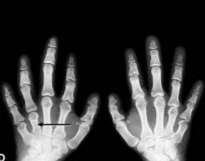
A 10‑year‑old child presents with short stature,
❓ Q1. Describe the radiographic findings. What is the most likely diagnosis?
✅ Model Answer:
• Shortening of 4th and 5th metacarpals (most characteristic).
• Brachydactyly – shortened fingers (especially ring and little fingers).
• Positive metacarpal sign – a line drawn across the heads of the 4th and 5th metacarpals does not meet.
• Short metacarpals – distal ends do not reach the normal line.
• Normal metacarpal 3 – helps highlight shortening of 4th and 5th.
• Diagnosis: Pseudohypoparathyroidism (PHP1a – Albright hereditary osteodystrophy).
• Shortening of 4th and 5th metacarpals (most characteristic).
• Brachydactyly – shortened fingers (especially ring and little fingers).
• Positive metacarpal sign – a line drawn across the heads of the 4th and 5th metacarpals does not meet.
• Short metacarpals – distal ends do not reach the normal line.
• Normal metacarpal 3 – helps highlight shortening of 4th and 5th.
• Diagnosis: Pseudohypoparathyroidism (PHP1a – Albright hereditary osteodystrophy).
❓ Q2. What is the "positive metacarpal sign" and how is it assessed?
✅ Model Answer:
• The metacarpal sign (Archibald's sign) is a clinical and radiographic sign used to assess shortening of the 4th and 5th metacarpals.
• Assessment: A line is drawn connecting the heads of the 4th and 5th metacarpals. In a normal hand, this line will intersect the head of the 3rd metacarpal.
• Positive metacarpal sign: If the line drawn between the heads of the 4th and 5th metacarpals does NOT intersect the 3rd metacarpal head, it is considered positive.
• A positive metacarpal sign indicates shortening of the 4th and 5th metacarpals.
• It is a characteristic finding in pseudohypoparathyroidism (PHP1a), Turner syndrome, and other conditions.
• The sign is best appreciated on a PA view of the hand.
• The metacarpal sign (Archibald's sign) is a clinical and radiographic sign used to assess shortening of the 4th and 5th metacarpals.
• Assessment: A line is drawn connecting the heads of the 4th and 5th metacarpals. In a normal hand, this line will intersect the head of the 3rd metacarpal.
• Positive metacarpal sign: If the line drawn between the heads of the 4th and 5th metacarpals does NOT intersect the 3rd metacarpal head, it is considered positive.
• A positive metacarpal sign indicates shortening of the 4th and 5th metacarpals.
• It is a characteristic finding in pseudohypoparathyroidism (PHP1a), Turner syndrome, and other conditions.
• The sign is best appreciated on a PA view of the hand.
❓ Q3. What is the pathophysiology of pseudohypoparathyroidism type 1a (PHP1a)?
✅ Model Answer:
• PHP1a is caused by GNAS gene mutations (maternal allele) → Gsα deficiency.
• Gsα is the alpha subunit of the stimulatory G protein, which is essential for the action of PTH, TSH, and other hormones that signal through G protein-coupled receptors.
• In PHP1a, the end organs (kidney, bone) are resistant to PTH → hypocalcemia, hyperphosphatemia, elevated PTH.
• Patients also have resistance to TSH (subclinical hypothyroidism), gonadotropins (hypogonadism), and other hormones.
• This results in the clinical features of Albright hereditary osteodystrophy (AHO): short stature, round face, brachydactyly, subcutaneous calcifications, and obesity.
• Key concept: PHP1a is a form of pseudohypoparathyroidism where PTH is elevated but the target tissues are unresponsive.
• PHP1a is caused by GNAS gene mutations (maternal allele) → Gsα deficiency.
• Gsα is the alpha subunit of the stimulatory G protein, which is essential for the action of PTH, TSH, and other hormones that signal through G protein-coupled receptors.
• In PHP1a, the end organs (kidney, bone) are resistant to PTH → hypocalcemia, hyperphosphatemia, elevated PTH.
• Patients also have resistance to TSH (subclinical hypothyroidism), gonadotropins (hypogonadism), and other hormones.
• This results in the clinical features of Albright hereditary osteodystrophy (AHO): short stature, round face, brachydactyly, subcutaneous calcifications, and obesity.
• Key concept: PHP1a is a form of pseudohypoparathyroidism where PTH is elevated but the target tissues are unresponsive.
❓ Q4. What are the clinical features of Albright hereditary osteodystrophy (AHO)?
✅ Model Answer:
• Albright hereditary osteodystrophy (AHO) is the phenotype associated with PHP1a and pseudopseudohypoparathyroidism (PPHP).
• Features:
1. Short stature: Growth retardation.
2. Round face: Moon-like facies.
3. Brachydactyly: Shortening of the 4th and 5th metacarpals (and sometimes phalanges).
4. Subcutaneous calcifications: Soft tissue ossifications (especially in the skin and subcutaneous tissues).
5. Obesity: Early-onset weight gain.
6. Dental anomalies: Enamel hypoplasia, delayed eruption.
7. Neurodevelopmental delay: Mild cognitive impairment in some cases.
8. Associated: Hypocalcemia, hyperphosphatemia, elevated PTH (in PHP1a).
• In PPHP: AHO features are present, but calcium and PTH are normal (no PTH resistance).
• Albright hereditary osteodystrophy (AHO) is the phenotype associated with PHP1a and pseudopseudohypoparathyroidism (PPHP).
• Features:
1. Short stature: Growth retardation.
2. Round face: Moon-like facies.
3. Brachydactyly: Shortening of the 4th and 5th metacarpals (and sometimes phalanges).
4. Subcutaneous calcifications: Soft tissue ossifications (especially in the skin and subcutaneous tissues).
5. Obesity: Early-onset weight gain.
6. Dental anomalies: Enamel hypoplasia, delayed eruption.
7. Neurodevelopmental delay: Mild cognitive impairment in some cases.
8. Associated: Hypocalcemia, hyperphosphatemia, elevated PTH (in PHP1a).
• In PPHP: AHO features are present, but calcium and PTH are normal (no PTH resistance).
❓ Q5. How does PHP1a differ from pseudopseudohypoparathyroidism (PPHP)?
✅ Model Answer:
| Feature | PHP1a | PPHP |
|---|---|---|
| GNAS mutation | Maternal allele | Paternal allele |
| AHO features | Present | Present |
| PTH resistance | Yes | No |
| Calcium | Low | Normal |
| PTH | Elevated | Normal |
| Treatment | Calcium + calcitriol | None (reassurance) |
❓ Q6. A child with PHP1a presents with hypocalcemia and seizures. What is the acute management?
✅ Model Answer:
• Hypocalcemia in PHP1a is due to PTH resistance.
• Acute management:
1. IV calcium gluconate 10%: 100 mg/kg (1-2 mL/kg) IV over 10-20 minutes, with ECG monitoring.
2. If seizures persist: Repeat calcium bolus or continuous IV calcium infusion (50-100 mg/kg/day).
3. Oral calcium: Calcium carbonate or calcium citrate (1000-1500 mg/day elemental calcium).
4. Calcitriol (1,25-dihydroxyvitamin D): 0.5-2 mcg/day (to improve calcium absorption).
5. Monitor serum calcium: q4-6h until stable.
6. Avoid: Thiazide diuretics (can worsen hypercalcemia) and phosphate supplementation (already elevated).
7. Long-term: Maintain calcium levels with oral calcium and calcitriol.
• Hypocalcemia in PHP1a is due to PTH resistance.
• Acute management:
1. IV calcium gluconate 10%: 100 mg/kg (1-2 mL/kg) IV over 10-20 minutes, with ECG monitoring.
2. If seizures persist: Repeat calcium bolus or continuous IV calcium infusion (50-100 mg/kg/day).
3. Oral calcium: Calcium carbonate or calcium citrate (1000-1500 mg/day elemental calcium).
4. Calcitriol (1,25-dihydroxyvitamin D): 0.5-2 mcg/day (to improve calcium absorption).
5. Monitor serum calcium: q4-6h until stable.
6. Avoid: Thiazide diuretics (can worsen hypercalcemia) and phosphate supplementation (already elevated).
7. Long-term: Maintain calcium levels with oral calcium and calcitriol.
❓ Q7. What is the role of calcitriol in the management of PHP1a?
✅ Model Answer:
• Calcitriol is the active form of vitamin D (1,25-dihydroxyvitamin D).
• In PHP1a, calcitriol is used to increase intestinal calcium absorption and improve bone mineralization.
• Dose: 0.5-2 mcg/day (titrated to maintain normal calcium levels).
• Advantages:
- Bypasses the need for renal 1-alpha-hydroxylase (which is PTH-dependent).
- Effective in raising calcium levels.
- Reduces the risk of hyperphosphatemia.
• Monitoring: Check serum calcium and urinary calcium to avoid hypercalcemia and nephrocalcinosis.
• Long-term: Lifelong therapy is required.
• Calcitriol is the active form of vitamin D (1,25-dihydroxyvitamin D).
• In PHP1a, calcitriol is used to increase intestinal calcium absorption and improve bone mineralization.
• Dose: 0.5-2 mcg/day (titrated to maintain normal calcium levels).
• Advantages:
- Bypasses the need for renal 1-alpha-hydroxylase (which is PTH-dependent).
- Effective in raising calcium levels.
- Reduces the risk of hyperphosphatemia.
• Monitoring: Check serum calcium and urinary calcium to avoid hypercalcemia and nephrocalcinosis.
• Long-term: Lifelong therapy is required.
❓ Q8. A child with PHP1a develops hypothyroidism. What is the management?
✅ Model Answer:
• Hypothyroidism in PHP1a is due to TSH resistance (also caused by Gsα deficiency).
• Management:
1. Levothyroxine therapy: Start at 50-75 mcg/m²/day (adjusted based on TSH and free T4).
2. Monitoring: TSH and free T4 every 3-6 months (target TSH in the normal range).
3. Consider: Higher starting doses may be needed due to TSH resistance.
4. Follow-up: Regular growth monitoring, clinical evaluation.
5. Avoid: Overtreatment (hyperthyroidism symptoms).
• Hypothyroidism in PHP1a is due to TSH resistance (also caused by Gsα deficiency).
• Management:
1. Levothyroxine therapy: Start at 50-75 mcg/m²/day (adjusted based on TSH and free T4).
2. Monitoring: TSH and free T4 every 3-6 months (target TSH in the normal range).
3. Consider: Higher starting doses may be needed due to TSH resistance.
4. Follow-up: Regular growth monitoring, clinical evaluation.
5. Avoid: Overtreatment (hyperthyroidism symptoms).
❓ Q9. A child with PHP1a has short stature and obesity. What is the management?
✅ Model Answer:
• Short stature and obesity are part of the AHO phenotype (not directly treatable with hormonal therapy).
• Management:
1. Growth hormone (GH) therapy: Some children may benefit from GH therapy, but response is variable.
2. Nutritional counseling: Healthy diet and physical activity to manage obesity.
3. Monitor growth: Plot height and weight on growth charts regularly.
4. Endocrine evaluation: Assess for other hormone deficiencies (growth hormone, thyroid, gonadotropins).
5. Multidisciplinary approach: Endocrinology, nutrition, and psychology support.
• Short stature and obesity are part of the AHO phenotype (not directly treatable with hormonal therapy).
• Management:
1. Growth hormone (GH) therapy: Some children may benefit from GH therapy, but response is variable.
2. Nutritional counseling: Healthy diet and physical activity to manage obesity.
3. Monitor growth: Plot height and weight on growth charts regularly.
4. Endocrine evaluation: Assess for other hormone deficiencies (growth hormone, thyroid, gonadotropins).
5. Multidisciplinary approach: Endocrinology, nutrition, and psychology support.
❓ Q10. How do you differentiate PHP1a from primary hypoparathyroidism?
✅ Model Answer:
| Feature | PHP1a | Primary Hypoparathyroidism |
|---|---|---|
| PTH level | Elevated | Low or undetectable |
| Calcium | Low | Low |
| Phosphorus | High | High |
| AHO features | Present | Absent |
| X-ray | Brachydactyly (short 4th/5th MC) | Normal |
⚠️ Key concept: Brachydactyly with shortening of the 4th and 5th metacarpals is a classic skeletal finding in pseudohypoparathyroidism (PHP) type 1a
(Albright hereditary osteodystrophy).
This is caused by GNAS mutations leading to Gsα deficiency and PTH resistance.
📋 Mock Test Feedback
💡 Examiner's note: Compare your answers with the model answers. In real TOACS, you would discuss these with the examiner.