💨 FCPS Paediatrics TOACS · Inhaler & Spacer Technique (Child)
📖 Nelson's Chapter 185 – Childhood Asthma · pMDI + Spacer · Tidal Breathing
📚 paeds.online – Paeds Online
🩺 OBSERVED/INTERACTIVE STATION · CPSP FORMAT · 8 MINUTES · TEACH INHALER TECHNIQUE TO CARER · pMDI + SPACER + MASK (CHILD 2 YEARS)
📋 Observed Station – “Teach a mother how to use pMDI + spacer + face mask for her 2-year-old with viral-induced wheeze”
👶🏻 Clinical Scenario (TOACS – read aloud / displayed):
A 2-year-old boy with recurrent viral-induced wheeze has been prescribed salbutamol (100 mcg/puff) via a pressurised metered dose inhaler (pMDI) with a spacer and face mask. He is not acutely wheezy today. The mother is anxious and says, “I’m not sure I’m giving the puffer correctly. Can you show me how to use the spacer and mask?”
🎯 Task (examiner observed): Using a demonstration spacer with mask and placebo inhaler, teach the mother the correct technique for administering one puff of salbutamol to her toddler. Explain why a spacer is necessary, how to position the child, the number of breaths (tidal breathing), waiting time between puffs, and post-inhalation care. Also discuss spacer cleaning and replacement.
📸 Spacer + Mask Image (for reference):
A 2-year-old boy with recurrent viral-induced wheeze has been prescribed salbutamol (100 mcg/puff) via a pressurised metered dose inhaler (pMDI) with a spacer and face mask. He is not acutely wheezy today. The mother is anxious and says, “I’m not sure I’m giving the puffer correctly. Can you show me how to use the spacer and mask?”
🎯 Task (examiner observed): Using a demonstration spacer with mask and placebo inhaler, teach the mother the correct technique for administering one puff of salbutamol to her toddler. Explain why a spacer is necessary, how to position the child, the number of breaths (tidal breathing), waiting time between puffs, and post-inhalation care. Also discuss spacer cleaning and replacement.
📸 Spacer + Mask Image (for reference):
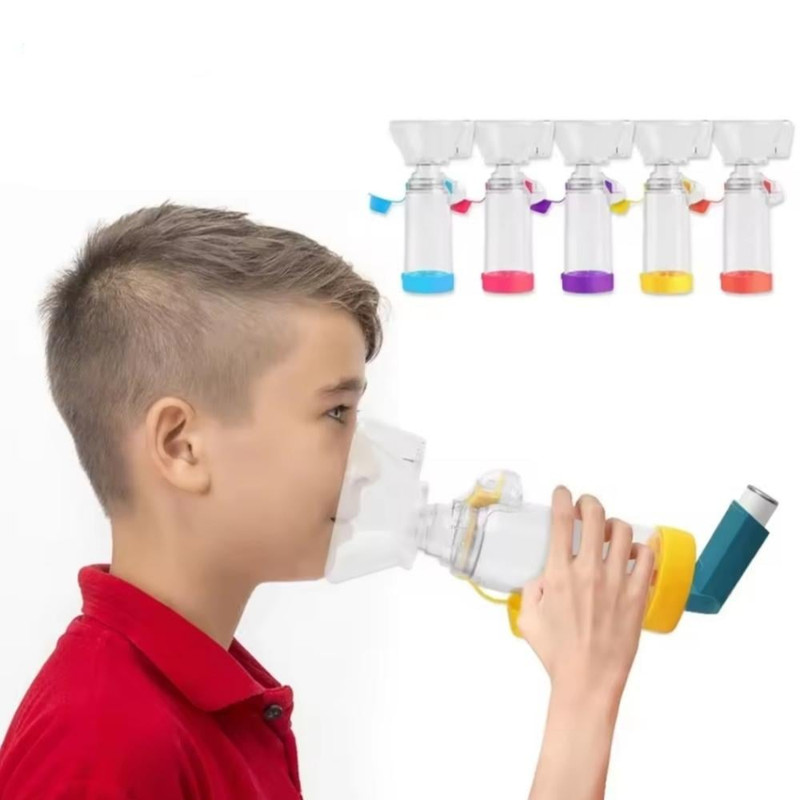
Figure: Correct use of pMDI with spacer and face mask in a young child (tidal breathing). Mask should form a tight seal over nose and mouth.
🔑 KEY TEACHING POINTS (to verbalize to mother):
• Spacer ensures more medicine reaches the lungs, less sticks in mouth/throat → reduces thrush and hoarseness.
• For children <3-4 years, use face mask; older children can use mouthpiece.
• Steps: 1) Shake inhaler, 2) Insert into spacer, 3) Place mask over nose/mouth (good seal), 4) Press canister ONCE, 5) Encourage 5–6 slow tidal breaths (watch valve move), 6) Wait 30-60 seconds before second puff, 7) Wash face / rinse mouth after steroid inhaler.
• Clean spacer monthly with warm soapy water, air dry (no towel → static). Replace every 6–12 months.
• Spacer ensures more medicine reaches the lungs, less sticks in mouth/throat → reduces thrush and hoarseness.
• For children <3-4 years, use face mask; older children can use mouthpiece.
• Steps: 1) Shake inhaler, 2) Insert into spacer, 3) Place mask over nose/mouth (good seal), 4) Press canister ONCE, 5) Encourage 5–6 slow tidal breaths (watch valve move), 6) Wait 30-60 seconds before second puff, 7) Wash face / rinse mouth after steroid inhaler.
• Clean spacer monthly with warm soapy water, air dry (no towel → static). Replace every 6–12 months.
💡 Examiner instruction: Candidate must demonstrate empathy, use teach-back method, show correct assembly, shaking, priming if needed, actuation, tidal breathing count (5 breaths), cleaning advice, and trouble-shoot common errors (no seal, child crying, rapid breathing, whistling). Reference National Asthma Council Australia and Asthma+Lung UK guidelines.
🧼 Correct Technique: pMDI + Spacer + Face Mask (Child < 4 years)
1 Prepare device
Remove caps from inhaler and spacer. Assemble spacer, attach face mask. Check expiry date.
Remove caps from inhaler and spacer. Assemble spacer, attach face mask. Check expiry date.
2 Shake inhaler
Shake pMDI for 3-5 seconds (4-5 times). If new or unused >7 days, prime with 2-4 actuations into air (away from face).
Shake pMDI for 3-5 seconds (4-5 times). If new or unused >7 days, prime with 2-4 actuations into air (away from face).
3 Insert inhaler
Place pMDI upright into back of spacer. Ensure canister is vertical.
Place pMDI upright into back of spacer. Ensure canister is vertical.
4 Position child
Sit child upright on lap or chair. Comfortable, calm. If distressed, cradle and reassure.
Sit child upright on lap or chair. Comfortable, calm. If distressed, cradle and reassure.
5 Apply mask
Place mask over child’s nose and mouth, ensuring a good seal (no gaps). Avoid covering eyes.
Place mask over child’s nose and mouth, ensuring a good seal (no gaps). Avoid covering eyes.
6 Actuate once
Press canister firmly once to release one puff into spacer. Only ONE puff at a time.
Press canister firmly once to release one puff into spacer. Only ONE puff at a time.
7 Tidal breathing
Encourage child to breathe in and out normally (through mouth) for 5–6 breaths (or 10 seconds). Watch valve click.
Encourage child to breathe in and out normally (through mouth) for 5–6 breaths (or 10 seconds). Watch valve click.
8 Repeat if needed
If second puff prescribed, wait 30-60 seconds, shake inhaler again, repeat steps 5-7.
If second puff prescribed, wait 30-60 seconds, shake inhaler again, repeat steps 5-7.
9 Aftercare
Remove mask, wipe child’s face and rinse mouth (if steroid inhaler). Replace caps.
Remove mask, wipe child’s face and rinse mouth (if steroid inhaler). Replace caps.
10 Spacer care
Wash spacer monthly in warm soapy water, air dry without rinsing. Replace every 6-12 months.
Wash spacer monthly in warm soapy water, air dry without rinsing. Replace every 6-12 months.
⚠️ COMMON ERRORS TO CORRECT:
• Not shaking inhaler between puffs.
• Firing more than one puff into spacer at a time (dose stacking reduces effectiveness).
• Poor mask seal → medicine leaks, reduced lung delivery.
• Child breathing too fast (whistle sound on small-volume spacers) → slow down.
• Not waiting between puffs (need 30-60 seconds for valve to re-open and aerosol to settle).
• Using spacer without cleaning → static charge sticks medicine to walls.
• Not shaking inhaler between puffs.
• Firing more than one puff into spacer at a time (dose stacking reduces effectiveness).
• Poor mask seal → medicine leaks, reduced lung delivery.
• Child breathing too fast (whistle sound on small-volume spacers) → slow down.
• Not waiting between puffs (need 30-60 seconds for valve to re-open and aerosol to settle).
• Using spacer without cleaning → static charge sticks medicine to walls.
🎥 VIDEO RESOURCES (for parent education):
• National Asthma Council Australia – puffer with spacer for children
• Asthma+Lung UK – Spacer without mask (older child)
• Asthma+Lung UK – Spacer tidal breathing technique
• National Asthma Council Australia – puffer with spacer for children
• Asthma+Lung UK – Spacer without mask (older child)
• Asthma+Lung UK – Spacer tidal breathing technique
🗨️ Examiner Q&A · Spacer Use · Age-appropriate Devices · Troubleshooting
❓ Q1 (Examiner): “Why is a spacer recommended for delivering pMDI medication to a young child?”
✅ Spacer reduces oropharyngeal deposition, increases lung deposition (from ~10% to ~20-30%), and eliminates need for hand-breath coordination. It reduces local side effects (oral thrush, hoarse voice) and systemic absorption. For young children who cannot coordinate actuation with inhalation, spacer with mask is essential.
❓ Q2 (Examiner): “What is the correct age for switching from mask to mouthpiece spacer?”
✅ Typically 3–4 years of age (some guidelines say 4-5 years). Child should be able to form a tight seal around mouthpiece, breathe tidally through mouth, and cooperate. Assess individually; children with developmental delay may need mask longer. EasyChamber® has detachable mask for same spacer.
❓ Q3 (Examiner): “How many breaths should a child take after actuation into the spacer? Why?”
✅ 5–6 tidal breaths (or 10 seconds of normal breathing). Tidal breathing (rather than deep breaths) is easier for young children and achieves adequate lung deposition. Studies show 5-6 breaths empties >90% of aerosol from spacer. Single deep breath and hold (used in older children/adults) is not feasible for toddlers.
❓ Q4 (Examiner): “How often should a spacer be cleaned? What is the correct cleaning method?”
✅ Once a month (or before first use). Disassemble spacer, wash in warm water with mild detergent, rinse with clean water, and air dry without rinsing (no cloth/paper towel which creates static charge). Do NOT put in dishwasher. Wipe mouthpiece dry before use. Replace spacer every 6–12 months or if cracked/damaged.
❓ Q5 (Examiner): “What should you do if the child cries or pulls the mask away during administration?”
✅ Stay calm. Try distraction (toy, video, singing). Cuddle child on lap, tuck arms gently. If very distressed, you may administer while child is asleep (if possible without waking). Never force mask if child fights excessively – reattempt later. Consider alternative device (e.g., nebulizer if severe symptoms). Teach parents to play with mask when child is well (familiarisation).
❓ Q6 (Examiner): “Why must you wait 30-60 seconds between puffs? Do you need to shake again?”
✅ Waiting allows the spacer valve to reset and the aerosol cloud to re-form. Shaking between puffs ensures uniform mixing of propellant and drug. For salbutamol, 30 seconds is adequate; for some corticosteroids, 60 seconds may be recommended. Always shake again before each puff.
❓ Q7 (Examiner): “What is the difference between tidal breathing (multiple breath) and single breath and hold technique? When to use each?”
✅ Tidal breathing: Child breathes normally in and out of spacer for 5-6 breaths. Used for young children (<5 years) or during acute attack when deep breath difficult. Single breath and hold: Child exhales fully, actuates, then inhales slowly and holds breath for 10 seconds. Used in older children (>6 years) and adults for optimal lung deposition. Single breath is more efficient but requires cooperation.
❓ Q8 (Examiner): “What is the role of priming a pMDI? Which inhalers need priming?”
✅ Priming releases 2-4 actuations into the air to ensure correct dose delivery. Required for new inhalers, inhalers not used for >7 days, or if dropped. After priming, the correct amount of medication is dispensed. Check patient information leaflet for specific priming instructions (some devices need 4 sprays).
❓ Q9 (Examiner): “What are the signs of poor technique with a spacer and mask?”
✅ • No valve movement (child breathing through nose or leak around mask)
• Whistling sound (breathing too fast)
• Child crying continuously (no tidal breaths)
• Mask seal broken (air leak)
• Multiple puffs actuated before breaths
• Spacer visibly cracked or static-charged (medicine coating walls)
• Not waiting between puffs
• Whistling sound (breathing too fast)
• Child crying continuously (no tidal breaths)
• Mask seal broken (air leak)
• Multiple puffs actuated before breaths
• Spacer visibly cracked or static-charged (medicine coating walls)
• Not waiting between puffs
❓ Q10 (Examiner): “When should a spacer be replaced?”
✅ Every 6–12 months or sooner if:
• Cracks or damage visible
• Valve becomes stiff or does not close properly
• Mask becomes brittle or seal compromised
• After 12 months even if looks intact (material degrades, static builds up). Some manufacturers recommend 12 months.
• Cracks or damage visible
• Valve becomes stiff or does not close properly
• Mask becomes brittle or seal compromised
• After 12 months even if looks intact (material degrades, static builds up). Some manufacturers recommend 12 months.
❓ Q11 (Examiner): “What is the difference between EasyChamber® and Volumatic® spacers? Which is preferred for young children?”
✅ EasyChamber® is anti-static (no need to pre-wash to reduce static), has detachable mask that fits the same spacer body, and is preferred by many guidelines for children. Volumatic® (large volume) may be used for older children/adults but requires regular washing to reduce static. For children <4 years, EasyChamber with mask is commonly recommended.
❓ Q12 (Examiner): “What should you advise regarding mouth rinsing/face washing after using a corticosteroid inhaler?”
✅ After using steroid (preventer) inhaler, child should rinse mouth with water and spit out (or brush teeth). For mask users, wash face with water to remove drug residue. This reduces risk of oral thrush (candidiasis) and perioral dermatitis. For reliever (salbutamol) alone, rinsing is not essential but harmless.
📢 Examiner probe: “How do you assess parental understanding?” → Use “teach-back” method: “Can you show me how you would give the medicine tonight?” Correct errors gently.
📘 Nelson's Chapter 185 · Asthma Management & Spacer Evidence
📖 Nelson's Key Points (Asthma)
Spacers improve drug delivery, reduce side effects. For acute exacerbations, give 2-4 puffs salbutamol via spacer (repeat every 20 min). For maintenance, corticosteroids via spacer with mask in young children.
Spacers improve drug delivery, reduce side effects. For acute exacerbations, give 2-4 puffs salbutamol via spacer (repeat every 20 min). For maintenance, corticosteroids via spacer with mask in young children.
🫁 Why Spacer Works
Overcomes poor hand-breath coordination. Slows aerosol velocity, reduces oropharyngeal impaction. Anti-static spacers (e.g., EasyChamber) have higher efficiency. Use single breath technique in older children.
Overcomes poor hand-breath coordination. Slows aerosol velocity, reduces oropharyngeal impaction. Anti-static spacers (e.g., EasyChamber) have higher efficiency. Use single breath technique in older children.
📊 Dose equivalence
pMDI + spacer is equivalent to nebulizer for mild-moderate exacerbations. 2-4 puffs salbutamol via spacer = 2.5 mg nebulized. Spacer preferred in outpatient/emergency setting (faster, less adverse effects).
pMDI + spacer is equivalent to nebulizer for mild-moderate exacerbations. 2-4 puffs salbutamol via spacer = 2.5 mg nebulized. Spacer preferred in outpatient/emergency setting (faster, less adverse effects).
🧼 Static electricity
New spacer may have static charge that binds drug to walls. Pre-wash with detergent reduces static. Anti-static spacers avoid this problem. Re-wash monthly to maintain low static.
New spacer may have static charge that binds drug to walls. Pre-wash with detergent reduces static. Anti-static spacers avoid this problem. Re-wash monthly to maintain low static.
🧒 Age recommendations
Mask: <3-4 years; mouthpiece: ≥4-5 years if able to form seal. For children with neuromuscular or developmental delay, mask may be continued. Always assess individual child.
Mask: <3-4 years; mouthpiece: ≥4-5 years if able to form seal. For children with neuromuscular or developmental delay, mask may be continued. Always assess individual child.
🏥 Acute asthma action
Give 4 puffs salbutamol (via spacer) every 4 hours as needed. For worsening, give 6-8 puffs and seek medical help. In hospital, spacer is as effective as nebulizer for mild-moderate attacks.
Give 4 puffs salbutamol (via spacer) every 4 hours as needed. For worsening, give 6-8 puffs and seek medical help. In hospital, spacer is as effective as nebulizer for mild-moderate attacks.
📖 Nelson's Textbook Reference: “Spacer devices are recommended for delivery of medication from a pMDI because they eliminate the need for coordination between actuation and inhalation, increase pulmonary deposition, and reduce oropharyngeal deposition. A face mask is required for young children until they can breathe reproducibly using the spacer mouthpiece.” (Nelson’s Pediatrics, Chapter on Asthma)
⭐ TOACS TAKE-HOME POINTS:
1. Always use spacer with pMDI in children.
2. Mask for <4 years; mouthpiece for older cooperative child.
3. Steps: Shake → Insert → Mask seal → One actuation → 5 tidal breaths → Wait 30s → Repeat.
4. Clean spacer monthly (soapy water, air dry). Replace yearly.
5. Wash face / rinse mouth after steroid inhaler.
6. Teach using “show me” method; correct errors calmly.
7. In acute attack, give 2-4 puffs every 20-30 min via spacer (more effective than nebulizer for mild-moderate).
1. Always use spacer with pMDI in children.
2. Mask for <4 years; mouthpiece for older cooperative child.
3. Steps: Shake → Insert → Mask seal → One actuation → 5 tidal breaths → Wait 30s → Repeat.
4. Clean spacer monthly (soapy water, air dry). Replace yearly.
5. Wash face / rinse mouth after steroid inhaler.
6. Teach using “show me” method; correct errors calmly.
7. In acute attack, give 2-4 puffs every 20-30 min via spacer (more effective than nebulizer for mild-moderate).
🔗 Online resources for candidates & parents:
• National Asthma Council Australia – video
• Asthma+Lung UK – spacer without mask
• Asthma+Lung UK – tidal breathing technique
• National Asthma Council Australia – video
• Asthma+Lung UK – spacer without mask
• Asthma+Lung UK – tidal breathing technique