🍄 TOACS FCPS Station · Hair Loss in Tinea Capitis
📷 Clinical Photograph – Tinea Capitis
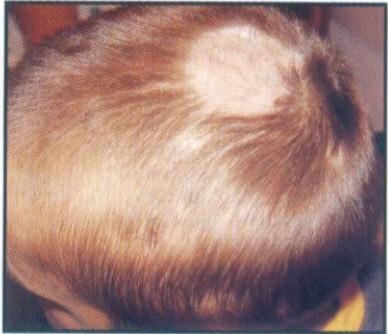
🔍 Key clinical features:
- ✓ Patchy alopecia – well-demarcated areas of hair loss
- ✓ Broken hairs ('black dots') – hairs broken off at the scalp
- ✓ Scaling and erythema – often with mild inflammation
- ✓ Kerion – boggy, tender, inflamed mass with pustules
- ✓ Most common in children – 3-7 years of age
📋 Clinical scenario (examiner prompt)
A 5‑year‑old boy is brought to the clinic with a patch of hair loss on the scalp that has been slowly enlarging over the past 2 weeks. The area is scaly and has several broken hairs at the scalp. The child has no significant medical history and has a pet dog at home. On examination, there is a well-circumscribed, scaly, hypopigmented patch with multiple broken hairs and mild erythema. No lymphadenopathy is present.
🧑⚕️ Examiner tasks · TOACS
1. Identify the diagnosis from the clinical image and context.
2. Describe the clinical features (patchy alopecia, broken hairs, scaling, erythema).
3. Explain the etiology and transmission (dermatophytes – Trichophyton tonsurans most common in US, Microsporum canis from pets).
4. Discuss diagnosis and management (KOH, Wood lamp, oral terbinafine/griseofulvin, kerion management).
🎯 Expected answers (for examiners)
- • Diagnosis: Tinea capitis (scalp ringworm)
- • Clinical features: Patchy alopecia (hair loss), broken hairs at scalp surface ('black dots'), scaling, erythema, pruritus; may have lymphadenopathy; kerion (inflammatory boggy mass with pustules) in some cases
- • Etiology: Dermatophytes: Trichophyton tonsurans (most common in US, endothrix, no fluorescence), Microsporum canis (from pets, ectothrix, green fluorescence under Wood lamp), Microsporum audouinii
- • Transmission: Direct contact with infected humans (T. tonsurans) or animals (M. canis); fomites (combs, hats, barber tools)
- • Diagnosis: Clinical; KOH prep of hair/scales (hyphae, spores); Wood lamp (green fluorescence for Microsporum); fungal culture (definitive)
- • Treatment: Systemic oral antifungals: terbinafine (weight-based x 6 weeks) or griseofulvin microsize (20-25 mg/kg/day x 8+ weeks); itraconazole or fluconazole as alternatives. Adjunctive: antifungal shampoo (selenium sulfide/ketoconazole) to reduce shedding.
- • Kerion: Systemic antifungals + short course corticosteroids (prednisone 1-2 mg/kg/day) if significant inflammation to prevent scarring
• Age: 3-7 years (most common)
• US organism: Trichophyton tonsurans (endothrix, no Wood lamp fluorescence)
• Animal source: Microsporum canis (Wood lamp positive, green fluorescence)
• Treatment: Systemic antifungals only (topicals ineffective)
• First-line: Terbinafine (6 weeks) or griseofulvin (8+ weeks)
• Kerion: Add corticosteroids to prevent scarring
⚡ Quick FCPS‑style MCQ
A 5-year-old child presents with patchy scalp hair loss, broken hairs at the scalp ('black dots'), and scaling. The most appropriate treatment is:
A. Topical clotrimazole cream B. Oral terbinafine or griseofulvin C. Selenium sulfide shampoo alone D. Oral corticosteroids alone📌 Topic summary · Tinea Capitis (Hair Loss)
Fungal infection of scalp hair follicles
Children 3-7 years
T. tonsurans (US), M. canis (pets)
KOH, Wood lamp, culture
Oral terbinafine/griseofulvin
Add corticosteroids
| Feature | Tinea Capitis |
|---|---|
| Pathogens | Trichophyton tonsurans (most common in US), Microsporum canis (pets), Microsporum audouinii |
| Transmission | Direct contact (humans/animals), fomites (combs, hats) |
| Clinical presentation | Patchy alopecia, broken hairs ('black dots'), scaling, erythema, pruritus; kerion (boggy, tender, inflamed mass with pustules) |
| Wood lamp | Green fluorescence: Microsporum canis, M. audouinii (ectothrix); no fluorescence: T. tonsurans (endothrix) |
| KOH prep | Arthrospores and hyphae within/around hair shaft |
| Treatment – First-line (T. tonsurans) | Terbinafine weight-based: 125 mg (<25 kg), 187.5 mg (25-35 kg), 250 mg (>35 kg) daily ×6 weeks |
| Treatment – Alternative (M. canis) | Griseofulvin microsize 20-25 mg/kg/day ×8+ weeks (better for Microsporum) |
| Adjunctive therapy | Selenium sulfide 2% or ketoconazole 2% shampoo twice weekly to reduce shedding |
| Kerion management | Systemic antifungals + prednisone (1-2 mg/kg/day) ×1-2 weeks to reduce inflammation and scarring |