🧫 TOACS FCPS Station · Pseudomonas Skin Infections in Newborn
📷 Clinical Photograph – Pseudomonas Skin Infection
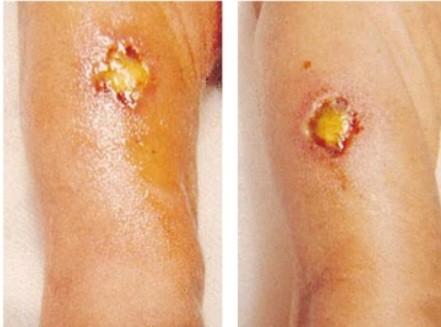
🔍 Key clinical features:
- ✓ Hemorrhagic bullae – fried egg appearence-necrotic center with surrounding inflammaton
- ✓ Necrotic ulcers with black eschar – pathognomonic for Pseudomonas septicemia (ecthyma gangrenosum)
- ✓ Rapid progression – can develop over hours
- ✓ Common sites – perineum, axillae, trunk, extremities
- ✓ Associated with neutropenia, severe sepsis – high mortality
📋 Clinical scenario (examiner prompt)
A 5‑day‑old term newborn in the NICU presents with fever, hypotension, and poor feeding. On examination, there are hemorrhagic bullae on the perineum and trunk that have progressed to necrotic ulcers with black eschar. The infant is neutropenic and has a central line in place. Blood cultures are pending.
🧑⚕️ Examiner tasks · TOACS
1. Identify the diagnosis from the clinical image and context.
2. Describe the clinical features (hemorrhagic bullae → necrotic ulcer with eschar, associated with neutropenia).
3. Explain the etiology and risk factors (Pseudomonas aeruginosa, neonatal sepsis, immunocompromise).
4. Discuss diagnosis and management (blood cultures, antipseudomonal antibiotics, surgical debridement, source control).
🎯 Expected answers (for examiners)
- • Diagnosis: Ecthyma gangrenosum (Pseudomonas aeruginosa septicemia)
- • Clinical features: Hemorrhagic bullae → necrotic ulcer with black eschar; often in neutropenic, immunocompromised patients
- • Risk factors: Neonatal sepsis, neutropenia, central venous catheter, prolonged antibiotics
- • Diagnosis: Blood cultures (Gram-negative rod), skin biopsy (if needed), cultures of lesions
- • Treatment: IV antipseudomonal beta-lactam (cefepime, meropenem, or piperacillin-tazobactam) ± aminoglycoside; remove central line; surgical debridement of necrotic tissue
• Lesions: Painless hemorrhagic bullae → necrotic ulcer with black eschar
• Pathogenesis: Pseudomonas vasculitis from septicemia
• High mortality if untreated (up to 50% in neonates)
• Prompt treatment with antipseudomonal antibiotics + source control
⚡ Quick FCPS‑style MCQ
A neonate with neutropenia and a central line develops hemorrhagic bullae that progress to necrotic ulcers with black eschar. The most likely organism is:
A. Staphylococcus aureus B. Pseudomonas aeruginosa C. Candida albicans D. Herpes simplex virus📌 Topic summary · Pseudomonas Skin Infections in Newborn
Pathognomonic for Pseudomonas sepsis
Neutropenia, NICU, central line
Blood culture, skin biopsy
IV antipseudomonal antibiotic + source control
| Feature | Pseudomonas Skin Infection (Neonate) |
|---|---|
| Organism | Pseudomonas aeruginosa |
| Classic lesion | Ecthyma gangrenosum (hemorrhagic bullae → necrotic ulcer with eschar) |
| Risk factors | Neutropenia, central line, prolonged antibiotics, NICU stay |
| Diagnosis | Blood cultures, skin culture, Gram stain (Gram-negative rods) |
| Treatment | IV cefepime, meropenem, or piperacillin-tazobactam ± aminoglycoside; remove central line; surgical debridement |
| Prognosis | High mortality if delayed; prompt treatment improves outcomes |