FCPS Paediatrics TOACS · Interactive Station
🩺 Beckwith-Wiedemann Syndrome (BWS) — Overgrowth, macrosomia, abdominal wall defect, hypoglycemia, tumor predisposition
📚 Paeds Online – paeds.online
⚕️ OBSERVED STATION · CPSP FORMAT · 8 MINUTES · SEPARATE TABS · CLINICAL PHOTO INCLUDED
📖 Problem-oriented Clinical Scenario + Photograph
👶🏻 Clinical Scenario (read aloud – 2 min):
A 2-hour-old term male infant is admitted to the neonatal unit from the delivery room. He was born at 38 weeks to a primigravida mother by spontaneous vaginal delivery. Birth weight is 4.5 kg (>97th percentile). Antenatal ultrasound showed polyhydramnios. On examination: The infant has a large anterior abdominal wall defect with a sac containing liver and intestines (omphalocele). He has macroglossia (tongue protrudes beyond the lips), earlobe creases/posterior helical pits, and facial nevus flammeus on the forehead (stork bite). He is jittery, and a bedside glucose test shows blood glucose of 28 mg/dL (1.6 mmol/L). No other dysmorphic features are noted.
A clinical photograph of the infant is shown below.
Task: Describe the findings, propose the most likely diagnosis, discuss the immediate management of hypoglycemia, and answer the examiner's questions regarding genetics, tumor surveillance, and long-term follow-up.
A 2-hour-old term male infant is admitted to the neonatal unit from the delivery room. He was born at 38 weeks to a primigravida mother by spontaneous vaginal delivery. Birth weight is 4.5 kg (>97th percentile). Antenatal ultrasound showed polyhydramnios. On examination: The infant has a large anterior abdominal wall defect with a sac containing liver and intestines (omphalocele). He has macroglossia (tongue protrudes beyond the lips), earlobe creases/posterior helical pits, and facial nevus flammeus on the forehead (stork bite). He is jittery, and a bedside glucose test shows blood glucose of 28 mg/dL (1.6 mmol/L). No other dysmorphic features are noted.
A clinical photograph of the infant is shown below.
Task: Describe the findings, propose the most likely diagnosis, discuss the immediate management of hypoglycemia, and answer the examiner's questions regarding genetics, tumor surveillance, and long-term follow-up.
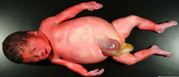
🔍 Figure: Clinical photograph showing macroglossia (large protruding tongue), large omphalocele (abdominal wall defect with herniated viscera), and macrosonic habitus. These are classic features of Beckwith-Wiedemann syndrome.
💡 Examiner instruction (interactive): The candidate will be asked to identify BWS, describe the clinical features, manage neonatal hypoglycemia (hyperinsulinism), discuss genetic etiology (11p15.5 imprinting disorders), tumor surveillance (Wilms tumor, hepatoblastoma, neuroblastoma), screening protocols, and provide parental counseling.
🔍 Examiner Questions (interactive) – Click to reveal model answers
❓ Q1 (Examiner): “What is the most likely diagnosis based on the image and clinical scenario? List the major clinical features of this syndrome.”
✅ Candidate's structured answer:
• Diagnosis: Beckwith-Wiedemann Syndrome (BWS) – an overgrowth syndrome with predisposition to embryonal tumors.
• Major features (>5 required for clinical diagnosis, or 3 if genetic/molecular confirmation):
- Macroglossia (large protruding tongue) – most characteristic.
- Omphalocele or other abdominal wall defect (diastasis recti, umbilical hernia).
- Macrosomia (birth weight >90th percentile, tall stature).
- Neonatal hypoglycemia (hyperinsulinism).
- Earlobe creases / posterior helical pits.
- Visceromegaly (hepatomegaly, splenomegaly, nephromegaly).
- Facial nevus flammeus (stork bite on forehead).
- Renal abnormalities (medullary dysplasia, nephrocalcinosis, cystic changes).
- Hemihyperplasia (asymmetric limb or organ overgrowth).
• Diagnosis: Beckwith-Wiedemann Syndrome (BWS) – an overgrowth syndrome with predisposition to embryonal tumors.
• Major features (>5 required for clinical diagnosis, or 3 if genetic/molecular confirmation):
- Macroglossia (large protruding tongue) – most characteristic.
- Omphalocele or other abdominal wall defect (diastasis recti, umbilical hernia).
- Macrosomia (birth weight >90th percentile, tall stature).
- Neonatal hypoglycemia (hyperinsulinism).
- Earlobe creases / posterior helical pits.
- Visceromegaly (hepatomegaly, splenomegaly, nephromegaly).
- Facial nevus flammeus (stork bite on forehead).
- Renal abnormalities (medullary dysplasia, nephrocalcinosis, cystic changes).
- Hemihyperplasia (asymmetric limb or organ overgrowth).
❓ Q2 (Examiner): “Describe the genetic basis of Beckwith-Wiedemann syndrome.”
✅ Candidate's answer:
• Location: BWS is caused by abnormal regulation of genes on chromosome 11p15.5 – an imprinted region (parent-of-origin specific expression).
• Key genes involved: IGF2 (promotes growth) and CDKN1C (growth inhibitor). Normally IGF2 is expressed only from paternal allele; CDKN1C from maternal allele.
• Molecular mechanisms (approximate frequencies):
- Loss of methylation at IC2 (KvDMR1) – 50% (maternal → biallelic CDKN1C silencing).
- Gain of methylation at IC1 (H19-DMR) – 5-10% (paternal → biallelic IGF2 expression).
- Paternal uniparental disomy (pUPD11) – 20% (both copies from father).
- CDKN1C mutation – 5% (usually familial, maternal inheritance).
- Unknown/rare – 5-10%.
• Inheritance: Majority (>85%) are sporadic; familial cases (autosomal dominant with imprinting) occur in 10-15%.
• Location: BWS is caused by abnormal regulation of genes on chromosome 11p15.5 – an imprinted region (parent-of-origin specific expression).
• Key genes involved: IGF2 (promotes growth) and CDKN1C (growth inhibitor). Normally IGF2 is expressed only from paternal allele; CDKN1C from maternal allele.
• Molecular mechanisms (approximate frequencies):
- Loss of methylation at IC2 (KvDMR1) – 50% (maternal → biallelic CDKN1C silencing).
- Gain of methylation at IC1 (H19-DMR) – 5-10% (paternal → biallelic IGF2 expression).
- Paternal uniparental disomy (pUPD11) – 20% (both copies from father).
- CDKN1C mutation – 5% (usually familial, maternal inheritance).
- Unknown/rare – 5-10%.
• Inheritance: Majority (>85%) are sporadic; familial cases (autosomal dominant with imprinting) occur in 10-15%.
❓ Q3 (Examiner): “The infant's blood glucose is 28 mg/dL. How do you manage the neonatal hypoglycemia in BWS?”
✅ Candidate's structured answer:
• Immediate:
1️⃣ Check point-of-care glucose.
2️⃣ If symptomatic (jittery, lethargy, apnea, seizures): IV 10% dextrose 2 mL/kg bolus followed by continuous infusion at 6-8 mg/kg/min.
3️⃣ If asymptomatic: Early frequent feeds (breast milk or formula) q2-3h; monitor glucose before feeds.
4️⃣ Target glucose: Maintain >50 mg/dL (2.8 mmol/L) for first 48 hours.
• Persistent hypoglycemia (hyperinsulinism):
- Diazoxide (5-15 mg/kg/day) – first-line for hyperinsulinemic hypoglycemia.
- Hydrochlorothiazide (adjunct).
- Octreotide or nifedipine – second-line if diazoxide refractory.
- Near-total pancreatectomy – for severe, medically refractory hyperinsulinism (rare in BWS).
• Monitoring: Frequent glucose checks until stable (usually resolves within days to weeks but may persist for months).
• Immediate:
1️⃣ Check point-of-care glucose.
2️⃣ If symptomatic (jittery, lethargy, apnea, seizures): IV 10% dextrose 2 mL/kg bolus followed by continuous infusion at 6-8 mg/kg/min.
3️⃣ If asymptomatic: Early frequent feeds (breast milk or formula) q2-3h; monitor glucose before feeds.
4️⃣ Target glucose: Maintain >50 mg/dL (2.8 mmol/L) for first 48 hours.
• Persistent hypoglycemia (hyperinsulinism):
- Diazoxide (5-15 mg/kg/day) – first-line for hyperinsulinemic hypoglycemia.
- Hydrochlorothiazide (adjunct).
- Octreotide or nifedipine – second-line if diazoxide refractory.
- Near-total pancreatectomy – for severe, medically refractory hyperinsulinism (rare in BWS).
• Monitoring: Frequent glucose checks until stable (usually resolves within days to weeks but may persist for months).
❓ Q4 (Examiner): “How do you manage the omphalocele in a newborn with BWS?”
✅ Candidate's answer:
• Immediate: Cover the sac with sterile, moist, non-adherent dressing. Avoid rupture. Place orogastric tube to decompress stomach.
• Evaluate contents – usually liver and intestines; assess for other associated anomalies (cardiac, renal).
• Surgical repair:
- Small omphalocele (silo): Primary closure in operating room.
- Large omphalocele (giant): Staged closure with prosthetic silo (mesh) followed by delayed primary closure, or conservative management (epithelialization then delayed repair at 6-12 months).
• Pre-op care: IV fluids, prophylactic antibiotics, monitor for sac rupture, infection.
• Outcome: Excellent if isolated; BWS patients do well post-surgery.
• Immediate: Cover the sac with sterile, moist, non-adherent dressing. Avoid rupture. Place orogastric tube to decompress stomach.
• Evaluate contents – usually liver and intestines; assess for other associated anomalies (cardiac, renal).
• Surgical repair:
- Small omphalocele (silo): Primary closure in operating room.
- Large omphalocele (giant): Staged closure with prosthetic silo (mesh) followed by delayed primary closure, or conservative management (epithelialization then delayed repair at 6-12 months).
• Pre-op care: IV fluids, prophylactic antibiotics, monitor for sac rupture, infection.
• Outcome: Excellent if isolated; BWS patients do well post-surgery.
❓ Q5 (Examiner): “What is the cancer risk in Beckwith-Wiedemann syndrome? Which tumors are most common?”
✅ Candidate's answer:
• Cumulative cancer risk: Approximately 7-10% by age 8 years (higher than general population). Highest risk in first 2 years of life.
• Most common tumors (in order of frequency):
1️⃣ Wilms tumor (nephroblastoma) – 40-50% of BWS-associated cancers.
2️⃣ Hepatoblastoma – 20-25% (most in first 2 years).
3️⃣ Neuroblastoma – 5-10%.
4️⃣ Adrenocortical carcinoma – 5%.
5️⃣ Rhabdomyosarcoma, leukemia, pancreaticoblastoma – less common.
• Risk varies by molecular subtype: pUPD11 and IC1 gain of methylation have highest tumor risk (up to 20-30%); IC2 loss of methylation has lower risk (~2-5%).
• Cumulative cancer risk: Approximately 7-10% by age 8 years (higher than general population). Highest risk in first 2 years of life.
• Most common tumors (in order of frequency):
1️⃣ Wilms tumor (nephroblastoma) – 40-50% of BWS-associated cancers.
2️⃣ Hepatoblastoma – 20-25% (most in first 2 years).
3️⃣ Neuroblastoma – 5-10%.
4️⃣ Adrenocortical carcinoma – 5%.
5️⃣ Rhabdomyosarcoma, leukemia, pancreaticoblastoma – less common.
• Risk varies by molecular subtype: pUPD11 and IC1 gain of methylation have highest tumor risk (up to 20-30%); IC2 loss of methylation has lower risk (~2-5%).
❓ Q6 (Examiner): “What is the recommended tumor surveillance protocol for a child with BWS?”
✅ Candidate's answer (based on consensus guidelines):
• Abdominal ultrasound (US) every 3 months until age 7 years (or age 8 years if high-risk molecular subtype).
- Screen for Wilms tumor (kidneys) and hepatoblastoma (liver).
- Also assess for neuroblastoma (adrenals) and renal medullary cysts.
• Serum alpha-fetoprotein (AFP) – every 3 months until age 4 years (for hepatoblastoma screening).
- Note: AFP is normally elevated in infancy; use age-adjusted normal ranges.
• Physical examination – every 3-4 months to assess for abdominal masses, hemihyperplasia progression.
• Blood pressure monitoring – for Wilms tumor associated hypertension.
• Frequency: Every 3-4 months for US and AFP until age 4; US alone until age 7-8.
• No routine screening for other tumors due to low incidence.
• Abdominal ultrasound (US) every 3 months until age 7 years (or age 8 years if high-risk molecular subtype).
- Screen for Wilms tumor (kidneys) and hepatoblastoma (liver).
- Also assess for neuroblastoma (adrenals) and renal medullary cysts.
• Serum alpha-fetoprotein (AFP) – every 3 months until age 4 years (for hepatoblastoma screening).
- Note: AFP is normally elevated in infancy; use age-adjusted normal ranges.
• Physical examination – every 3-4 months to assess for abdominal masses, hemihyperplasia progression.
• Blood pressure monitoring – for Wilms tumor associated hypertension.
• Frequency: Every 3-4 months for US and AFP until age 4; US alone until age 7-8.
• No routine screening for other tumors due to low incidence.
❓ Q7 (Examiner): “What other organ systems are commonly affected in BWS besides the abdominal wall?”
✅ Candidate's answer:
• Renal: Nephromegaly, medullary dysplasia, nephrocalcinosis, medullary sponge kidney, renal cysts. Risk of Wilms tumor.
• Cardiomegaly – usually asymptomatic, may be associated with overgrowth.
• Hepatosplenomegaly – visceromegaly (liver, spleen). Risk of hepatoblastoma.
• Adrenal: Adrenocortical cytomegaly; rarely adrenal carcinoma.
• Endocrine: Hyperinsulinism (neonatal hypoglycemia), rarely hypothyroidism.
• Musculoskeletal: Hemihyperplasia (limb/trunk asymmetry), scoliosis, advanced bone age.
• Cardiac: Rare structural defects (ASD, VSD, cardiomyopathy).
• Renal: Nephromegaly, medullary dysplasia, nephrocalcinosis, medullary sponge kidney, renal cysts. Risk of Wilms tumor.
• Cardiomegaly – usually asymptomatic, may be associated with overgrowth.
• Hepatosplenomegaly – visceromegaly (liver, spleen). Risk of hepatoblastoma.
• Adrenal: Adrenocortical cytomegaly; rarely adrenal carcinoma.
• Endocrine: Hyperinsulinism (neonatal hypoglycemia), rarely hypothyroidism.
• Musculoskeletal: Hemihyperplasia (limb/trunk asymmetry), scoliosis, advanced bone age.
• Cardiac: Rare structural defects (ASD, VSD, cardiomyopathy).
❓ Q8 (Examiner): “What is hemihyperplasia in BWS? How is it managed?”
✅ Candidate's answer:
• Definition: Asymmetric overgrowth of one side of the body (limb, trunk, face) compared to the other. Present in ~25-30% of BWS patients.
• May be segmental or entire limb. Progressive during childhood; may stabilize or worsen.
• Management:
- Orthopedic surveillance for leg length discrepancy (LLD) – monitored with serial scanograms.
- LLD >2 cm → may require shoe lift or epiphysiodesis (contralateral growth arrest) when nearing skeletal maturity.
- Monitor for intra-abdominal tumors (Wilms, neuroblastoma) on the hyperplastic side – no change in screening frequency.
- Reassure parents that most children function normally.
• Definition: Asymmetric overgrowth of one side of the body (limb, trunk, face) compared to the other. Present in ~25-30% of BWS patients.
• May be segmental or entire limb. Progressive during childhood; may stabilize or worsen.
• Management:
- Orthopedic surveillance for leg length discrepancy (LLD) – monitored with serial scanograms.
- LLD >2 cm → may require shoe lift or epiphysiodesis (contralateral growth arrest) when nearing skeletal maturity.
- Monitor for intra-abdominal tumors (Wilms, neuroblastoma) on the hyperplastic side – no change in screening frequency.
- Reassure parents that most children function normally.
❓ Q9 (Examiner): “What baseline investigations should be done in a newborn diagnosed with BWS?”
✅ Candidate's answer:
1️⃣ Blood glucose monitoring – every 2-4 hours for first 48 hours, then as needed.
2️⃣ Abdominal ultrasound – baseline for kidney size, nephromegaly, renal cysts, adrenal size, liver/spleen size.
3️⃣ Serum AFP – baseline (elevated, but need trend monitoring).
4️⃣ Echocardiogram – screen for structural heart disease or cardiomyopathy.
5️⃣ Renal function tests – BUN, creatinine, electrolytes.
6️⃣ Genetic testing – methylation analysis at 11p15.5 (IC1 and IC2), UPD testing, CDKN1C sequencing if familial.
7️⃣ Ophthalmologic exam – if adrenal abnormalities suspected (rare).
8️⃣ Baseline skeletal survey – for hemihyperplasia (optional; clinical exam usually sufficient).
1️⃣ Blood glucose monitoring – every 2-4 hours for first 48 hours, then as needed.
2️⃣ Abdominal ultrasound – baseline for kidney size, nephromegaly, renal cysts, adrenal size, liver/spleen size.
3️⃣ Serum AFP – baseline (elevated, but need trend monitoring).
4️⃣ Echocardiogram – screen for structural heart disease or cardiomyopathy.
5️⃣ Renal function tests – BUN, creatinine, electrolytes.
6️⃣ Genetic testing – methylation analysis at 11p15.5 (IC1 and IC2), UPD testing, CDKN1C sequencing if familial.
7️⃣ Ophthalmologic exam – if adrenal abnormalities suspected (rare).
8️⃣ Baseline skeletal survey – for hemihyperplasia (optional; clinical exam usually sufficient).
❓ Q10 (Examiner): “How do you manage macroglossia in BWS? When is surgical reduction indicated?”
✅ Candidate's answer:
• Conservative management (majority): Feeding support (speech therapy, positioning), monitor for airway obstruction, dental malocclusion. Macroglossia often improves spontaneously as facial growth catches up.
• Indications for tongue reduction surgery (partial glossectomy):
- Severe upper airway obstruction (stridor, obstructive sleep apnea).
- Feeding difficulties with failure to thrive.
- Persistent drooling or speech articulation problems.
- Dental malocclusion (open bite, mandibular prognathism).
• Timing: Usually after 12-18 months (if severe, earlier).
• Procedure: Keyhole or wedge resection of the anterior tongue (reduces bulk while preserving function).
• Outcome: Good functional results with improved airway, feeding, and speech.
• Conservative management (majority): Feeding support (speech therapy, positioning), monitor for airway obstruction, dental malocclusion. Macroglossia often improves spontaneously as facial growth catches up.
• Indications for tongue reduction surgery (partial glossectomy):
- Severe upper airway obstruction (stridor, obstructive sleep apnea).
- Feeding difficulties with failure to thrive.
- Persistent drooling or speech articulation problems.
- Dental malocclusion (open bite, mandibular prognathism).
• Timing: Usually after 12-18 months (if severe, earlier).
• Procedure: Keyhole or wedge resection of the anterior tongue (reduces bulk while preserving function).
• Outcome: Good functional results with improved airway, feeding, and speech.
❓ Q11 (Examiner): “What is the long-term growth pattern and cognitive outcome in BWS?”
✅ Candidate's answer:
• Growth: Macrosomia at birth; accelerated growth in early childhood (height >90th percentile). However, adult height is usually within normal range (no tall stature as adult). Hemihyperplasia may persist but often becomes less noticeable.
• Cognitive outcome:
- Majority have normal intelligence (~85-90%).
- Mild developmental delays (language, motor) may occur, especially if severe neonatal hypoglycemia or prematurity.
- Early intervention and speech therapy often needed if macroglossia causes articulation issues.
- Learning disabilities (dyslexia, ADHD) more common than general population but not universal.
• Long-term follow-up: Regular developmental screening; early intervention services if delay detected.
• Growth: Macrosomia at birth; accelerated growth in early childhood (height >90th percentile). However, adult height is usually within normal range (no tall stature as adult). Hemihyperplasia may persist but often becomes less noticeable.
• Cognitive outcome:
- Majority have normal intelligence (~85-90%).
- Mild developmental delays (language, motor) may occur, especially if severe neonatal hypoglycemia or prematurity.
- Early intervention and speech therapy often needed if macroglossia causes articulation issues.
- Learning disabilities (dyslexia, ADHD) more common than general population but not universal.
• Long-term follow-up: Regular developmental screening; early intervention services if delay detected.
❓ Q12 (Examiner): “What are the differential diagnoses for Beckwith-Wiedemann syndrome?”
✅ Candidate's answer:
• Simpson-Golabi-Behmel syndrome (SGBS) – X-linked overgrowth, coarse facies, polydactyly, similar tumor risk (Wilms, hepatoblastoma).
• Perlman syndrome – neonatal overgrowth, renal dysplasia, nephroblastomatosis, high neonatal mortality.
• Isolated omphalocele – without other features.
• Costello syndrome – coarse facies, skin laxity, cardiomyopathy, no tumor predisposition.
• Weaver syndrome – overgrowth, advanced bone age, camptodactyly, intellectual disability.
• Sotos syndrome (cerebral gigantism) – macrocephaly, advanced bone age, characteristic facial features (long face, prominent forehead), no omphalocele or hypoglycemia.
• Familial macroglossia – without other features.
• Key distinguishing features: Neonatal hypoglycemia + omphalocele + macroglossia + ear creases = BWS.
• Simpson-Golabi-Behmel syndrome (SGBS) – X-linked overgrowth, coarse facies, polydactyly, similar tumor risk (Wilms, hepatoblastoma).
• Perlman syndrome – neonatal overgrowth, renal dysplasia, nephroblastomatosis, high neonatal mortality.
• Isolated omphalocele – without other features.
• Costello syndrome – coarse facies, skin laxity, cardiomyopathy, no tumor predisposition.
• Weaver syndrome – overgrowth, advanced bone age, camptodactyly, intellectual disability.
• Sotos syndrome (cerebral gigantism) – macrocephaly, advanced bone age, characteristic facial features (long face, prominent forehead), no omphalocele or hypoglycemia.
• Familial macroglossia – without other features.
• Key distinguishing features: Neonatal hypoglycemia + omphalocele + macroglossia + ear creases = BWS.
❓ Q13 (Examiner): “Can Beckwith-Wiedemann syndrome be diagnosed prenatally? What are the sonographic findings?”
✅ Candidate's answer:
• Yes, often suspected prenatally.
• Sonographic findings:
- Macrosomia (large for gestational age).
- Polyhydramnios (due to macrosomia +/- swallowing difficulty).
- Omphalocele or other abdominal wall defect (most common finding).
- Macroglossia (tongue protruding from mouth).
- Visceromegaly (hepatomegaly, nephromegaly).
- Placentomegaly (thickened placenta).
- Hemihyperplasia (asymmetric limb growth).
• Diagnosis: Prenatal genetic testing via amniocentesis or CVS for methylation analysis at 11p15.5 (if prenatal findings suggestive).
• Perinatal planning: Delivery at tertiary center with NICU and pediatric surgery for omphalocele and hypoglycemia management.
• Yes, often suspected prenatally.
• Sonographic findings:
- Macrosomia (large for gestational age).
- Polyhydramnios (due to macrosomia +/- swallowing difficulty).
- Omphalocele or other abdominal wall defect (most common finding).
- Macroglossia (tongue protruding from mouth).
- Visceromegaly (hepatomegaly, nephromegaly).
- Placentomegaly (thickened placenta).
- Hemihyperplasia (asymmetric limb growth).
• Diagnosis: Prenatal genetic testing via amniocentesis or CVS for methylation analysis at 11p15.5 (if prenatal findings suggestive).
• Perinatal planning: Delivery at tertiary center with NICU and pediatric surgery for omphalocele and hypoglycemia management.
❓ Q14 (Examiner): “How will you counsel the parents regarding recurrence risk for future pregnancies?”
✅ Candidate's answer:
• Recurrence risk depends on molecular diagnosis:
- Sporadic case with IC2 LOM or IC1 GOM or pUPD11 → recurrence risk <1% (negligible).
- CDKN1C mutation (5% of cases) → autosomal dominant with maternal inheritance (imprinting). If mother carries mutation, recurrence risk up to 50% for future children (maternal transmission). If father carries mutation, no increased risk (paternal allele normally silenced).
- Familial imprinting center defects – recurrence risk up to 50% depending on parent-of-origin.
• Recommend: Genetic counseling and molecular testing in affected child to determine recurrence risk and guide prenatal diagnosis in future pregnancies.
• Prenatal options: Ultrasound surveillance and/or prenatal genetic testing (amniocentesis) in future affected pregnancies.
• Reassure parents: Most cases are sporadic with low recurrence risk.
• Recurrence risk depends on molecular diagnosis:
- Sporadic case with IC2 LOM or IC1 GOM or pUPD11 → recurrence risk <1% (negligible).
- CDKN1C mutation (5% of cases) → autosomal dominant with maternal inheritance (imprinting). If mother carries mutation, recurrence risk up to 50% for future children (maternal transmission). If father carries mutation, no increased risk (paternal allele normally silenced).
- Familial imprinting center defects – recurrence risk up to 50% depending on parent-of-origin.
• Recommend: Genetic counseling and molecular testing in affected child to determine recurrence risk and guide prenatal diagnosis in future pregnancies.
• Prenatal options: Ultrasound surveillance and/or prenatal genetic testing (amniocentesis) in future affected pregnancies.
• Reassure parents: Most cases are sporadic with low recurrence risk.
❓ Q15 (Examiner): “What is the overall prognosis for a child with Beckwith-Wiedemann syndrome?”
✅ Candidate's answer:
• Excellent prognosis for most. Mortality rate <5% in developed countries (mainly from complications of omphalocele, severe hypoglycemia, or metastatic tumors).
• Survival: Normal life expectancy if no malignancy develops.
• Curable tumors: Wilms tumor and hepatoblastoma have excellent survival (>90% with standard therapy) when detected early through surveillance.
• Quality of life: Most lead normal, productive lives. Macroglossia improves; omphalocele repaired; hypoglycemia resolves.
• Long-term issues: Hemihyperplasia may cause cosmetic concerns; small risk of adult-onset tumors (adrenocortical carcinoma, pancreaticoblastoma) – rare.
• Final counsel: Reassure parents that with tumor surveillance and multidisciplinary care, their child has an excellent chance for normal development and survival.
• Excellent prognosis for most. Mortality rate <5% in developed countries (mainly from complications of omphalocele, severe hypoglycemia, or metastatic tumors).
• Survival: Normal life expectancy if no malignancy develops.
• Curable tumors: Wilms tumor and hepatoblastoma have excellent survival (>90% with standard therapy) when detected early through surveillance.
• Quality of life: Most lead normal, productive lives. Macroglossia improves; omphalocele repaired; hypoglycemia resolves.
• Long-term issues: Hemihyperplasia may cause cosmetic concerns; small risk of adult-onset tumors (adrenocortical carcinoma, pancreaticoblastoma) – rare.
• Final counsel: Reassure parents that with tumor surveillance and multidisciplinary care, their child has an excellent chance for normal development and survival.
🗣️ Examiner's probing / high-yield points:
• "What is the most life-threatening complication in the neonatal period?" → Hypoglycemia due to hyperinsulinism. IV dextrose and diazoxide may be needed.
• "What is the most common tumor in BWS?" → Wilms tumor (nephroblastoma).
• "What is the recommended screening frequency for Wilms tumor?" → Abdominal ultrasound every 3 months until age 7-8 years.
• "What is the difference between hemihyperplasia and hemihypertrophy?" → Hemihyperplasia is overgrowth (correct term); hemihypertrophy implies enlargement due to hyperplasia/hypertrophy but both terms used interchangeably.
• "Why is AFP monitored in BWS?" → To screen for hepatoblastoma (elevated AFP). Must use age-adjusted normal values.
• "What is the inheritance pattern if a CDKN1C mutation is found?" → Autosomal dominant with maternal transmission (maternal imprinting).
• "What is the most life-threatening complication in the neonatal period?" → Hypoglycemia due to hyperinsulinism. IV dextrose and diazoxide may be needed.
• "What is the most common tumor in BWS?" → Wilms tumor (nephroblastoma).
• "What is the recommended screening frequency for Wilms tumor?" → Abdominal ultrasound every 3 months until age 7-8 years.
• "What is the difference between hemihyperplasia and hemihypertrophy?" → Hemihyperplasia is overgrowth (correct term); hemihypertrophy implies enlargement due to hyperplasia/hypertrophy but both terms used interchangeably.
• "Why is AFP monitored in BWS?" → To screen for hepatoblastoma (elevated AFP). Must use age-adjusted normal values.
• "What is the inheritance pattern if a CDKN1C mutation is found?" → Autosomal dominant with maternal transmission (maternal imprinting).
📘 Beckwith-Wiedemann Syndrome (BWS) – Core Revision for TOACS
🔍 Definition
Overgrowth syndrome due to abnormal imprinting at 11p15.5 (IGF2 and CDKN1C). Incidence 1 in 10,000-13,000.
Overgrowth syndrome due to abnormal imprinting at 11p15.5 (IGF2 and CDKN1C). Incidence 1 in 10,000-13,000.
📊 Major Clinical Features
Macroglossia, omphalocele, macrosomia, neonatal hypoglycemia, ear creases/pits, visceromegaly, hemihyperplasia, nevus flammeus.
Macroglossia, omphalocele, macrosomia, neonatal hypoglycemia, ear creases/pits, visceromegaly, hemihyperplasia, nevus flammeus.
🧬 Genetic Etiology
IC2 LOM (50%), pUPD11 (20%), IC1 GOM (5-10%), CDKN1C mutation (5%), unknown/rare (10%).
IC2 LOM (50%), pUPD11 (20%), IC1 GOM (5-10%), CDKN1C mutation (5%), unknown/rare (10%).
🩺 Neonatal Management
Monitor/treat hypoglycemia (IV dextrose, diazoxide for hyperinsulinism). Omphalocele: sterile dressing, surgical repair.
Monitor/treat hypoglycemia (IV dextrose, diazoxide for hyperinsulinism). Omphalocele: sterile dressing, surgical repair.
⚠️ Tumor Risk
7-10% by age 8 years. Wilms tumor (most common), hepatoblastoma, neuroblastoma, adrenocortical carcinoma.
7-10% by age 8 years. Wilms tumor (most common), hepatoblastoma, neuroblastoma, adrenocortical carcinoma.
📈 Tumor Surveillance
Abdominal US q3 months until age 7-8 years; serum AFP q3 months until age 4 years (hepatoblastoma).
Abdominal US q3 months until age 7-8 years; serum AFP q3 months until age 4 years (hepatoblastoma).
🔁 Long-term
Normal growth (adult height normal), normal intelligence (85-90%), multidisciplinary follow-up (genetics, oncology, endocrinology, surgery).
Normal growth (adult height normal), normal intelligence (85-90%), multidisciplinary follow-up (genetics, oncology, endocrinology, surgery).
⭐ High-yield BWS pearls for TOACS:
• Classic triad: Omphalocele + Macroglossia + Macrosomia → BWS until proven otherwise.
• Neonatal emergency: Hypoglycemia (hyperinsulinism) – treat aggressively to prevent neurologic injury.
• Most common tumor: Wilms tumor → strict abdominal US surveillance q3 months.
• Recurrence risk: Most sporadic (<1%); but if CDKN1C mutation → up to 50% (maternal inheritance).
• Macroglossia: Usually improves with age; surgery only if severe airway/feeding/ speech issues.
• AFP screening: Q3 months until age 4 years for hepatoblastoma (use age-adjusted norms).
• Classic triad: Omphalocele + Macroglossia + Macrosomia → BWS until proven otherwise.
• Neonatal emergency: Hypoglycemia (hyperinsulinism) – treat aggressively to prevent neurologic injury.
• Most common tumor: Wilms tumor → strict abdominal US surveillance q3 months.
• Recurrence risk: Most sporadic (<1%); but if CDKN1C mutation → up to 50% (maternal inheritance).
• Macroglossia: Usually improves with age; surgery only if severe airway/feeding/ speech issues.
• AFP screening: Q3 months until age 4 years for hepatoblastoma (use age-adjusted norms).
🗣️ Candidate's role-play & examiner feedback
💬 To the candidate (role‑play): You will be asked the 15 questions from the Examiner Q&A tab (including clinical recognition, neonatal hypoglycemia management, genetic basis, tumor surveillance protocol, and parental counseling). Provide concise, evidence‑based answers. Examiner may ask for clarification on molecular subtypes or screening intervals. Use structured points and demonstrate empathetic counseling.
📝 Examiner Marking Grid (BWS – TOACS station):
- ✅ Correctly identifies BWS from clinical features (macroglossia, omphalocele, macrosomia)
- ✅ Lists major diagnostic criteria of BWS
- ✅ Describes genetic basis (11p15.5 imprinting, IGF2/CDKN1C)
- ✅ Outlines immediate management of neonatal hypoglycemia (IV dextrose, diazoxide)
- ✅ Describes omphalocele management (sterile dressing, surgical options)
- ✅ States tumor predisposition (Wilms tumor, hepatoblastoma) and surveillance protocol
- ✅ Explains abdominal US q3 months until age 7-8 and AFP q3 months until age 4
- ✅ Discusses hemihyperplasia and macroglossia management
- ✅ Provides appropriate genetic counseling (recurrence risk based on molecular subtype)
- ✅ Gives reassuring prognosis (normal lifespan, normal intelligence)
📚 Key references: Nelson Textbook of Pediatrics 22e (Chapter 105), BWS Consensus Guidelines (Eur J Hum Genet 2018), American College of Medical Genetics (tumor surveillance), CPSP guidelines.