FCPS Paediatrics TOACS · Interactive Station
🍼 Neonatal Breast Enlargement — Physiologic gynecomastia, pathogenesis, reassurance, and red flags
📚 Paeds Online – paeds.online
⚕️ OBSERVED STATION · CPSP FORMAT · 8 MINUTES · SEPARATE TABS · CLINICAL PHOTO INCLUDED
📖 Problem-oriented Clinical Scenario + Photograph
👶🏻 Clinical Scenario (read aloud – 2 min):
A 3-week-old term female infant is brought to the pediatric clinic by her mother. The mother reports that she noticed firm, smooth, disc-like swellings under both nipples for the past 2 weeks. There is no redness, warmth, or discharge. The baby is breastfeeding well, afebrile, and otherwise healthy. On examination: The infant is alert and well-appearing. Bilateral subareolar, firm, mobile, non-tender, symmetric breast buds measuring approximately 1.5 cm in diameter are palpable. There is no erythema, peau d'orange, or nipple discharge. No axillary lymphadenopathy. The rest of the examination is normal. The mother is anxious about "early puberty" or "breast cancer" and asks if anything needs to be done.
A clinical photograph of the breast enlargement is shown below.
Task: Describe the findings, propose the most likely diagnosis, explain the pathophysiology, discuss management (including parental reassurance and avoidance of harmful practices), and answer the examiner's questions about red flags and differential diagnosis.
A 3-week-old term female infant is brought to the pediatric clinic by her mother. The mother reports that she noticed firm, smooth, disc-like swellings under both nipples for the past 2 weeks. There is no redness, warmth, or discharge. The baby is breastfeeding well, afebrile, and otherwise healthy. On examination: The infant is alert and well-appearing. Bilateral subareolar, firm, mobile, non-tender, symmetric breast buds measuring approximately 1.5 cm in diameter are palpable. There is no erythema, peau d'orange, or nipple discharge. No axillary lymphadenopathy. The rest of the examination is normal. The mother is anxious about "early puberty" or "breast cancer" and asks if anything needs to be done.
A clinical photograph of the breast enlargement is shown below.
Task: Describe the findings, propose the most likely diagnosis, explain the pathophysiology, discuss management (including parental reassurance and avoidance of harmful practices), and answer the examiner's questions about red flags and differential diagnosis.
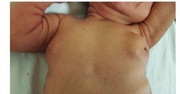
🔍 Figure: Bilateral, symmetric subareolar breast enlargement in a newborn. The breasts are firm, mobile, non-tender, and there is no overlying erythema. This is classic physiologic neonatal gynecomastia (also called "witch's milk").
💡 Examiner instruction (interactive): The candidate will be asked to identify physiologic neonatal breast enlargement, explain the hormonal etiology (maternal estrogen and prolactin crossing placenta), differentiate from mastitis and breast abscess, discuss the benign self-limiting course, and counsel parents against breast massage or "expression" of milk (which can introduce infection).
🔍 Examiner Questions (interactive) – Click to reveal model answers
❓ Q1 (Examiner): “Describe the findings in the image. What is the most likely diagnosis?”
✅ Candidate's structured answer:
• Findings: Bilateral, symmetric, subareolar, firm, mobile, non-tender breast buds. No erythema, warmth, discharge, or lymphadenopathy.
• Diagnosis: Physiologic neonatal gynecomastia (neonatal breast hypertrophy) – also known as "witch's milk."
• Findings: Bilateral, symmetric, subareolar, firm, mobile, non-tender breast buds. No erythema, warmth, discharge, or lymphadenopathy.
• Diagnosis: Physiologic neonatal gynecomastia (neonatal breast hypertrophy) – also known as "witch's milk."
❓ Q2 (Examiner): “What is the pathophysiology of physiologic neonatal breast enlargement?”
✅ Candidate's answer:
• Placental transfer of maternal hormones: Estrogen and progesterone from the mother cross the placenta during pregnancy, stimulating fetal breast tissue.
• After birth, the sudden withdrawal of these maternal hormones causes a drop in estrogen levels, leading to a surge of neonatal prolactin secretion.
• Prolactin and residual estrogen cause transient proliferation of breast ductal and glandular tissue.
• Additionally, some infants produce "witch's milk" (a small amount of milky discharge) due to prolactin effect.
• Time course: Typically appears in first 2-3 weeks of life, peaks at 1-2 months, and gradually resolves by 3-6 months (can last up to 12 months).
• It occurs in both sexes (more common in term infants) and is bilateral in 60-80%.
• Placental transfer of maternal hormones: Estrogen and progesterone from the mother cross the placenta during pregnancy, stimulating fetal breast tissue.
• After birth, the sudden withdrawal of these maternal hormones causes a drop in estrogen levels, leading to a surge of neonatal prolactin secretion.
• Prolactin and residual estrogen cause transient proliferation of breast ductal and glandular tissue.
• Additionally, some infants produce "witch's milk" (a small amount of milky discharge) due to prolactin effect.
• Time course: Typically appears in first 2-3 weeks of life, peaks at 1-2 months, and gradually resolves by 3-6 months (can last up to 12 months).
• It occurs in both sexes (more common in term infants) and is bilateral in 60-80%.
❓ Q3 (Examiner): “What are the important differential diagnoses of neonatal breast enlargement?”
✅ Candidate's answer:
• Physiologic gynecomastia (most common) – bilateral, symmetric, non-tender, no inflammation.
• Neonatal mastitis (breast infection) – unilateral or bilateral, but presents with erythema, warmth, tenderness, swelling, purulent nipple discharge, fever, irritability. Common pathogens: S. aureus, Group B Strep.
• Breast abscess – fluctuant mass, erythema, systemic signs; complication of untreated mastitis.
• Subareolar cyst – rare.
• Fibroadenoma – extremely rare in neonates.
• Hemangioma or other soft tissue tumor – usually not symmetric, not subareolar exclusively.
• Lipoma – rare.
• Key distinguishing feature: Physiologic = non-tender, no erythema, no systemic signs, bilateral in most cases.
• Physiologic gynecomastia (most common) – bilateral, symmetric, non-tender, no inflammation.
• Neonatal mastitis (breast infection) – unilateral or bilateral, but presents with erythema, warmth, tenderness, swelling, purulent nipple discharge, fever, irritability. Common pathogens: S. aureus, Group B Strep.
• Breast abscess – fluctuant mass, erythema, systemic signs; complication of untreated mastitis.
• Subareolar cyst – rare.
• Fibroadenoma – extremely rare in neonates.
• Hemangioma or other soft tissue tumor – usually not symmetric, not subareolar exclusively.
• Lipoma – rare.
• Key distinguishing feature: Physiologic = non-tender, no erythema, no systemic signs, bilateral in most cases.
❓ Q4 (Examiner): “How would you differentiate physiologic breast enlargement from neonatal mastitis?”
✅ Candidate's answer:
• Physiologic gynecomastia: Bilateral (often), symmetric, non-tender, no erythema, no fever, no discharge (or occasional milky discharge without pus), baby well.
• Mastitis: Unilateral (usually), erythematous, warm, tender, swollen, purulent nipple discharge, fever, irritability, poor feeding.
• Implication: Mastitis requires antibiotic treatment (oral or IV depending on severity) and sometimes incision/drainage if abscess forms. Physiologic enlargement requires no treatment.
• Warning: Never express or massage physiologic breast enlargement – can introduce bacteria and convert it into mastitis/abscess.
• Physiologic gynecomastia: Bilateral (often), symmetric, non-tender, no erythema, no fever, no discharge (or occasional milky discharge without pus), baby well.
• Mastitis: Unilateral (usually), erythematous, warm, tender, swollen, purulent nipple discharge, fever, irritability, poor feeding.
• Implication: Mastitis requires antibiotic treatment (oral or IV depending on severity) and sometimes incision/drainage if abscess forms. Physiologic enlargement requires no treatment.
• Warning: Never express or massage physiologic breast enlargement – can introduce bacteria and convert it into mastitis/abscess.
❓ Q5 (Examiner): “Some mothers notice a milky discharge from the nipples. Is this normal? What is 'witch's milk'?”
✅ Candidate's answer:
• Yes, milky discharge (witch's milk) is a normal variant – occurs in about 5% of newborns (both sexes).
• Cause: Prolactin stimulation of breast tissue after estrogen withdrawal.
• Appearance: Thin, watery, white or clear discharge; may be expressed spontaneously or with pressure.
• Historical term "witch's milk": Old folklore that witches would suckle the discharge from newborns; has no medical significance.
• Management: Reassure parents, do NOT attempt to express or massage the breasts – this can cause trauma, infection, and mastitis.
• Red flag: Purulent, bloody, or foul-smelling discharge suggests infection (mastitis) and requires evaluation.
• Yes, milky discharge (witch's milk) is a normal variant – occurs in about 5% of newborns (both sexes).
• Cause: Prolactin stimulation of breast tissue after estrogen withdrawal.
• Appearance: Thin, watery, white or clear discharge; may be expressed spontaneously or with pressure.
• Historical term "witch's milk": Old folklore that witches would suckle the discharge from newborns; has no medical significance.
• Management: Reassure parents, do NOT attempt to express or massage the breasts – this can cause trauma, infection, and mastitis.
• Red flag: Purulent, bloody, or foul-smelling discharge suggests infection (mastitis) and requires evaluation.
❓ Q6 (Examiner): “How will you manage this 3-week-old infant? What will you tell the anxious mother?”
✅ Candidate's structured answer:
• Management is entirely reassurance – NO treatment needed.
• Parental counseling points:
1️⃣ “This is a completely normal and common finding in newborns (up to 70% of term infants). It happens because the baby received your hormones during pregnancy, and after birth, the hormone levels change.”
2️⃣ “It is not a sign of early puberty, a tumor, or any disease. It will go away on its own.”
3️⃣ “Do NOT squeeze, massage, or express the breasts. This does NOT help and can cause a serious infection (mastitis) that requires antibiotics and possibly drainage.”
4️⃣ “There is no need for medication, hot/cold compresses, or any other treatment.”
5️⃣ “The swelling usually resolves within 3-6 months (can take up to 12 months).”
6️⃣ “If you see redness, warmth, tenderness, fever, or pus, come back immediately – that would be a sign of infection.”
7️⃣ “Continue breastfeeding normally – the breast enlargement does not interfere with feeding.”
• Management is entirely reassurance – NO treatment needed.
• Parental counseling points:
1️⃣ “This is a completely normal and common finding in newborns (up to 70% of term infants). It happens because the baby received your hormones during pregnancy, and after birth, the hormone levels change.”
2️⃣ “It is not a sign of early puberty, a tumor, or any disease. It will go away on its own.”
3️⃣ “Do NOT squeeze, massage, or express the breasts. This does NOT help and can cause a serious infection (mastitis) that requires antibiotics and possibly drainage.”
4️⃣ “There is no need for medication, hot/cold compresses, or any other treatment.”
5️⃣ “The swelling usually resolves within 3-6 months (can take up to 12 months).”
6️⃣ “If you see redness, warmth, tenderness, fever, or pus, come back immediately – that would be a sign of infection.”
7️⃣ “Continue breastfeeding normally – the breast enlargement does not interfere with feeding.”
❓ Q7 (Examiner): “What is the natural history of physiologic neonatal breast enlargement? When does it resolve?”
✅ Candidate's answer:
• Onset: Usually appears in the first 2-3 weeks of life.
• Peak: Typically peaks around 1-2 months of age.
• Resolution: Gradually regresses over 3-6 months as maternal hormones are metabolized and the infant's own hormonal axis stabilizes.
• Can last up to 12 months in some infants; persistent beyond 12 months warrants evaluation (pathologic gynecomastia).
• No adverse sequelae: The breast tissue returns to normal; no long-term effects on breast development or future health.
• No increased risk of later gynecomastia or breast pathology.
• Onset: Usually appears in the first 2-3 weeks of life.
• Peak: Typically peaks around 1-2 months of age.
• Resolution: Gradually regresses over 3-6 months as maternal hormones are metabolized and the infant's own hormonal axis stabilizes.
• Can last up to 12 months in some infants; persistent beyond 12 months warrants evaluation (pathologic gynecomastia).
• No adverse sequelae: The breast tissue returns to normal; no long-term effects on breast development or future health.
• No increased risk of later gynecomastia or breast pathology.
❓ Q8 (Examiner): “What complication can arise if parents squeeze or massage the breast enlargement? How would you recognize it?”
✅ Candidate's answer:
• Neonatal mastitis (breast infection) and breast abscess – most common iatrogenic complication.
• Pathogenesis: Manipulation (squeezing/massage) causes microtrauma to the breast tissue and introduces skin flora (especially Staphylococcus aureus) into the breast parenchyma.
• Clinical features of mastitis:
- Unilateral erythema, warmth, swelling, tenderness.
- Purulent nipple discharge.
- Fever, irritability, poor feeding.
- May progress to fluctuant abscess.
• Management:
- Oral or IV antibiotics (cover S. aureus: cloxacillin, cephalexin; MRSA coverage if risk factors).
- If abscess: incision and drainage or needle aspiration.
- Severe cases may require hospitalization and IV antibiotics.
• Prevention: Advise parents emphatically NOT to manipulate the breasts.
• Neonatal mastitis (breast infection) and breast abscess – most common iatrogenic complication.
• Pathogenesis: Manipulation (squeezing/massage) causes microtrauma to the breast tissue and introduces skin flora (especially Staphylococcus aureus) into the breast parenchyma.
• Clinical features of mastitis:
- Unilateral erythema, warmth, swelling, tenderness.
- Purulent nipple discharge.
- Fever, irritability, poor feeding.
- May progress to fluctuant abscess.
• Management:
- Oral or IV antibiotics (cover S. aureus: cloxacillin, cephalexin; MRSA coverage if risk factors).
- If abscess: incision and drainage or needle aspiration.
- Severe cases may require hospitalization and IV antibiotics.
• Prevention: Advise parents emphatically NOT to manipulate the breasts.
❓ Q9 (Examiner): “What are the red flags that would require further evaluation or referral?”
✅ Candidate's answer:
• Red flags for infection (mastitis/abscess):
- Unilateral erythema, warmth, tenderness.
- Purulent discharge.
- Fever, systemic symptoms.
- Fluctuance (abscess).
• Red flags for pathology (non-physiologic):
- Asymmetric, unilateral enlargement without signs of infection (possible tumor or cyst).
- Persistent enlargement beyond 12 months of age.
- Rapidly progressive growth.
- Associated with other signs of precocious puberty (pubic hair, clitoromegaly, growth acceleration, acne).
- Nipple discharge that is bloody, purulent, or spontaneous (non-milky).
- Axillary lymphadenopathy.
• Referral: To pediatric endocrinology if persistent >12 months or signs of precocious puberty; to pediatric surgery if mass/tumor suspected.
• Red flags for infection (mastitis/abscess):
- Unilateral erythema, warmth, tenderness.
- Purulent discharge.
- Fever, systemic symptoms.
- Fluctuance (abscess).
• Red flags for pathology (non-physiologic):
- Asymmetric, unilateral enlargement without signs of infection (possible tumor or cyst).
- Persistent enlargement beyond 12 months of age.
- Rapidly progressive growth.
- Associated with other signs of precocious puberty (pubic hair, clitoromegaly, growth acceleration, acne).
- Nipple discharge that is bloody, purulent, or spontaneous (non-milky).
- Axillary lymphadenopathy.
• Referral: To pediatric endocrinology if persistent >12 months or signs of precocious puberty; to pediatric surgery if mass/tumor suspected.
❓ Q10 (Examiner): “Does neonatal breast enlargement predispose to early puberty or later breast pathology?”
✅ Candidate's answer:
• No association. Physiologic neonatal gynecomastia is a benign, self-limited condition caused by transplacental maternal hormones.
• It does not indicate or predispose to:
- Precocious (early) puberty.
- True gynecomastia in adolescence.
- Breast cancer or other breast pathology in later life.
- Endocrine disorders.
• Clinical evidence: Studies show no increased risk of any endocrine or breast disease later in childhood or adulthood.
• Reassurance: Parents should be clearly told that this is a normal part of newborn adaptation and will not affect their child's future development.
• No association. Physiologic neonatal gynecomastia is a benign, self-limited condition caused by transplacental maternal hormones.
• It does not indicate or predispose to:
- Precocious (early) puberty.
- True gynecomastia in adolescence.
- Breast cancer or other breast pathology in later life.
- Endocrine disorders.
• Clinical evidence: Studies show no increased risk of any endocrine or breast disease later in childhood or adulthood.
• Reassurance: Parents should be clearly told that this is a normal part of newborn adaptation and will not affect their child's future development.
❓ Q11 (Examiner): “Do you need to order any investigations (ultrasound, hormone levels) for this infant?”
✅ Candidate's answer:
• No investigations are indicated for classic physiologic neonatal breast enlargement.
• The diagnosis is clinical based on history and examination (bilateral, symmetric, non-tender, no signs of infection, well infant).
• Indications for investigation (ultrasound, hormone levels):
1️⃣ Unilateral or asymmetric enlargement without infectious signs – ultrasound to rule out cyst, tumor.
2️⃣ Persistent enlargement beyond 12 months – check LH, FSH, estradiol/testosterone, bone age.
3️⃣ Signs of precocious puberty (breast Tanner stage >2 before age 8 in girls, 9 in boys).
4️⃣ Suspicious mass (firm, fixed, irregular).
• Ultrasound findings in physiologic gynecomastia: Symmetric subareolar hypoechoic breast tissue, no mass, no cyst.
• Hormone levels: In physiologic gynecomastia, estradiol, prolactin, LH, FSH are normal for age.
• No investigations are indicated for classic physiologic neonatal breast enlargement.
• The diagnosis is clinical based on history and examination (bilateral, symmetric, non-tender, no signs of infection, well infant).
• Indications for investigation (ultrasound, hormone levels):
1️⃣ Unilateral or asymmetric enlargement without infectious signs – ultrasound to rule out cyst, tumor.
2️⃣ Persistent enlargement beyond 12 months – check LH, FSH, estradiol/testosterone, bone age.
3️⃣ Signs of precocious puberty (breast Tanner stage >2 before age 8 in girls, 9 in boys).
4️⃣ Suspicious mass (firm, fixed, irregular).
• Ultrasound findings in physiologic gynecomastia: Symmetric subareolar hypoechoic breast tissue, no mass, no cyst.
• Hormone levels: In physiologic gynecomastia, estradiol, prolactin, LH, FSH are normal for age.
❓ Q12 (Examiner): “What is the long-term prognosis for this infant? When would you see her again?”
✅ Candidate's answer:
• Excellent prognosis. Complete resolution expected by 3-6 months (up to 12 months).
• Follow-up: Routine well-child visits. No special follow-up needed for the breast enlargement.
• Return precautions taught to parents:
- If redness, warmth, swelling, pain, or fever develops → possible mastitis, seek care.
- If breast enlargement persists beyond 12 months of age → then evaluation by pediatric endocrinology.
- If breast mass becomes hard, fixed, or grows rapidly → evaluate for rare tumor.
• No long-term restrictions – normal activities, no dietary modifications, no medications.
• Final note to parents: “This will completely disappear and will not affect your baby’s health or development.”
• Excellent prognosis. Complete resolution expected by 3-6 months (up to 12 months).
• Follow-up: Routine well-child visits. No special follow-up needed for the breast enlargement.
• Return precautions taught to parents:
- If redness, warmth, swelling, pain, or fever develops → possible mastitis, seek care.
- If breast enlargement persists beyond 12 months of age → then evaluation by pediatric endocrinology.
- If breast mass becomes hard, fixed, or grows rapidly → evaluate for rare tumor.
• No long-term restrictions – normal activities, no dietary modifications, no medications.
• Final note to parents: “This will completely disappear and will not affect your baby’s health or development.”
🗣️ Examiner's probing / high-yield points:
• "What is the pathophysiology?" → Maternal estrogen and prolactin cross placenta → after delivery, estrogen withdrawal causes prolactin surge → breast tissue proliferation.
• "What is the most important advice for parents?" → Do NOT squeeze or massage the breasts – may cause mastitis/abscess.
• "How long does it last?" → Resolves by 3-6 months (can be up to 12 months).
• "How to differentiate from mastitis?" → Mastitis: unilateral, erythematous, tender, fever, purulent discharge.
• "Does it predispose to early puberty?" → Absolutely not.
• "What is witch's milk?" → Milky discharge from nipples – normal variant.
• "What is the pathophysiology?" → Maternal estrogen and prolactin cross placenta → after delivery, estrogen withdrawal causes prolactin surge → breast tissue proliferation.
• "What is the most important advice for parents?" → Do NOT squeeze or massage the breasts – may cause mastitis/abscess.
• "How long does it last?" → Resolves by 3-6 months (can be up to 12 months).
• "How to differentiate from mastitis?" → Mastitis: unilateral, erythematous, tender, fever, purulent discharge.
• "Does it predispose to early puberty?" → Absolutely not.
• "What is witch's milk?" → Milky discharge from nipples – normal variant.
📘 Neonatal Breast Enlargement (Physiologic Gynecomastia) – Core Revision for TOACS
🔍 Definition
Transient, benign, bilateral subareolar breast enlargement in newborns due to transplacental transfer of maternal hormones (estrogen, progesterone) and postnatal prolactin surge.
Transient, benign, bilateral subareolar breast enlargement in newborns due to transplacental transfer of maternal hormones (estrogen, progesterone) and postnatal prolactin surge.
📊 Epidemiology
Occurs in 60-90% of term newborns (both sexes). Peaks at 1-2 months; resolves by 3-6 months (up to 12 months).
Occurs in 60-90% of term newborns (both sexes). Peaks at 1-2 months; resolves by 3-6 months (up to 12 months).
🩺 Clinical Features
Bilateral, symmetric, firm but mobile, non-tender, subareolar breast buds. No erythema, warmth, or systemic symptoms. May have milky discharge ("witch's milk").
Bilateral, symmetric, firm but mobile, non-tender, subareolar breast buds. No erythema, warmth, or systemic symptoms. May have milky discharge ("witch's milk").
⚕️ Management
Reassurance, observation. NO treatment, NO massage, NO expression, NO medications. Avoid manipulation to prevent infection.
Reassurance, observation. NO treatment, NO massage, NO expression, NO medications. Avoid manipulation to prevent infection.
⚠️ Differential Diagnosis
Mastitis (unilateral, erythematous, tender, fever, purulent discharge) – requires antibiotics. Breast abscess – fluctuant, drainage. Rare tumors (extremely rare).
Mastitis (unilateral, erythematous, tender, fever, purulent discharge) – requires antibiotics. Breast abscess – fluctuant, drainage. Rare tumors (extremely rare).
📈 Prognosis
Excellent. Self-limiting, no sequelae, no association with precocious puberty or future breast pathology.
Excellent. Self-limiting, no sequelae, no association with precocious puberty or future breast pathology.
⭐ High-yield pearls for TOACS (Neonatal Breast Enlargement):
• Clinical hallmark: Bilateral, symmetric, non-tender subareolar breast buds in a well infant.
• Most important parental advice: DO NOT SQUEEZE OR MASSAGE THE BREASTS – risk of mastitis/abscess.
• Mastitis red flags: Unilateral, erythema, warmth, tenderness, purulent discharge, fever.
• Natural history: Resolves spontaneously by 3-6 months.
• No investigations needed for typical presentation.
• Witch's milk = milky discharge – normal variant, not infected unless purulent.
• Clinical hallmark: Bilateral, symmetric, non-tender subareolar breast buds in a well infant.
• Most important parental advice: DO NOT SQUEEZE OR MASSAGE THE BREASTS – risk of mastitis/abscess.
• Mastitis red flags: Unilateral, erythema, warmth, tenderness, purulent discharge, fever.
• Natural history: Resolves spontaneously by 3-6 months.
• No investigations needed for typical presentation.
• Witch's milk = milky discharge – normal variant, not infected unless purulent.
🗣️ Candidate's role-play & examiner feedback
💬 To the candidate (role‑play): You will be asked the 12 questions from the Examiner Q&A tab (including pathophysiology, differential diagnosis from mastitis, management, parental counseling, and red flags). Provide concise, evidence‑based answers. Examiner may ask for the most important advice to parents and how to distinguish mastitis from physiologic enlargement. Use structured points and demonstrate reassurance.
📝 Examiner Marking Grid (Neonatal Breast Enlargement – TOACS station):
- ✅ Correctly identifies physiologic neonatal gynecomastia
- ✅ Explains pathophysiology (transplacental maternal hormones, prolactin surge)
- ✅ Differentiates from mastitis (unilateral, erythema, tenderness, fever, purulent discharge)
- ✅ States that no treatment, massage, or expression is indicated
- ✅ Advises parents against manipulation (risk of infection)
- ✅ Describes natural history (resolves by 3-6 months, up to 12 months)
- ✅ Recognizes red flags for infection (mastitis/abscess)
- ✅ Knows that no investigations are needed for typical presentation
- ✅ Reassures that there is no link to precocious puberty or future breast disease
- ✅ Provides appropriate follow-up and return precautions
📚 Key references: Nelson Textbook of Pediatrics 22e, American Academy of Pediatrics Newborn Care Guidelines, CPSP guidelines on common neonatal findings.