🧠 TOACS FCPS Station · Hypotonia in the Floppy Infant
📷 Clinical Photograph – Floppy Infant
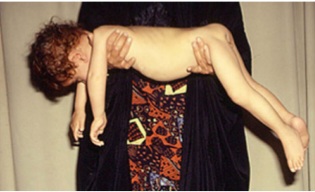
🔍 Key clinical features (floppy infant):
- ✓ Lack of antigravity movements – frog-leg posture
- ✓ Decreased muscle tone – axial and limb hypotonia
- ✓ Tongue fasciculations – characteristic of anterior horn cell disease (SMA)
- ✓ Bell-shaped chest – due to intercostal muscle weakness
- ✓ Absent deep tendon reflexes – lower motor neuron involvement
📋 Clinical scenario (examiner prompt)
A 4‑month‑old infant is brought to the pediatric neurology clinic with concerns about poor head control, weak cry, and difficulty feeding. The parents report that the infant has been "floppy" since birth and has not been able to roll over or sit with support. On examination, the infant is alert with a bright-eyed appearance, but has severe hypotonia with frog-leg posture, tongue fasciculations, a bell-shaped chest, and absent deep tendon reflexes. There is no contractures and no dysmorphic features.
🧑⚕️ Examiner tasks · TOACS
1. Identify the diagnosis from the clinical image and context.
2. Describe the clinical features (frog-leg posture, tongue fasciculations, areflexia, bell-shaped chest).
3. Explain the underlying condition (spinal muscular atrophy type 1, SMN1 deletion).
4. Discuss diagnostic approach and treatment (SMN1 testing, nusinersen, risdiplam, Zolgensma, supportive care).
🎯 Expected answers (for examiners)
- • Diagnosis: Spinal muscular atrophy type 1 (Werdnig-Hoffmann), 5q-associated SMA
- • Clinical features: Severe generalized hypotonia (frog-leg posture), tongue fasciculations, absent deep tendon reflexes, bell-shaped chest (diaphragmatic breathing), weak cry, poor feeding, areflexia, alert infant with normal cognition
- • Genetics: Homozygous deletion of SMN1 (5q13); SMN2 copy number (2 copies = severe, 3-4 = milder)
- • Diagnostic tests: SMN1 deletion analysis (blood), genetic testing for SMA; EMG (denervation), CK may be normal or mildly elevated
- • Treatment – Disease-modifying: Nusinersen (Spinraza – intrathecal ASO), risdiplam (Evrysdi – oral), Zolgensma (onasemnogene abeparvovec – IV gene therapy for children <2 years)
- • Supportive care: Noninvasive ventilation, cough assist, feeding tube (gastrostomy), physical therapy, multidisciplinary care
• Central vs peripheral: Central → axial > limbs, hyperreflexia; peripheral (SMA) → diffuse hypotonia, areflexia, tongue fasciculations
• Most common cause of floppy infant: Central (hypoxic-ischemic encephalopathy, genetic syndromes)
• Most common motor neuron cause: Spinal muscular atrophy (SMA)
• Diagnosis: SMN1 deletion → confirms SMA
• Treatment: Nusinersen, risdiplam, Zolgensma – early treatment is crucial
⚡ Quick FCPS‑style MCQ
A 4-month-old infant with severe hypotonia, frog-leg posture, tongue fasciculations, absent reflexes, and a bell-shaped chest. The most likely diagnosis and first-line diagnostic test are:
A. Congenital myotonic dystrophy – DMPK CTG repeat analysis B. Spinal muscular atrophy type 1 – SMN1 deletion analysis C. Infantile botulism – stool toxin assay D. Myasthenia gravis – AChR antibodies📌 Topic summary · Floppy Infant & SMA
Hypotonic infant with frog-leg posture
SMN1 deletion, tongue fasciculations, areflexia
SMN1 genetic testing (blood)
Nusinersen, risdiplam, Zolgensma
NIPPV, cough assist, gastrostomy
Improved with early treatment
| Feature | SMA Type 1 (Werdnig-Hoffmann) |
|---|---|
| Gene | SMN1 (5q13) – homozygous deletion |
| Onset | <6 months (often within first weeks) |
| Tone | Severe hypotonia (frog-leg posture) |
| Reflexes | Absent deep tendon reflexes (areflexia) |
| Fasciculations | Present (tongue, limbs) |
| Respiratory | Bell-shaped chest, diaphragmatic breathing, respiratory failure by age 2 |
| Cognition | Normal, bright-eyed |
| SMN2 copies | Usually 2 (severe); 3-4 milder (type 2/3) |
| Treatment | Nusinersen (IT), risdiplam (oral), Zolgensma (IV gene therapy) |
| Newborn screening | Available in many regions; early treatment improves outcomes |