🩺 TOACS FCPS Station · Hyperextensible Skin in Ehlers-Danlos Syndrome
📷 Clinical Photograph – Hyperextensible Skin
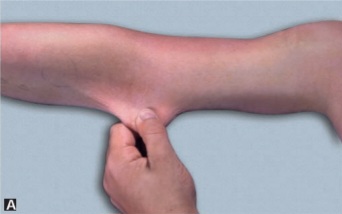
🔍 Key clinical features:
- ✓ Skin hyperextensibility – stretches >1.5 cm (wrist) or >2 cm (neck) and recoils
- ✓ Velvety, soft skin texture – characteristic of EDS
- ✓ Joint hypermobility – often coexists (Beighton score ≥6)
- ✓ Atrophic scars – widened (cigarette-paper) in classical EDS
- ✓ Easy bruising – fragile skin and vessels
📋 Clinical scenario (examiner prompt)
A 12‑year‑old girl is referred for evaluation of soft, velvety, and unusually stretchy skin. The skin on her neck and arms can be pulled far away from the body and snaps back when released. She has a history of joint dislocations (shoulder, patella) and chronic joint pain. On examination, the skin is hyperextensible (wrist >1.5 cm, neck >2 cm), and she has widened, atrophic scars on her knees and elbows. The Beighton score is 7/9. Her mother has similar features.
🧑⚕️ Examiner tasks · TOACS
1. Identify the diagnosis from the clinical image and context.
2. Describe the clinical features (skin hyperextensibility, velvety texture, joint hypermobility, atrophic scars).
3. Explain the underlying condition (Ehlers-Danlos syndrome, classical or hypermobile type).
4. Discuss management (skin protection, wound care, physical therapy, genetic testing).
🎯 Expected answers (for examiners)
- • Diagnosis: Ehlers-Danlos syndrome (classical or hypermobile type)
- • Clinical features: Skin hyperextensibility (>1.5 cm wrist, >2 cm neck), velvety soft skin, joint hypermobility (Beighton ≥6), atrophic scars (cigarette-paper in cEDS), easy bruising
- • Differential: Cutis laxa (skin hangs, does not recoil), Marfan syndrome (arachnodactyly, lens dislocation, aortic root dilation)
- • Genetics: cEDS: COL5A1/COL5A2 (autosomal dominant); hEDS: unknown gene (clinical diagnosis)
- • Management: Skin protection (sunblock, avoid trauma), wound care (deep sutures, leave skin sutures 10-14 days), physical therapy (strengthening, proprioception), pain management, avoid contact sports
- • Complications: Joint dislocations, chronic pain, wound dehiscence, aortic root dilation (rare in hEDS/cEDS but screen)
• Definition: Skin stretches >1.5 cm (wrist) or >2 cm (neck) and recoils
• Differential: EDS vs cutis laxa (hangs, does not recoil)
• Associated: Joint hypermobility, atrophic scars, easy bruising
• Genetics: COL5A1/COL5A2 (cEDS), unknown (hEDS)
• Management: Skin protection, delayed suture removal, PT
⚡ Quick FCPS‑style MCQ
A child with soft, velvety, hyperextensible skin (stretches >2 cm and recoils), joint hypermobility (Beighton 7), and widened atrophic scars. The most likely diagnosis is:
A. Cutis laxa B. Ehlers-Danlos syndrome (classical or hypermobile type) C. Marfan syndrome D. Osteogenesis imperfecta📌 Topic summary · Hyperextensible Skin in Ehlers-Danlos Syndrome
Skin stretches >1.5 cm (wrist) or >2 cm (neck) and recoils
Ehlers-Danlos syndrome (cEDS, hEDS)
Cutis laxa (hangs, no recoil)
Joint hypermobility, atrophic scars, bruising
COL5A1/COL5A2 (cEDS); unknown (hEDS)
Skin protection, delayed sutures, PT
| Feature | EDS (Hyperextensible Skin) | Cutis Laxa |
|---|---|---|
| Skin property | Stretches and recoils | Hangs in folds, does not recoil |
| Texture | Velvety, soft | Loose, wrinkled |
| Joint hypermobility | Yes (common) | Rare |
| Atrophic scars | Yes (cEDS) | No |
| Genes | COL5A1/COL5A2 (cEDS), unknown (hEDS) | FBLN5, ELN, etc. |
| Inheritance | AD (cEDS, hEDS) | AD or AR |