🦴 TOACS FCPS Station · Septic Arthritis
📷 Clinical Photograph – Septic Arthritis
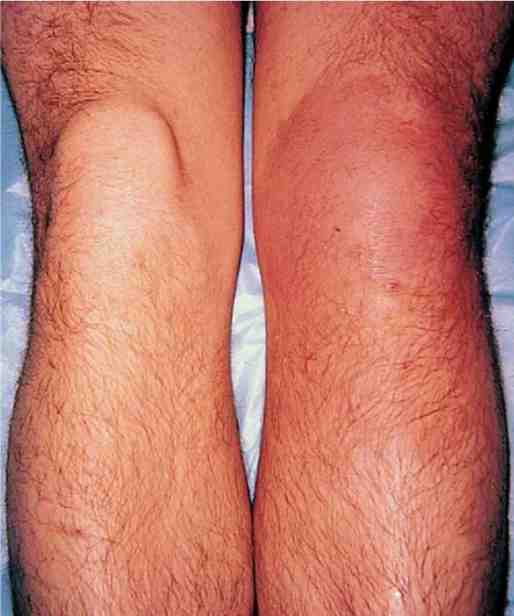
🔍 Key clinical features:
- ✓ Swollen, warm, erythematous joint – often knee or hip
- ✓ Pain with passive motion – hallmark sign
- ✓ Refusal to bear weight – child limps or refuses to stand
- ✓ Fever, malaise – systemic signs of infection
- ✓ Hip septic arthritis – held in flexion, abduction, external rotation
📋 Clinical scenario (examiner prompt)
A 4‑year‑old boy is brought to the emergency department with a fever of 39°C and refusal to bear weight on his left leg. His mother reports that he has been limping and crying with movement of the left knee. On examination, the left knee is swollen, warm, and erythematous. Passive flexion and extension cause severe pain. He appears ill and lethargic.
🧑⚕️ Examiner tasks · TOACS
1. Identify the diagnosis from the clinical image and context.
2. Describe the clinical features (fever, joint swelling, pain, refusal to bear weight).
3. Explain the Kocher criteria and its role in predicting septic arthritis.
4. Discuss diagnosis and management (joint aspiration, surgical irrigation, IV antibiotics).
🎯 Expected answers (for examiners)
- • Diagnosis: Septic arthritis (bacterial joint infection)
- • Clinical features: Fever, joint swelling/erythema/warmth, pain with passive motion, refusal to bear weight
- • Kocher criteria: Fever >38.5°C, non‑weight‑bearing, ESR >40, WBC >12,000; CRP >2 mg/dL also predictive
- • Pathogens: S. aureus (most common), Kingella kingae (6m‑4y, PCR), Group B strep/gram‑neg (neonates), gonococcus (adolescents)
- • Diagnosis: Joint aspiration → WBC >50,000 (often >100,000), Gram stain, culture, PCR for Kingella
- • Treatment: Surgical irrigation (arthrotomy/arthroscopy) + IV antibiotics (10‑14 days uncomplicated; 3‑4 weeks if osteomyelitis)
• Fever >38.5°C • Non‑weight‑bearing • ESR >40 • WBC >12,000
0 factors: 0.2% risk 4 factors: 99% risk
CRP >2 mg/dL is also highly predictive.
⚡ Quick FCPS‑style MCQ
A 4-year-old with fever 39°C, refusal to bear weight, swollen knee, ESR 50, WBC 14,000. The Kocher score is 4/4. What is the probability of septic arthritis?
A. 3% B. 40% C. 93% D. 99%📌 Topic summary · Septic Arthritis
S. aureus (MSSA/MRSA)
6m‑4y, PCR needed
4 factors → 99% risk
WBC >50,000
Surgery + IV antibiotics
AVN of femoral head
| Feature | Septic Arthritis |
|---|---|
| Definition | Bacterial infection of the joint space |
| Most common joint | Knee (35%), Hip (25%) |
| Kocher criteria | Fever >38.5°C, non‑weight‑bearing, ESR >40, WBC >12,000 |
| Synovial fluid WBC | >50,000 cells/mm³ (often >100,000) |
| Antibiotic duration | 10‑14 days (uncomplicated); 3‑4 weeks (with osteomyelitis) |
| Complication (hip) | Avascular necrosis (AVN) of femoral head |