🖐️ TOACS FCPS Station · Trident Hand in Achondroplasia
📷 Clinical Photograph – Trident Hand
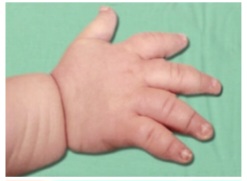
🔍 Key clinical features of Trident Hand:
- ✓ Short, broad fingers – all digits shortened
- ✓ Wide gap between 3rd and 4th digits – “trident” appearance
- ✓ Short, stubby thumbs – often held in a “trident” posture
- ✓ Soft tissue redundancy – fingers appear “fleshy”
- ✓ Associated with rhizomelic shortening (proximal limbs)
📋 Clinical scenario (examiner prompt)
A 6‑month‑old infant is brought with disproportionately short stature (height < 3rd percentile, sitting height normal). The child has a large head with frontal bossing, midface hypoplasia, and a flattened nasal bridge. On examination of the hands, there is a characteristic “trident” appearance – the fingers are short and broad with a prominent gap between the 3rd and 4th digits. The child also has rhizomelic shortening of the arms and legs.
🧑⚕️ Examiner tasks · TOACS
1. Identify the diagnosis from the clinical image and context.
2. Describe the clinical features (trident hand, rhizomelic shortening, frontal bossing, midface hypoplasia).
3. Explain the underlying genetic abnormality (FGFR3 mutation – achondroplasia).
4. Discuss prognosis and management (multidisciplinary: growth monitoring, respiratory, neurologic, orthopedic).
🎯 Expected answers (for examiners)
- • Diagnosis: Achondroplasia (FGFR3 mutation)
- • Clinical features: Trident hand, rhizomelic shortening, frontal bossing, midface hypoplasia, macrocephaly, short stature
- • Genetics: Autosomal dominant (80% de novo) – gain-of-function mutation in FGFR3
- • Prognosis: Near-normal lifespan with proactive management; monitor for foramen magnum stenosis, obstructive sleep apnea, restrictive lung disease, hydrocephalus.
⚡ Quick FCPS‑style MCQ
A 4-year-old with disproportionate short stature, frontal bossing, and a trident hand most likely has:
A. Hypochondroplasia B. Achondroplasia C. Thanatophoric dysplasia D. Osteogenesis imperfecta📌 Topic summary · Achondroplasia
FGFR3 (gain-of-function)
Autosomal dominant (80% de novo)
Short, broad fingers; gap between 3rd & 4th digits
Proximal limb shortening
OSA, restrictive lung disease, central hypoventilation
Multidisciplinary; monitor for foramen magnum stenosis
| Feature | Achondroplasia |
|---|---|
| Incidence | 1 in 15,000–40,000 live births |
| Craniofacial | Frontal bossing, midface hypoplasia, flattened nasal bridge |
| Hands | Trident hand (short, broad fingers, wide gap between 3rd & 4th) |
| Limbs | Rhizomelic shortening (proximal) |
| Neurologic | Foramen magnum stenosis, hydrocephalus |
| Prognosis | Near-normal with proactive management |