🧴 TOACS FCPS Station · Hard Scaly Scalp in Netherton Syndrome
📷 Clinical Photograph – Netherton Syndrome (Scalp)
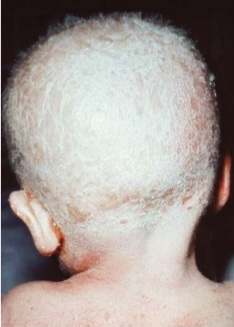
🔍 Key clinical features:
- ✓ Severe scalp scaling and erythema – often congenital
- ✓ Sparse, brittle hair – trichorrhexis invaginata (bamboo hair)
- ✓ Ichthyosis linearis circumflexa – migratory serpiginous plaques
- ✓ Atopic diathesis – eczema, elevated IgE
- ✓ Failure to thrive – due to skin barrier dysfunction
📋 Clinical scenario (examiner prompt)
A 3‑year‑old child is brought to the dermatology clinic with severe scaling of the scalp and sparse, brittle hair. The mother reports that the child has had scaly skin since birth, with migratory, ring‑shaped lesions on the trunk. The child has severe eczema and frequent infections. On examination, the scalp has thick, adherent scales with erythema and alopecia. The hair is short, broken, and lusterless. The child is failing to thrive and has elevated IgE.
🧑⚕️ Examiner tasks · TOACS
1. Identify the diagnosis from the clinical image and context.
2. Describe the clinical features (scalp scaling, bamboo hair, ichthyosis linearis circumflexa, atopy).
3. Explain the underlying condition (Netherton syndrome, SPINK5, serine protease inhibitor).
4. Discuss diagnosis and management (emollients, topical steroids, antihistamines, avoid tacrolimus).
🎯 Expected answers (for examiners)
- • Diagnosis: Netherton syndrome
- • Clinical features: Scalp: thick scaling, erythema, alopecia; hair: trichorrhexis invaginata (bamboo hair) – brittle, broken, lusterless; skin: ichthyosis linearis circumflexa (migratory serpiginous plaques with double-edged scale); severe atopic dermatitis, elevated IgE, food allergies, failure to thrive, recurrent infections
- • Genetics: SPINK5 gene (serine protease inhibitor Kazal type 5); autosomal recessive; loss of function leads to unopposed protease activity, skin barrier dysfunction
- • Diagnosis: Clinical; hair microscopy (bamboo hair); genetic testing (SPINK5); elevated IgE, eosinophilia; skin biopsy (epidermal hyperplasia, parakeratosis)
- • Management: Emollients; topical steroids (potent but cautiously due to systemic absorption); antihistamines for pruritus; treat infections; avoid tacrolimus/pimecrolimus (systemic absorption risk); nutritional support; treat secondary infections; multidisciplinary approach
• Gene: SPINK5 (serine protease inhibitor)
• Triad: Ichthyosis linearis circumflexa + bamboo hair + atopy
• Scalp: Severe scaling, alopecia, brittle hair
• Management: Emollients, topical steroids, antihistamines
• Avoid: Topical calcineurin inhibitors (tacrolimus/pimecrolimus)
• Prognosis: Variable; may improve with age
⚡ Quick FCPS‑style MCQ
A child with severe scalp scaling, sparse brittle hair (bamboo hair), migratory ring-shaped lesions, and elevated IgE. The most likely diagnosis is:
A. Seborrheic dermatitis B. Netherton syndrome C. Atopic dermatitis D. Tinea capitis📌 Topic summary · Netherton Syndrome (Scalp Involvement)
AR ichthyosis – SPINK5
Ichthyosis linearis circumflexa + bamboo hair + atopy
Severe scaling, alopecia
Trichorrhexis invaginata
Emollients, topical steroids, antihistamines
Tacrolimus/pimecrolimus
| Feature | Netherton Syndrome |
|---|---|
| Gene | SPINK5 (serine protease inhibitor Kazal type 5) |
| Inheritance | Autosomal recessive |
| Clinical triad | Ichthyosis linearis circumflexa (migratory serpiginous plaques with double-edged scale), trichorrhexis invaginata (bamboo hair), atopic diathesis (severe eczema, elevated IgE, food allergies) |
| Scalp findings | Thick adherent scales, erythema, alopecia, brittle hair |
| Hair microscopy | Trichorrhexis invaginata – "ball and socket" (bamboo hair) |
| Other features | Failure to thrive, recurrent infections, dehydration, hypernatremia, hypoalbuminemia |
| Treatment – Skin | Emollients; topical steroids (potent but cautiously); avoid topical calcineurin inhibitors (tacrolimus/pimecrolimus) – systemic absorption |
| Treatment – Pruritus | Antihistamines (cetirizine, hydroxyzine) |
| Treatment – Infections | Prompt treatment of secondary bacterial/fungal infections; antibiotics/antifungals as needed |
| Prognosis | Variable; may improve with age; early mortality in severe cases due to infections, hypernatremia, failure to thrive |