🧴 TOACS FCPS Station · Hard Skin in Harlequin Baby
📷 Clinical Photograph – Harlequin Ichthyosis
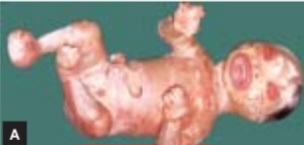
🔍 Key clinical features:
- ✓ Thick, rigid, plate-like scales – covering the entire body
- ✓ Deep, red fissures – between the scales
- ✓ Ectropion – severe eversion of eyelids
- ✓ Eclabion – severe eversion of lips
- ✓ Flexion contractures – of fingers and toes
📋 Clinical scenario (examiner prompt)
A 1‑day‑old neonate is born with a strikingly abnormal skin appearance. The entire body is covered with thick, hard, plate-like scales separated by deep, red fissures. The eyelids are severely everted (ectropion) and the lips are pulled outward (eclabion). The infant has flexion contractures of the digits. The baby is febrile and has poor feeding. The mother has no family history of skin disease.
🧑⚕️ Examiner tasks · TOACS
1. Identify the diagnosis from the clinical image and context.
2. Describe the clinical features (thick plate-like scales, fissures, ectropion, eclabion, contractures).
3. Explain the underlying condition (harlequin ichthyosis, ABCA12, autosomal recessive).
4. Discuss management (NICU, humidification, emollients, oral retinoids, ABCA12 testing).
🎯 Expected answers (for examiners)
- • Diagnosis: Harlequin ichthyosis (severe autosomal recessive congenital ichthyosis)
- • Clinical features: Thick, rigid, plate-like (armor-like) scales covering entire body; deep, red fissures between plates; severe ectropion (eversion of eyelids); eclabion (eversion of lips); flexion contractures of digits; ears may be small or absent; nasal flattening; respiratory distress; feeding difficulties
- • Genetics: ABCA12 gene mutation (chromosome 2q34); autosomal recessive; encodes ATP-binding cassette transporter (lipid transporter) essential for epidermal lipid transport and barrier function
- • Management – Immediate: NICU admission; humidified incubator; non-adherent dressings; avoid dehydration (increased insensible water loss); monitor for infection, hypernatremia, respiratory distress
- • Management – Long-term: Oral retinoids (acitretin 0.5-1 mg/kg/day) to reduce scale; emollients; ophthalmology (ectropion), nutrition support; physical therapy for contractures
- • Prognosis: Previously uniformly fatal; now with intensive care and retinoids, ~80% survive infancy
• Gene: ABCA12 (lipid transporter)
• Inheritance: Autosomal recessive
• Onset: At birth – thick, plate-like scales
• Key signs: Ectropion, eclabion, contractures
• Management: NICU, retinoids, emollients
• Prognosis: ~80% survival with modern care
⚡ Quick FCPS‑style MCQ
A neonate with thick, rigid, plate-like scales, deep fissures, ectropion, and eclabion. The most likely diagnosis and underlying gene are:
A. Collodion baby – TGM1 B. Harlequin ichthyosis – ABCA12 C. Epidermolytic ichthyosis – KRT1/KRT10 D. Netherton syndrome – SPINK5📌 Topic summary · Harlequin Ichthyosis
Severe AR ichthyosis – ABCA12
Thick plate-like scales, fissures
Ectropion, eclabion, contractures
NICU, retinoids, emollients
~80% survival with modern care
ABCA12 (lipid transporter)
| Feature | Harlequin Ichthyosis |
|---|---|
| Gene | ABCA12 (ATP-binding cassette transporter A12) |
| Inheritance | Autosomal recessive |
| Clinical presentation | Thick, rigid, plate-like scales covering the entire body; deep red fissures; severe ectropion and eclabion; flexion contractures; ears/nasal flattening |
| Complications | Dehydration, hypernatremia, infection, respiratory distress, feeding difficulty, temperature instability |
| Immediate management | NICU admission; humidified incubator; non-adherent dressings; monitor fluid/electrolytes; avoid infection |
| Long-term management | Oral retinoids (acitretin 0.5-1 mg/kg/day); emollients; ophthalmology; nutrition support; physical therapy |
| Prognosis | Previously fatal; now ~80% survival with intensive care and retinoids |