🦠 TOACS FCPS Station · Rash on Sole and Foot in Scabies
📷 Clinical Photograph – Scabies Rash on Sole and Foot
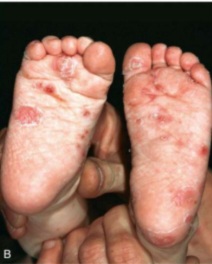
🔍 Key clinical features (infantile scabies):
- ✓ Papules, vesicles, pustules – on palms, soles, and scalp
- ✓ Burrows may be absent – in infants and young children
- ✓ Intense pruritus – worse at night, may be irritability
- ✓ Secondary excoriations and crusts
- ✓ Family history – other household members may have pruritus
📋 Clinical scenario (examiner prompt)
A 9‑month‑old infant is brought in with a rash on the feet and hands that has been present for 3 weeks. The mother reports the infant is irritable and not sleeping well, with intense scratching at night. On examination, there are erythematous papules, vesicles, and pustules on the palms, soles, and some on the scalp. There are also excoriations and crusts. No burrows are visible. The mother also reports that she and her older child have had itchy rashes for the past month.
🧑⚕️ Examiner tasks · TOACS
1. Identify the diagnosis from the clinical image and context.
2. Describe the clinical features (infantile scabies – papules/vesicles/pustules on palms, soles, scalp; nocturnal pruritus; lack of burrows).
3. Explain the etiology and transmission (Sarcoptes scabiei, mite burrow, close contact, family spread).
4. Discuss diagnosis and management (permethrin 5% cream, treat all contacts, bedding, ivermectin for resistant/crusted).
🎯 Expected answers (for examiners)
- • Diagnosis: Scabies (infantile scabies) – Sarcoptes scabiei infestation
- • Clinical features: Papules, vesicles, pustules on palms, soles, and scalp; intense nocturnal pruritus; excoriations; lack of classic burrows in infants; family members often affected
- • Transmission: Direct skin-to-skin contact; mites can survive 48-72 hours off the host
- • Diagnosis: Clinical; mineral oil scraping of papule or burrow (if present) → mites, ova, scybala; dermoscopy may show 'delta wing' sign
- • Treatment – First-line: Permethrin 5% cream (Elimite) – apply to entire body from neck down (infants: include scalp, face, avoid eyes), wash off after 8-14 hours; repeat in 7 days
- • Treat all household and close contacts simultaneously, even if asymptomatic
- • Wash clothing/bedding in hot water (54°C) or store in plastic bag for 72 hours
- • Resistant/crusted scabies: Oral ivermectin (200 μg/kg) + permethrin
• Classic burrows are often absent – look for papules/vesicles on palms, soles, scalp
• Nocturnal pruritus – intense itching, worse at night
• Family history – almost all household members have pruritus
• Treatment: Permethrin 5% cream (include scalp and face, avoid eyes)
• Treat all contacts – simultaneous treatment prevents reinfestation
• Pruritus may persist for 2-4 weeks after successful treatment (hypersensitivity)
⚡ Quick FCPS‑style MCQ
An infant presents with papules, vesicles, and pustules on the palms, soles, and scalp with intense nocturnal pruritus. The mother and sibling also have itchy rashes. The most likely diagnosis and first-line treatment are:
A. Atopic dermatitis – topical steroids B. Scabies – permethrin 5% cream (include scalp and face) C. Tinea corporis – topical antifungals D. Contact dermatitis – avoid irritants📌 Topic summary · Scabies in Infants (Rash on Sole/Foot)
Sarcoptes scabiei (mite)
Burrows, nocturnal pruritus
Papules/vesicles on palms, soles, scalp
Skin-to-skin contact
Permethrin 5% cream (body + scalp in infants)
All household members treat simultaneously
| Feature | Scabies (Infantile) |
|---|---|
| Age | Infants and young children (often <2 years) |
| Typical skin findings | Papules, vesicles, pustules on palms, soles, scalp; excoriations; burrows may be absent |
| Pruritus | Intense, worse at night; can cause irritability, poor sleep |
| Family history | Almost always – household members have pruritus |
| Diagnosis | Clinical; mineral oil scraping (mites, ova, scybala); dermoscopy |
| Treatment – First-line | Permethrin 5% cream – apply to entire body (including scalp, face, avoid eyes) for 8-14 hours, repeat in 7 days |
| Contacts | All household and close contacts must be treated simultaneously |
| Crusted scabies | Permethrin + oral ivermectin (200 μg/kg), repeated in 7-14 days |
| Post-treatment itch | May persist 2-4 weeks (hypersensitivity reaction); topical steroids if needed |