🩻 TOACS FCPS Station · Invertogram for Anorectal Malformations
📷 Invertogram (Prone Cross‑Table Lateral X‑ray)
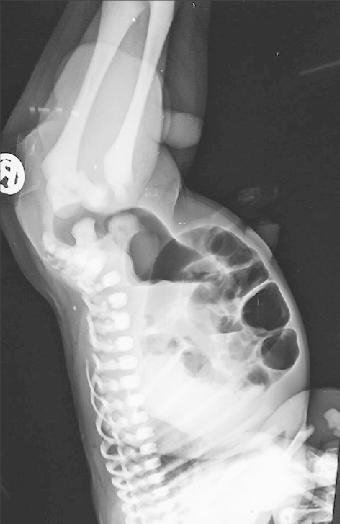
🔍 Key radiographic features:
- ✓ Prone position with pelvis elevated (invertogram view)
- ✓ Air-filled distal rectum visible as a gas shadow
- ✓ Distance from rectal gas to perineal skin – measured on the x-ray
- ✓ Rectal gas level ≥1 cm above perineum → high lesion (needs colostomy)
- ✓ Rectal gas <1 cm from perineum → low lesion (primary anoplasty)
📋 Clinical scenario (examiner prompt)
A newborn male is noted to have no anal opening on the first day of life. The abdomen is distended and he has passed no meconium. The perineum appears flat with no visible fistula. A prone cross‑table lateral x‑ray (invertogram) is performed at 24 hours of age to assess the level of the anorectal malformation. The image shows the distal rectal gas shadow ≥1 cm above the perineal skin.
🧑⚕️ Examiner tasks · TOACS
1. Interpret the invertogram – classify the lesion as low or high.
2. Describe the technique – prone position, 24‑hour timing, measurement.
3. Identify the most likely diagnosis (high ARM with rectourethral fistula).
4. Discuss surgical management (colostomy → PSARP).
🎯 Expected answers (for examiners)
- • Interpretation: High anorectal malformation (rectal gas ≥1 cm from perineum)
- • Technique: Prone position, pelvis elevated, 24-hour film (allows gas to reach distal rectum)
- • Diagnosis: High ARM – likely rectourethral fistula (most common in males)
- • Management: Protective colostomy (neonatal), then PSARP at 3-6 months
⚡ Quick FCPS‑style MCQ
On an invertogram for anorectal malformation, a rectal gas shadow ≥1 cm from the perineal skin indicates:
A. High lesion – needs colostomy B. Low lesion – primary anoplasty C. Normal finding D. Currarino triad📌 Topic summary ·
Prone cross‑table lateral x‑ray at 24 hours
Gas ≥1 cm from perineum → colostomy
Gas <1 cm from perineum → primary anoplasty
Rectourethral fistula
Rectovestibular fistula
PSARP (Pena procedure) at 3‑6 months
| Feature | Low Lesion | High Lesion |
|---|---|---|
| Perineum | Meconium visible/fistula | Flat, no fistula |
| Invertogram | Gas <1 cm from perineum | Gas ≥1 cm from perineum |
| Initial surgery | Primary anoplasty | Protective colostomy |
| Definitive repair | None needed | PSARP at 3‑6 months |
| Continence prognosis | Excellent (90%) | Variable (40‑60%) |